
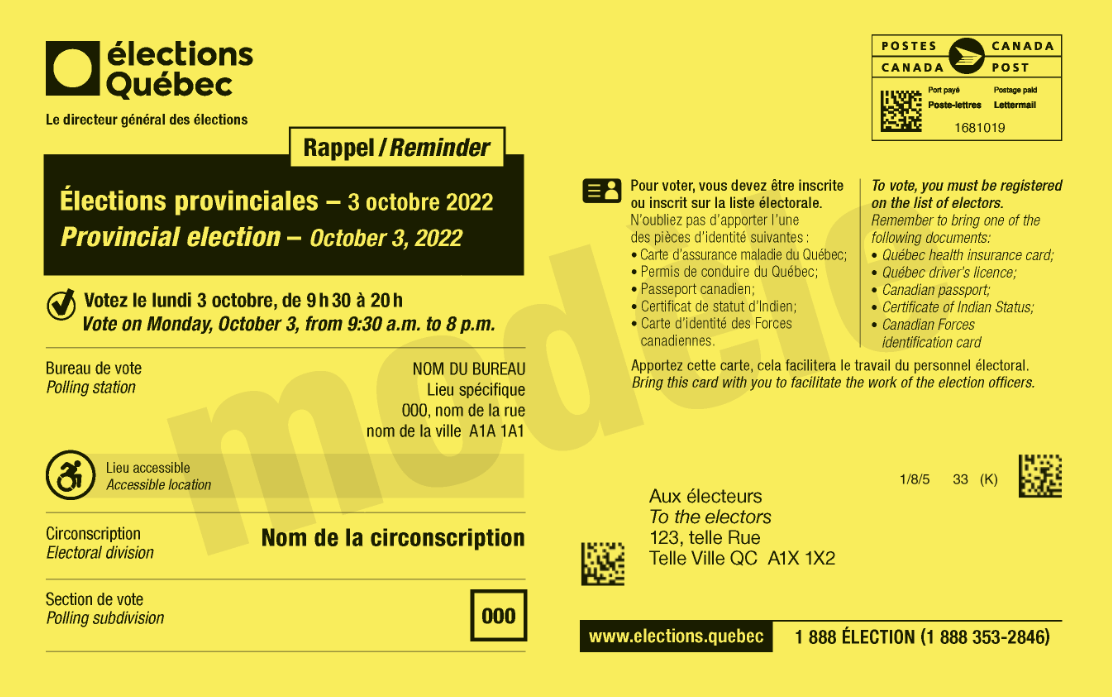
Élections Québec must prepare bilingual reminder cards to mail to voters ahead of the provincial election, but it won’t have to send out English versions of the registration notice and voter’s guide, a Quebec Superior Court judge ruled on Wednesday.
The decision came after a hearing for a lawsuit against the Quebec government and Élections Québec took place last week over French-only mailouts. Judge Sylvain Lussier ruled on part of the legal challenge, partially granting the demand for a provisional interlocutory injunction.
“The evidence indicates a serious risk that a large number of anglophone seniors will be unable to exercise their right to vote due to a lack of understandable information,” Lussier wrote.
The 10-day injunction means the provincial election authority must prepare the reminder cards, but Lussier says the statutory date for mailing “falls outside” the duration of his ruling.
“If necessary, the parties may appear before the court to seek a renewal of the order, at which time the court could order the mailing,” Lussier wrote.
He noted the court, however, “will not order the mailing of an English version of the registration notices and the voter’s guide. The evidence on record convinces the court that this would be an unrealistic and extremely costly undertaking.” Last week, a lawyer for Élections Québec told the court it was too late to send bilingual versions of those two documents.
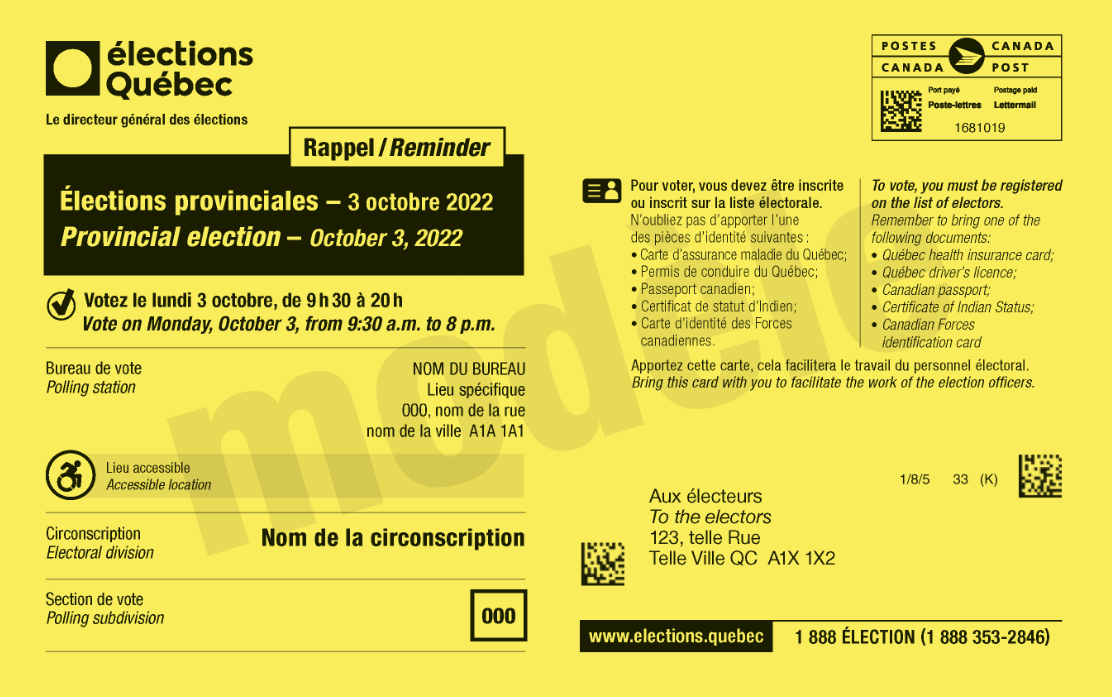 French-only election mailers will include a QR code and contact information to access the documents in English.
Élections Québec announced on Sept. 1 it wouldn’t mail out English-language versions of the provincial election guide, the notice of voter registration and the reminder card. The French-only mailers will include a QR code and contact information to access English versions.
Pointing to possible hurdles English-speaking seniors could face in accessing voting information, Lussier said the court is “not convinced that the existence of a telephone line with services in both languages enables all members of the community to obtain complete information.” The Election Act, he added, “mandates the mailing of three documents for this purpose.”
The unilingual mailouts were a result of language reforms by the Coalition Avenir Québec government. Élections Québec said it voiced concerns about the measure, but its requests for an exemption were denied.
The ruling issued Wednesday temporarily suspends part of the language law. A spokesperson for Quebec’s Justice Ministry told The Gazette that “out of respect for the judicial process, we will not comment” on the ruling.
Quebec’s French Language Ministry also did not comment, referring questions to the Justice Ministry.
Doug Mitchell, the lawyer representing plaintiff Geoffrey Chambers, said in an interview he is pleased with the decision.
“The judge did a very thorough review of the law and, in my view, clearly arrived at the right result,” he said.
Mitchell added that it’s “unfortunate that we were in a position that we came before him” when it was already too late to send out bilingual versions of all three documents, but he thinks “it’s a very solid judgment.”
The lawsuit’s goal was to reinstate the English versions of the documents ahead of the Oct. 5 vote with a provisional interlocutory injunction. A permanent injunction is also being sought.
“While it is at a provisional stage, it really endorses the rights that we were seeking to advance,” Mitchell said of the ruling.
Élections Québec spokesperson Gabriel Sauvé-Lesiège said in an email that “we acknowledge the decision handed down this morning. We will be able to produce the reminder card in both languages.”
Chambers — a former president of the Quebec Community Groups Network, an anglophone-advocacy organization now known as TALQ — said the ruling “makes it very clear that the rights of the community have been compromised and that they will be protected to the extent the court can do so at this late date.”
“But that doesn’t mean the damage that has been done by the impossibility of getting the first communications out to everybody isn’t a serious matter,” he told The Gazette.
Given the time crunch and circumstances, Chambers said he believes “everything that could be possibly done to secure the community’s rights has been done.”
“The bad news is that the circumstances were pretty tough and the rights of the community are going to be compromised in regard to this election,” he said. “So that’s really a matter for which the government should be answerable.”
Coalition Avenir Québec leader and incumbent premier Christine Fréchette has defended the unilingual mailings despite criticism from anglophone advocacy groups, saying French is the sole official language of the province. She also told reporters the ballot question will be available in both languages, though Élections Québec noted there isn’t much to translate.
Chambers, for his part, said he would like the Quebec government to “look at the judgment and say: ‘We were wrong and we won’t do it again.’”
Failing that, he said he thinks “we’re going to have an additional, expensive, difficult, troublesome litigation to get this from an interim order to something that is more close to established law.”
Editor’s Picks
The Gazette’s On Quebec Politics newsletter by Andy Riga breaks down key election issues, from polling shifts to legislative manoeuvring to ideas circulating in francophone commentary that don’t make it into English-language coverage.
To sign up, visit this page and check the box labelled “On Quebec Politics” before providing your email address.