
Sign up for the Slatest to get the most insightful analysis, criticism, and advice out there, delivered to your inbox daily.
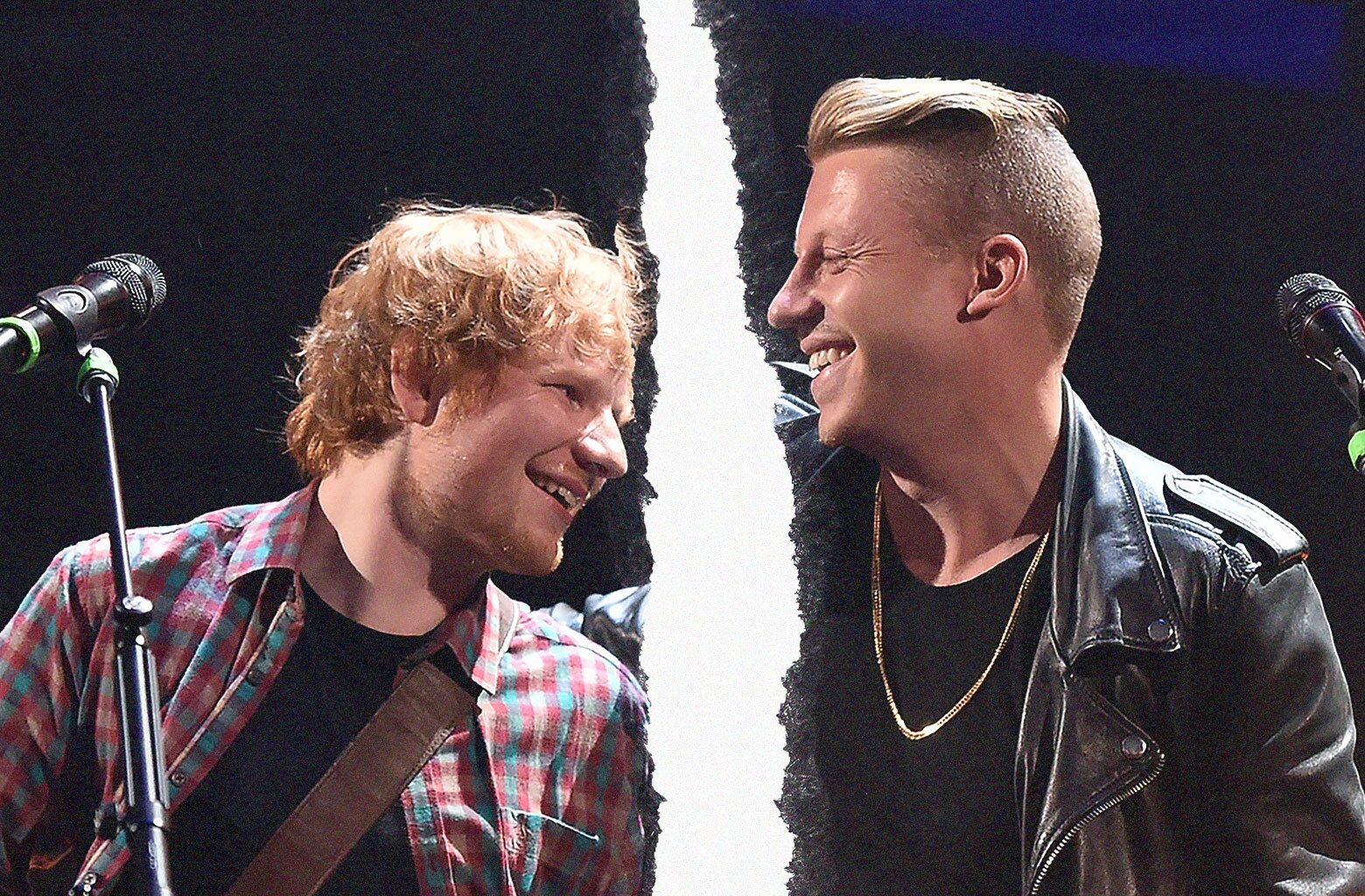
Ed Sheeran’s tour needs new opening acts. On Sept. 4, one of the pop star’s openers, Seattle-bred rapper Macklemore, gave a speech in which he called for a “free Palestine” and also said the words “genocide” and “apartheid” when talking about Israel. (He also called for several other peoples to be free, all around the world, including in Cuba and Sudan.) This all sat poorly with one of the most influential owners in the NFL, whose stadium is set to host Sheeran later this month. Soon, Sheeran agreed to drop Macklemore from his tour, and Sheeran’s other openers quit in solidarity.
Following this scuffle, the heads of some of the biggest Jewish organizations in the country want you to know how happy they are that this happened, or even that they themselves worked to make it happen. Robert Kraft, the owner of the New England Patriots and founder of the “Blue Square Alliance Against Hate,” not only didn’t deny that he had prohibited Macklemore from performing at his stadium but confirmed it with zest. Kraft said Macklemore’s appearance would “cross that line” between a welcoming environment and hate speech.
The billionaire didn’t address a claim by Macklemore that Kraft had whipped up support from other NFL owners whose stadiums host Sheeran’s tour to ice out the opening act altogether. But Jonathan Greenblatt, the head of the Anti-Defamation League, made no secret of his desire for venue operators to do just that: “We encourage stadium owners and venue management to demonstrate their values,” he wrote, a few days before Macklemore was indeed nixed. He then got what he wanted. “Glad to see Macklemore off Ed Sheeran’s tour,” Greenblatt said. “For years, Macklemore has pushed antisemitic tropes and demonized Israel and Israelis. Now he certainly has the 1A right to speak out and express his views, but demonizing Jews and Israelis shouldn’t be rewarded.” The Israeli American Council had also petitioned for Sheeran to drop Macklemore.
These organizations are playing a dangerous game. For one thing, they are smart enough to know that their approach risks becoming recruiting fodder for the worst antisemites in the world, the ones who thrive on tropes about Jews exerting influence on media and culture. But they are willing to risk it, because of the second problem: They are singularly focused on framing support for Palestine as the most pressing form of antisemitism, a choice that is not just tactically baffling at the moment but at odds with the views of many American Jews. Greenblatt leads a camp that is not trying to represent the Jewish community as it really is, so much as dictating what it stands for. I don’t know where this fracture will lead, other than that it won’t be anywhere good.
We can grant that Macklemore is not an ideal ambassador for this fight. In 2014, he wore a prosthetic nose that looked very antisemitic, before unequivocally apologizing and denying intent. Not a good start for someone trying to convince skeptical American Jews of good faith. Plus, his music sucks, and most people would find it impossible that useful public discourse would ever emerge from an Ed Sheeran concert. But nevertheless, here we are. And the speech Macklemore gave at Sheeran’s concert on Sept. 4 was well within the Overton window on this topic. He praised college students for their activism. When he accused Israel of the most serious crimes, he was crystal clear about who he wasn’t blaming: “To all of my Jewish brothers and sisters: Criticism of Israel, criticism of apartheid, being against genocide in no way is a criticism of you.”
Macklemore was not exactly on a limb here. The International Association of Genocide Scholars concurs with him. So might someone who watched the Israeli national security minister’s recent A.I. video of Palestinians being shuffled into an Israeli prison on a conveyor belt and emerging malnourished. (Benjamin Netanyahu neither publicly condemned the video nor removed the minister from his post.) I thought we could all agree that criticism of Israel in 2026 isn’t automatically antisemitic, but the blackballing of Macklemore suggests that the middle of the Venn diagram is getting bigger. Instead, many leading Jewish organizations continue to try to referee a definition of antisemitism that doesn’t just accommodate Israel’s unique “right to exist” but also says the state should be immune from even the accusation of the worst crimes.
The fight over this boundary predates Macklemore. The International Holocaust Remembrance Alliance’s 2016 working definition of antisemitism says that denying Jews self-determination or applying double standards to Israel can, depending on context, be antisemitic. It also says criticism of Israel comparable to criticism of other countries is not. Last week, the ADL, American Jewish Committee, Jewish Federations of North America, and other groups signed a declaration that pushed harder in one direction: Zionism is “part of Jewish identity,” and “demonizing or delegitimizing” Israel (rather than just “Jews,” who were already included) can be antisemitic. The declaration leaves “demonizing” undefined. But a separate letter backed by the ADL and AJC that same week supplied an example: the accusation that Israel committed genocide in Gaza, which it calls a “blood libel” against Jews that “fuels antisemitism worldwide.”
Underneath this united organizational front is a rupture. The major Jewish organizations are committed to protecting the state’s reputation at all costs, but rank-and-file American Jews are less so. A Washington Post poll last October found that 39 percent of us agreed Israel had committed genocide against Palestinians in Gaza and 61 percent thought the country had committed war crimes. Respondents blamed Netanyahu only slightly less for the conflict than Hamas. It seems impossible that anyone could claim to represent the views of Jewish Americans while also suggesting that any charges of apartheid and genocide are rank forms of antisemitism.
The big organizations, though, do not seem to feel that tension. In fact, their efforts to marginalize groups that do feel that tension began within weeks of the Oct. 7 attacks. William Daroff, CEO of the Conference of Presidents of Major American Jewish Organizations, wrote on Oct. 27, 2023, that Jewish organizations aligned with left-wing Palestine activism and suspecting Israel of genocide were “useful idiots.” He said they were fringe groups attempting to speak for American Jewry, “and one suspects their Jewishness primarily exists to be wielded against other Jews.” This was a preview of the next three years of intra-Jewish communal turf wars that never ebb and always flow.

Scaachi Koul
A Major Artist Was Just Kicked Off a Tour for His Political Beliefs. Now I Have to Do the Unthinkable.
Read More
You can see why the Israel hawks might think they have the wind at their back. That same Washington Post poll found that 76 percent of American Jews thought Israel’s existence was vital to the future of the Jewish people. Fifty-eight percent said they had something in common with Jews in Israel, and 56 percent said they were at least somewhat emotionally attached to the state. But is that the same as supporting the state or thinking it should be spared from judgment for the killing of more than 73,000 Palestinians since Oct. 7? The major organizations clearly think yes, without saying it explicitly. But an AP-NORC survey in July found that only 36 percent of American Jewish adults (and still fewer than half of self-identified “religious” Jews) thought “supporting Israel” was extremely or very important.
Trumpworld Has Found Its New Jeffrey Epstein
John Roberts’ New Role Model Demonstrates Everything Wrong With the Supreme Court
We Found the Most Galling Argument of the Upcoming Supreme Court Term
These findings might seem incompatible, like they were only arrived at because pollsters asked questions in different ways. But I don’t think they’re incongruous at all. It seems natural that scores of American Jews would feel connected to Israel, after growing up being told of its supreme importance and perhaps visiting the country or having family there. But it seems just as natural that scores of American Jews have their eyes open, are disgusted with what they’ve seen, and don’t think the country should be cloaked in a “cannot be accused of genocide” protective blanket just because they feel connected to it. This is the broken link in the chain between a critical mass of American Jews and the faith’s biggest domestic organizations.
Something, eventually, is going to have to give. The available data says the organizational response is at best a huge exaggeration of the rank and file’s view. It’s just not tenable for Jewish organizations to make a campaign out of bouncing Macklemore (who criticized Israel 12 years after apologizing for a likely antisemitic costume) from NFL stadiums while standing down when Kanye West (who released a song called “Heil Hitler” in 2025) prepares to play the Dallas Cowboys’ stadium without institutional opposition. (The ADL has condemned him before; it is not, however, running a PR effort this month to deny him a venue.) Can this really continue? It’s also worth asking one other question of someone like Greenblatt, who has made combating antisemitism his life’s work. Does he look around at the response to this story and think he’s doing a good job?