
For the second time in under a week, President Catherine Connolly on Wednesday found herself discussing the future of Northern Ireland in a meeting with a head of government.
At Áras an Uachtaráin on Saturday, US president Donald Trump voiced his support for a united Ireland during a private conversation with Connolly, before he said that unity would be a “great thing”. The comments caused a stir North and South of the Border – and disquiet among some in Westminster and Stormont.
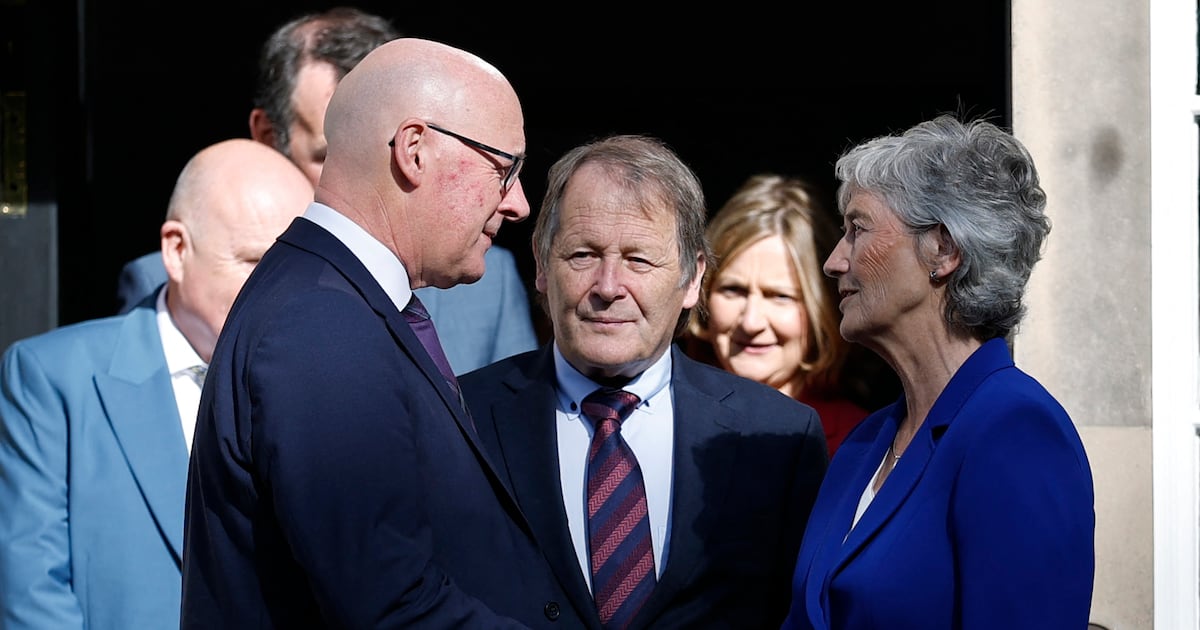
It came as no surprise, then, that Scottish first minister John Swinney was keen to talk about “self-determination and independence” when he received Connolly at Bute House in Edinburgh at the outset of the President’s four-day official visit to Scotland.
Swinney, leader of the Scottish National Party, was back at base after a productive start to his week in Manchester.
There, he, along with Sinn Féin leader Mary Lou McDonald, her deputy Michelle O’Neill, and Rhun ap Iorwerth of the nationalist Plaid Cymru, signed a memorandum calling on the British government to “prepare for, plan and facilitate” constitutional change in Northern Ireland, Scotland and Wales.
Swinney said he discussed the Manchester conference with Connolly: “Scotland, Wales and Northern Ireland are led by first ministers who all believe in the self-determination of their peoples and the right of their peoples to change their constitutional relationship with the United Kingdom.”
Some hours later, the President was at the Royal Society of Edinburgh, sitting under an imposing portrait of George III. During that monarch’s reign, questions of self-determination were to the fore, as rebellious British colonies in North America sought – and secured – independence. Britain recognised the sovereignty of the United States of America in 1783.
Following a brief ceremony, Connolly was inducted into the society as an honorary fellow – an honour previously bestowed on predecessors Mary Robinson and Mary McAleese.
“I’m honoured and privileged and I will do my best to live up to the honour you have bestowed on me. Míle buíochas daoibh go léir,” she told those assembled in the room.
Earlier, Connolly had spent time at the National Library of Scotland, where she saw several artefacts in the collection.
Among them was the final letter written by Mary, Queen of Scots before her execution in 1587, and the Iona Psalter, an illuminated Latin manuscript dating from the 13th century.
The President also perused a diary kept by celebrated Scottish folklorist John Francis Campbell during a trip to Ireland in 1872, and letters written by pacifist and anti-nuclear activist Beth Junor.
The President read aloud a line from one of Junor’s papers: “The more diverse we are, the more powerful we are.”
“Very powerful,” offered Cllr Robert Aldridge, Lord Provost of Edinburgh, who had joined the President’s library visit.
Chris Cassells, head of archives and manuscripts at the library, guided Connolly through the collection’s highlights.
“We wanted to showcase material that is of particular significance within the library but also items that would speak to [the President’s] personal interests, and also the shared cultural history between Scotland and Ireland,” said Cassells.