

There you are, all set to build a new neighborhood in southern Israel, but a 2,000-year-old ritual bath gets in the way. You don’t want to damage a precious artifact, but you do want to expand the gritty city of Kiryat Gat. What to do?
Dig the mivkeh up and move it intact was the solution at the Israel Antiquities Authority, not because mikvehs from the Second Temple period are rare. But this one and other sundry finds are the first indication that there was once a Jewish settlement in what is now Kiryat Gat’s Carmei Gat neighborhood, the antiquities authority said Thursday.
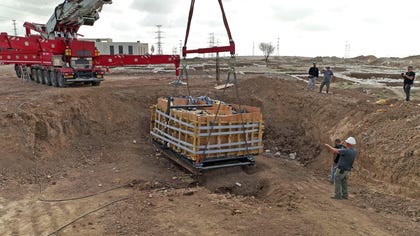
The mikveh was found during a salvage excavation by the authority, and it wasn’t small. It was 4 meters (13 feet) wide and weighed 25 tons. Removing it was a trial by engineering. It took four IAA conservation experts two weeks to completely expose the buried bath.
 Close
Close
The mikveh before the lift. It took four conservation experts from the antiquities authority two weeks to completely expose the bath. Credit: Emil Aladjem/Israel Antiquities Authority
The mikveh before the lift. It took four conservation experts from the antiquities authority two weeks to completely expose the bath. Credit: Emil Aladjem/Israel Antiquities Authority
“Then, close-knit drilling was carried out underneath it through which steel beams were inserted. This infrastructure strengthened the ancient pool and enabled it to be detached from the ground,” the authority says.
To protect the ancient plaster coating the walls, to waterproof them, the conservators applied gauze and adhesives to the ancient stones. The trauma of being lifted out and hauled away could easily damage the plaster, the experts note. Then the entire structure was wrapped in a foam material to help it withstand the jolting.
Related Articles
Ultimately the hero of the day was a 300-ton crane operated under the auspices of the conservators.
Once placed on a wide-load truck, the mikveh was transported in style to the National Treasures Department at nearby Beit Guvrin, next to Beit Guvrin-Maresha National Park. The plan is to put the bath complete with its original plaster back once the new neighborhood has been built, the antiquities authority says. Maybe not exactly, but at least nearby.
 Close
Close
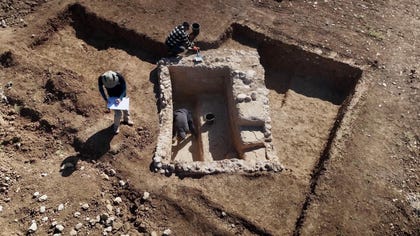
To protect the ancient plaster coating the walls, the conservators applied gauze and adhesives to the ancient stones. Credit: Emil Aladjem/Israel Antiquities Authority
To protect the ancient plaster coating the walls, the conservators applied gauze and adhesives to the ancient stones. Credit: Emil Aladjem/Israel Antiquities Authority
The discoveries were a surprise because during the Second Temple/Roman period, Jewish settlements were known to have thronged the Judean Lowlands, but not this stretch. The archaeologists also found measuring vessels made of stone, which are a hallmark of Late Second Temple-era Jewish life.
Under Jewish law, kitchenware and other vessels made of cloth, wood and leather must be ritually cleansed after exposure to contaminants such as swine or human cadavers. And corrupted clay vessels must be destroyed, on the rationale that unglazed clay is porous (which it is) and the filth has penetrated the very matrix of the plate, cup, bowl or platter.
The place would only be resettled about 500 years later when the Negev’s more habitable areas became the home of farming communities in the Byzantine period.
The Jewish sources don’t mention stone as a material for household utensils, and evidently they were unaware that limestone is porous too (with porosity of 1 percent to 40 percent, meaning up to 40 percent of the stone can be cavities capable of being filled by fluids). Thus an assumption developed that this material couldn’t become ritually impure. Stone dishes therefore became widely used among Jews from about 40 B.C.E. for about 150 years, the archaeologist Shimon Gibson revealed. Stoneware only went out of use after the debacle of the failed Bar Kochba Revolt in 135 C.E.
 Close
Close
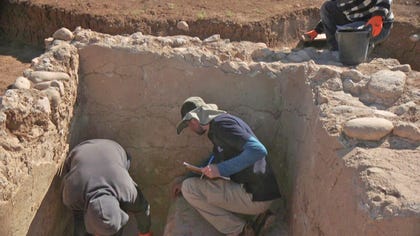
Researchers at the site. The failed Bar Kochba Revolt ended a whole community, not just a penchant for stoneware. Credit: Emil Aladjem/Israel Antiquities Authority
Researchers at the site. The failed Bar Kochba Revolt ended a whole community, not just a penchant for stoneware. Credit: Emil Aladjem/Israel Antiquities Authority
Now stone vessels have been found in this area of Kiryat Gat, where we didn’t know Jews had lived during the Roman period. But clearly they did.
“The Jewish settlement we discovered here is the first and the only known one in this area,” the heads of the excavation for the antiquities authority, Elena Kogan-Zahavi, Maayan Margulis and Shira Lifshitz, said in a statement. “In the seam between the Judean Lowlands and the northern Negev, no Jewish settlement was known until now.”
The Bar Kochba Revolt ended more than the penchant for stoneware. It also ended this settlement in the northern Negev in the south, the archaeologists deduce. The place would only be resettled about 500 years later when the Negev’s more habitable areas became the home of farming communities in the Byzantine period, most likely because the more hospitable areas had become densely populated.
Note that this isn’t the first time an ancient mikveh has been moved so it could be preserved. In 2020, a mikveh at Kibbutz Hanaton in the Galilee was also dug out and moved – to save it from becoming the foundation of a new intersection. There was never a plan to return it to its home, now the middle of a road. It’s nearby at the kibbutz.