
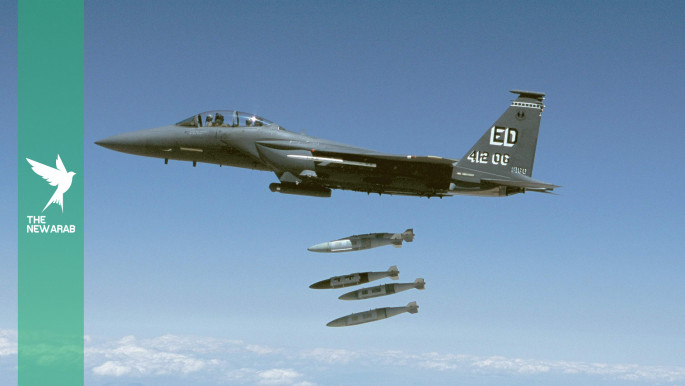
MK-84 bombs (pictured) are 2,000-pound bombs that can create craters 50 feet deep [Usaf/Getty Images]
The United States’ approval of a $2.8bn arms deal with Israel has renewed criticism of US policy towards Tel Aviv, with the package set to include 2,000-pound bombs that have frequently been used in both Gaza and Lebanon to devastating effect.
The approval, which could bypass Congress, is set to replenish the stockpile of heavy munitions, according to reporting from the New York Times.
What are these munitions, where have they been used, and why have they spurred controversy? The New Arab takes a look.
Heavy munitions
The arms package consists of 40,000 heavy bombs developed and made by the US, including 20,000 MK-84 bombs and 20,000 BLU-117 bombs.
The bombs are nearly identical, weighing 2,000 pounds (907kg), creating up to 50 feet (15 metres) deep craters in use, as well as being programmed to detonate above ground as well as underground.
Detonation above ground can send shrapnel 1,000 feet (300 metres) in any direction.
Alongside the bombs, the US will also be supplying 20,000 I-2000 Penetrator warheads. These bombs are also 2,000 pounds but are reinforced and explode on delay, allowing them to punch through surfaces before exploding underground.
Where have they been used?
These bombs have been extensively used by Israel in its wars on Gaza and Lebanon, to deadly effect.
Israel’s war on Gaza has killed over 73,000 Palestinians in a dense urban environment that saw Israeli strikes sometimes killing hundreds at a time in built-up areas, particularly during the first months of the war.
Their repeated use in Gaza, and Israel’s other wars, has seen the US resupply Israeli stockpiles several times in the last three years. In 2024, the Biden administration blocked the transfer of 2,000-pound bombs amid public pressure urging Washington to stop Israel’s invasion of Rafah, which occurred anyway.
US President Donald Trump later unblocked the transfer of the weapons, just a few days into his administration.
According to the New York Times, it has identified 208 craters at least 40 feet across in an area of southern Gaza where Israel told civilians to move to safety.
One such incident in the Jabaliya Refugee Camp at the start of the war killed around 195 Palestinians and wounded a further 777, according to Gaza’s Ministry of Health.
Israel’s bombardment of Gaza, which has since seen the systematic destruction of infrastructure in Israeli-occupied areas of the enclave, has destroyed most of Gaza’s housing and other infrastructure, including schools, hospitals, roads, water and sewage.
Though Israel has launched campaigns against seven Middle Eastern countries since the outbreak of its war on Gaza — including Lebanon, Syria, Yemen, Iran, Iraq and Qatar – MK-84 bombs are not deep-strike munitions, meaning they have a minimum range that’s limited to the aircraft’s operational range, limiting their usage to areas where Israeli aircraft can directly fly over.
Where is the backlash?
The sale has generated backlash from parts of the US political scene, which has seen figures from both sides of the aisle become increasingly wary of the partnership with Israel.
The most vocal critic of the deal among the Democrats has been Representative Gregory W. Meeks, Ranking Member of the House Foreign Affairs Committee and supporter of Israel, who said he would not clear Trump’s proposal.
In a press release published on Wednesday, Meeks said that though he is committed to Israel’s security, “the Trump administration’s proposed sale of 40,000 2,000-pound bombs, some of the most destructive munitions in our arsenal, raises grave, unresolved concerns about how these munitions could be used in densely populated areas of Gaza and Lebanon”.
“The Trump administration has not provided sufficient assurances that these weapons will be used by the Netanyahu government in accordance with U.S. law and with appropriate protections for civilians. I therefore will not clear this sale at this time,” he added.
Democrat Senator Chris Van Hollen also weighed in on X, saying he would work to stop the transfer.
Within the Republican political commentariat, Tucker Carlson, who in recent years has distinguished himself as a staunch critic of Israel’s wars in the region, also hit out against the decision.
“By definition, what the Netanyahu government has done in Gaza is genocide. The 40,000 new bombs the Trump administration is sending will be used to do the same in Lebanon, and likely in other countries in the region.
“If you wanted to extend the Iran war into the indefinite future, this is exactly what you’d do,” he added.
It is unlikely that Congress will be able to stop the transfer, as it would require a resolution of disapproval with a two-thirds majority in both the House and Senate, which has never happened before, according to the New York Times.
Both the Trump and Biden administrations have also bypassed congressional reviews when selling and transferring arms to Israel since the start of Israel’s war on Gaza by invoking emergency authority.