
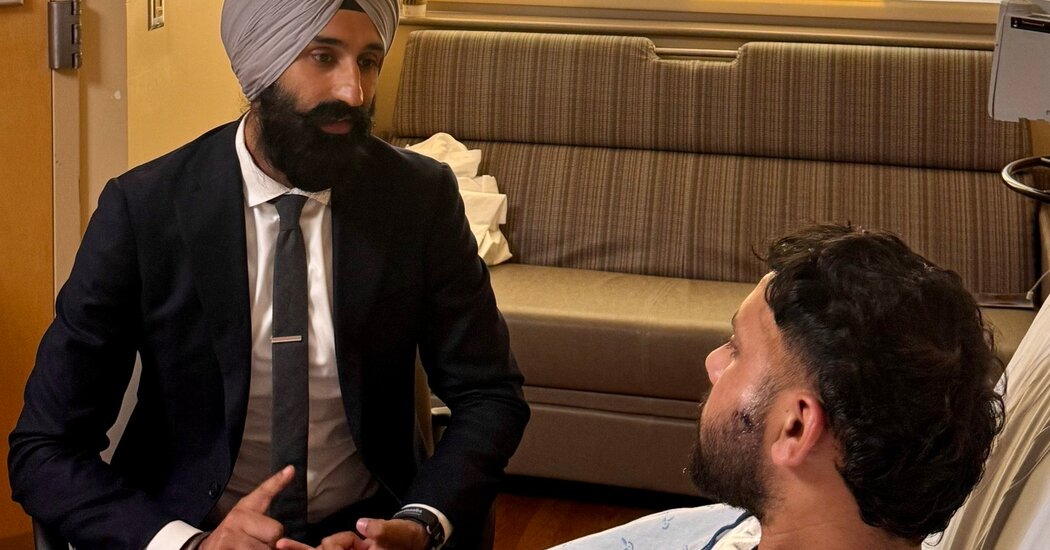
For years, Gurvinder Singh has hauled energy drinks, snacks and other items from California to supermarkets and big-box stores across the country, one of more than 100,000 Sikhs earning a living in the trucking business.
In the wee hours of Sept. 13, Mr. Singh pulled into a rest stop in Wyoming to use the bathroom. Moments later, he was ambushed and stabbed repeatedly by a white man. He was airlifted to a hospital in Casper, Wyo., where he was treated for 17 lacerations, including to the neck, chest and arms.
“I am close to the sink and suddenly I am hit on the neck and then punched in the face,” he recalled on Saturday, after being discharged from the hospital.
“When I tried to push the man away, he got a knife and stabbed me 17 times,” Mr. Singh said in a phone interview.
Local law enforcement arrested Andrew Kris Bzdak and charged him with attempted first-degree murder. His bail was set at $1 million. Authorities have not yet determined a motive.
The attack occurred amid a surge in hostile rhetoric targeting Indians of Sikh faith. Members of the monotheistic religion, who traditionally wear turbans and maintain beards, have become the face of the Trump administration’s efforts to bar certain immigrants from operating commercial vehicles.
Just days before the stabbing, the Department of Homeland Security posted an image on social media of a bearded man in a head covering with the caption “Get off our roads, you don’t know how to drive Mr. Singh,” the most common Sikh surname.
Published on Sept. 10, the eve of the 25th anniversary of the Sept. 11 attacks, the posts drew immediate, widespread condemnation. Following the 2001 attacks, Sikh men were erroneously targeted in multiple anti-Muslim violent incidents because their turbans and beards were conflated with extremist groups.
DHS said the post depicted Harjinder Singh, a Sikh man (no relation to Gurvinder Singh) accused of causing a fatal collision last year that left three people in a minivan dead in Florida. The agency removed the post the next day but dismissed complaints about it as “nonsensical drivel.”
“It’s impossible to separate the stabbing from the DHS post and the Trump administration’s rhetoric,” said Jasjit Singh, legal director of the Jakara Movement, a nonprofit that advocates for Sikhs in the United States.
“Just because we don’t know the motive doesn’t mean this was random,” said Mr. Singh, a lawyer in Northern California whose father was a truck driver for four decades.
An image posted to the Department of Homeland Security’s X account, which appeared to show a Sikh man facing off against Optimus Prime, was removed the following day.Credit…Department of Homeland Security
The DHS post and the stabbing have deeply shaken the 750,000-strong Sikh community, already reeling from a spike in online hate speech and threats, he said. And with upcoming national elections, which in the past have correlated with a rise in violence, Sikh houses of worship remain on alert.
As older truck drivers have retired, immigrant drivers have increasingly filled the void. About 200,000 foreign drivers hold licenses that allow them to operate commercial vehicles, and about half of them are Sikhs.
The Trump administration has been pressuring states to revoke driver’s licenses and restrict the issuance of new ones to certain immigrants, tightening language requirements and dispatching federal agents to stop drivers at checkpoints to verify their immigration status.
Munmeeth Soni, legal director of the Sikh Coalition, an advocacy group, accused the administration of fueling violence, such as the stabbing, by using Sikh truck drivers as “scapegoats for their campaign to remove immigrant drivers.”
She said that some observant Sikh drivers have stopped wearing their head coverings, whether the turban or a bandana called a rumal, and they have begun shaving their beards to avoid scrutiny.
“Are we ever going to be American enough for people who don’t want us here?” she said.
Raman Dhillon, CEO of the North American Punjabi Trucking Association, said that some drivers were now reluctant to take routes through red states.
“Somebody traveling in the middle of nowhere by themselves doesn’t want to go to a state where they feel they could be attacked,” he said.
Despite their tiny population, Sikh Americans consistently rank as the third most targeted religious group for hate crimes in the United States, behind Jewish and Muslim Americans.
Between January 2023 and December 2025, online slurs targeting South Asians jumped 109 percent, according to Stop AAPI Hate, which tracks hate against Asian Americans and Pacific Islanders.
In a report published earlier this month, the group said that the increase in hostility toward South Asians was fueled by the Florida truck crash, President Trump’s re-election, debates over H-1B skilled-worker visas and New York City mayor Zohran Mamdani’s election campaign.
Sikh immigrants, who hail from the Indian state of Punjab, are frequently associated with driving cabs, running gas stations and working in trucking. However, among the immigrants and their U.S.-born children are many engineers, doctors and other educated professionals.
Jesse Singh, a 46-year-old finance professional, was born in Berkeley, Cal. His father, a scientist who immigrated to the United States in the 1970s, worked at the University of California and the Lawrence Livermore National Laboratory and has been a U.S. citizen for decades.
“This government is making enemies out of citizens,” he said. “The community is feeling unsafe.”
Since arriving in the United States, Gurvinder Singh has plied the nation’s highways, driving up to 11 hours at a stretch and sleeping inside his big rig. His most frequent routes take him from his home base in Sacramento to Chicago and St. Louis. This time, he was headed to Bethlehem, Pa.
“I can’t help but think that I was attacked because of my dark skin, features, and my religion,” he said, adding that he was aware of the DHS social media post. His head was uncovered at the time, but he maintains a beard and wears a kara, a traditional silver steel bracelet symbolizing spiritual strength.
He had stopped at the Bitter Creek Rest Area on Interstate 80, in southern Wyoming between Salt Lake City and Cheyenne, on previous trips. It was just after 3 a.m. on Sept. 13 when he pulled in to use the restroom.
A man followed him inside and struck him from behind. When Mr. Singh turned around, the assailant, in a blue tracksuit, delivered blows to his face. Mr. Singh said he attempted to push him away, but the man drew a knife and began stabbing him repeatedly.
Staggering outside, Mr. Singh was met by a Latino family who rushed to his aid. They applied towels to his wounds, dialed 911, and provided details that assisted law enforcement in locating the suspect, he said.
“They gave me a second life,” Mr. Singh said, adding that he wishes he could find them again.
Once he fully recovers, Mr. Singh plans to resume crisscrossing the country.
“I am a skilled driver,” he said, pointing to his spotless safety record. “I am proud of being a truck driver.”
Georgia Geecontributed research.