
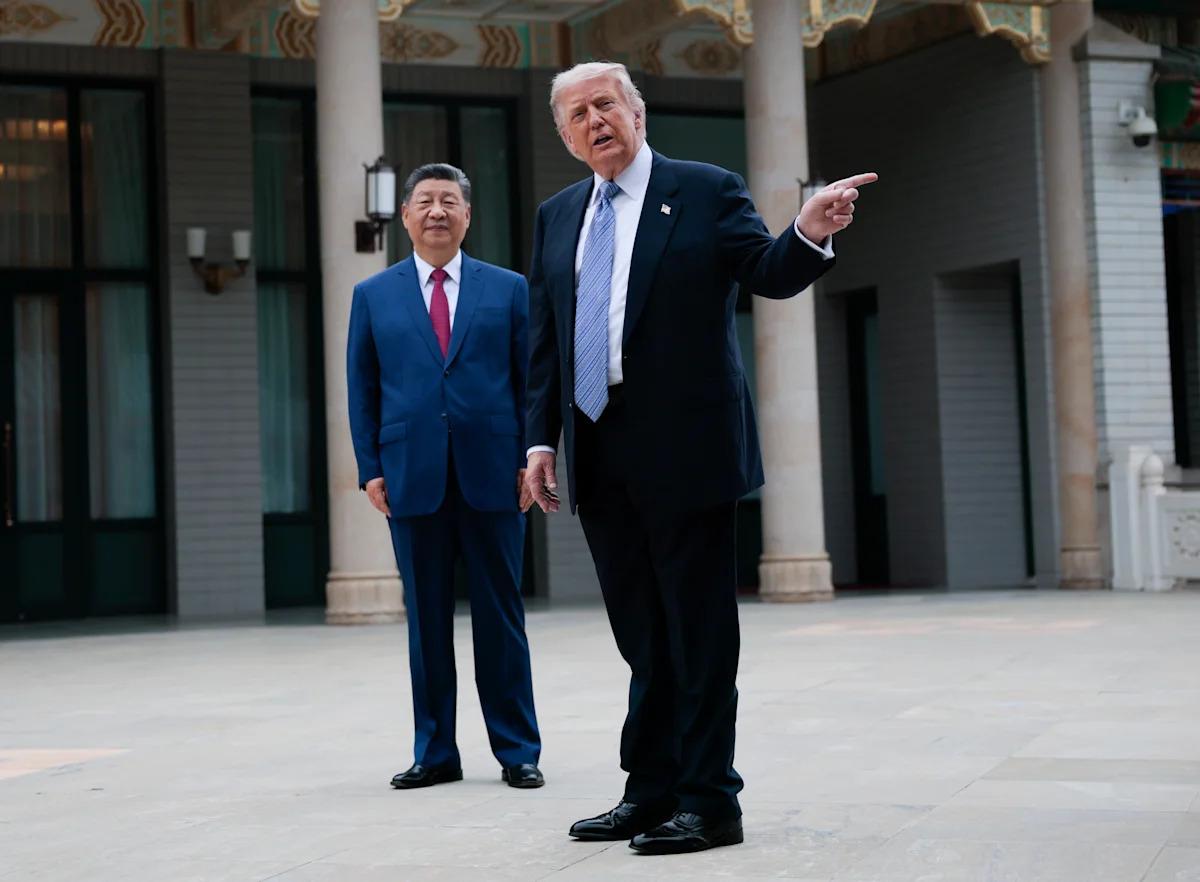
President Trump meets later this week with Chinese President Xi Jinping, and observers are hoping for incremental progress on key issues.
But don’t expect major policy breakthroughs.
On trade, there is a hope that the current truce between the US and China could be formally extended and some concessions negotiated, as Trump has delayed making new tariff provocations.
Meanwhile, on artificial intelligence, there is little expectation for any agreement around scaling back the rapid pace of developing frontier AI models but hopes for increased communication. Treasury Secretary Scott Bessent said Sunday that preliminary talks had focused on a possible “notification mechanism between the two countries” around AI.
A senior US official confirmed that both AI and trade were on the agenda for the talks but made clear how much is up in the air, suggesting to reporters on Friday that no agreements had been reached in advance.
“We’ll know more once the two leaders meet,” the official said.
 President Donald Trump and Chinese President Xi Jinping during a tour of Zhongnanhai Garden in China in May. (Evan Vucci-Pool/Getty Images) · China Pool via Getty Images
The week ahead could also be a ripe one for dealmaking. CEOs from both nations are set to be on hand, including a number of big names from the US side — from Jeff Bezos of Amazon (AMZN) to Elon Musk of Tesla (TSLA) and SpaceX (SPCX) to Jensen Huang of NVIDIA (NVDA) to Sam Altman of OpenAI (OPAI.PVT) and more.
Trump touted the planned state dinner and lamented that it would take place in the East Room of the White House (instead of in his still under construction ballroom). He said only about 125 people will be in attendance, calling it “a very tough ticket.”
Yet for all the pomp and circumstance, there is a sense that less news might be made on the policy front.
“My shorthand for describing the current dynamic is managed stalemate,” said Craig Singleton, a senior fellow at the Foundation for Defense of Democracies and a former US diplomat.
Singleton says Trump is aiming to stage a visit that equals his own highly choreographed visit to Beijing earlier this year, and “the style will almost certainly be more impressive than the substance.”
President Donald Trump and China’s President Xi Jinping inspect a guard of honour during a welcome ceremony at the Great Hall of the People in Beijing on May 14, 2026. (Kenny HOLSTON / POOL / AFP via Getty Images) · KENNY HOLSTON via Getty Images
AI and trade are just a few issues to watch, with the talks between the world’s two largest economies also expected to touch on the status of Taiwan, export curbs on rare earth minerals, the war in Iran, and recent currency developments around the Chinese Yuan after Secretary Bessent called the Chinese currency undervalued.
Three days of events are scheduled, beginning on Wednesday in Washington after Trump makes a trip to New York early this week for the UN General Assembly.
Story Continues
An airport arrival ceremony is planned Wednesday, a bilateral meeting and state dinner Thursday, and then a tour of the US National Archives on Friday before Xi’s departure.
Hopes for — at most — ‘a framework for future discussions’ on AI
A key theme of the visit — which has been elevated by a growing focus on the issue — is AI.
Trump has staked out a China-focused stance, often saying that the US needs to pull out all the stops to win on AI. On Saturday, he announced plans for an “AI force” to oversee the technology that he was quick to note “will not in any way hinder or stifle the Growth of this incredible Industry.”
China has likewise signaled it has little interest in slowing down.
Against that landscape, Kevin Allison of the Center for European Policy Analysis said it’s hard to see much beyond a pro forma agreement on AI emerging this week, though communication could improve.
In “an optimistic case, you might have a framework for future discussions,” Allison said.
He said a hotline is in place to discuss these topics, but a problem in the past has been that “the Chinese don’t answer it.”
Bessent said the US proposed a notification mechanism between the two countries because “we want a shared vision.” He did not say how the Chinese reacted to the idea.
President Donald Trump and Open AI CEO Sam Altman are seen during meeting of artificial intelligence business leaders as part of a G7 summit France in June (Julia Demaree Nikhinson / POOL / AFP via Getty Images) · JULIA DEMAREE NIKHINSON via Getty Images
The overall mood is expected to be full speed ahead on AI from both sides, underlined by the attendance of Huang at the state dinner as well as former Trump AI czar David Sacks, who NBC reported is also set to attend.
Huang and Sacks have been allied with Trump on pushing back on the need for new AI regulations.
Huang took a call from the president onstage at a conference last week, allowing Trump to tell the assembled audience that “the robots are not going to be taking over the world.” Huang then chimed in and said, “We don’t need any new laws.”
On tariffs: Potential for short-term de-escalation
The expectations on the tariff front have shifted in a de-escalatory direction, as importers pin hopes on a formal extension of the bilateral trade truce that expires in November.
That sense of guarded optimism was helped by the Trump administration making clear it wasn’t likely to hike up tariffs on the eve of Xi’s visit.
It was just a few weeks ago that Trump had been seen as likely to move forward with, but with the midterms looming the focus has more recently shifted to limited possible tariff cuts.
Treasury Secretary Scott Bessent and US Trade Representative Jamieson Greer are seen during talks with Chinese officials on tariffs in Geneva in May. (VALENTIN FLAURAUD/AFP via Getty Images) · VALENTIN FLAURAUD via Getty Images
Both the US and China are eager to show progress on the “Board of Trade” announced earlier this year. Bloomberg reports that one plan could cut duties on Chinese inputs for manufacturers in return for some concessions from China.
A US official said discussions were already underway on some tariff relief on a “narrow band” of less sensitive goods, which could be finalized this week.
The framework to judge the trade talks is not whether any major new agreements are struck but “whether China demonstrates measurable progress on its previous commitments,” Andrew Harding recently wrote for the Heritage Foundation.
One certainty: A lot of CEOs will be on hand
Xi’s government reportedly has plans for several top business leaders to join him alongside the large US delegation.
The full list of CEOs and former CEOs the White House has confirmed includes Jeff Bezos of Amazon (AMZN), Sundar Pichai of Google (GOOG), Michael Dell of Dell Technologies (DELL), Jane Fraser of Citigroup (C), and Tim Cook of Apple (AAPL).
Nvidia CEO Jensen Huang following a welcome ceremony at the Great Hall of the People on May 14 in Beijing with President Trump Chinese President Xi Jinping. (Alex Wong/Getty Images) · Alex Wong via Getty Images
Executives from electric carmaker BYD could also be in attendance, the South China Morning Post reports. The company is effectively banned from selling cars in the US, but Trump raised eyebrows by suggesting an openness to change, which led to protests from US automakers.
“If China wanted to come in and open a plant to build their cars here, I’d be okay with that,” Trump told Fox News. “What I don’t want is them to build in Mexico and just build it inexpensively and ship it across the border.”
Ben Werschkul is a Washington correspondent for Yahoo Finance.
Read the latest financial and business news from Yahoo Finance