
Beirut, Lebanon – Israel’s military is continuing a “scorched earth” strategy in southern Lebanon, despite a framework peace deal and ongoing direct negotiations between Beirut and Tel Aviv, analysts told The New Arab.
Airstrikes and controlled demolitions have rocked southern towns and villages almost daily, while US-mediated talks aimed at securing an Israeli withdrawal and Hezbollah’s disarmament have stalled ahead of the Israeli legislative elections in October.
Earlier this month, Israeli ground troops took control of the strategic Ali al-Taher ridge – allegedly containing a Hezbollah command centre, tunnels and weapons stores – after months of fighting in southern Lebanon.
“Ali al-Taher is considered a linchpin for the Israeli security system of today,” Elias Hanna, a retired Lebanese army general, told The New Arab.
Hanna added that from this vantage point, Israeli forces can consolidate their position in the previously captured Beaufort Castle and dominate the area south of the Litani River.
But it is not clear whether the Israeli military’s seizure of the Ali al-Taher ridge signals an intent to expand its occupation deeper into Lebanese territory.
The subsequent destruction of the alleged Hezbollah command centre – Israeli troops detonated the hilltop, causing a 4.1-magnitude seismic tremor – has been touted as a strategic and symbolic victory by Israel.
However, Hanna said the Ali al-Taher ridge was not as valuable a stronghold for Hezbollah as it was before this war began, as the armed group has switched to guerrilla-style warfare that precludes the use of large bases.
According to Hanna, Israel’s military, for its part, is also pursuing a new strategy in the south.
“This time it’s totally different from the 1982 invasion – now they are destroying everything,” Hanna said.
Israel historically occupied a swathe of southern Lebanon from 1982 to 2000, when Israeli forces withdrew completely. This time, however, Hanna argued that Israel cannot afford to put a large number of boots on the ground and is opting instead for a “scorched earth” approach.
“If you want to destroy your enemy, you destroy the ecosystem of your enemy, so he won’t be able to ever recover and come back,” Hanna explained.
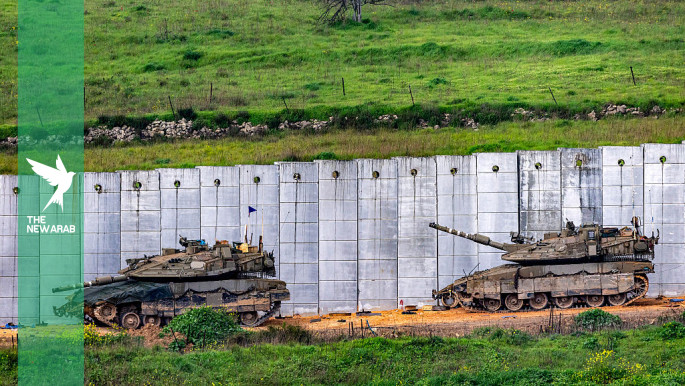
Israeli tanks and military vehicles drive along the road between destroyed houses in southern Lebanon near the border with Israel on 25 April 2026. Analysts say Israel is consolidating permanent control over a security zone. [Getty]
The remaking of south Lebanon
Israel has flattened entire villages inside the “yellow line”, a 10km-deep ribbon of land occupied by Israel along the Lebanese-Israeli border.
At least 46 of 54 towns and villages in this area have been heavily damaged or completely levelled by airstrikes and controlled demolitions, according to satellite analysis by Bellingcat. More than 340,000 people remain internally displaced.
In August, Israeli Defence Minister Israel Katz visited southern Lebanon and said the military was destroying underground infrastructure and “all the houses” in the area. Lebanon’s Prime Minister Nawaf Salam has called the destruction a serious violation of international humanitarian law.
“Israel is consolidating its control over this dead security zone that it has demarcated in the south, in which it is attempting to erase any evidence of civilian life and then any possible social or infrastructural base for Hezbollah,” Sam Heller, a Beirut-based analyst with the Center for International Policy, told The New Arab.
The direct negotiations between Lebanon and Israel were announced in April, shortly before the latest ceasefire, despite heavy opposition from Hezbollah.
In June, a framework deal was agreed between Beirut and Tel Aviv that included a plan to launch “pilot zones” in southern Lebanon where the Lebanese army would disarm Hezbollah.
The last round of talks, held in Rome in August, reached a deadlock after Beirut failed to achieve either of its two key objectives: to secure a genuine ceasefire and to make progress on Israel’s withdrawal from the areas it occupies in southern Lebanon.
Israel, by contrast, prioritised Hezbollah’s disarmament and rejected a proposal to launch additional pilot zones.
Asked whether the Lebanese army was capable of disarming Hezbollah, which is widely considered to be the more powerful force, Hanna said: “It’s not about the Lebanese army’s capabilities, it’s about the political will of Hezbollah.”
One of the main obstacles to the negotiations has been the failure to appoint a third party to verify the agreement’s implementation on the ground. Italy and France emerged as potential candidates, but Israel objected to both options.
Israel has flattened entire villages inside the ‘yellow line’, a 10km-deep ribbon of land occupied by Israel along the Lebanese-Israeli border, with at least 46 of 54 towns and villages heavily damaged or completely levelled by airstrikes and controlled demolitions. [Getty]
“The Israelis likely have basically nil confidence in Lebanese authorities’ ability or willingness to really confront Hezbollah or disarm it,” Heller said. “Instead, Israel will seek to legitimate internationally its continued direct role in Lebanon and to make that maximally sustainable politically,” he added.
“Israel has gotten most of what it wanted, which is a step towards the normalisation of relations, the opening of direct negotiations, and the legitimation by Lebanese authorities – as part of this agreement – of Israel’s indefinite presence inside South Lebanon.”
The diplomacy of an indefinite occupation
The next round of talks, which has been postponed to October, is due to take place as Israel gears up for what could be pivotal elections.
“The negotiations themselves have stalled, given the upcoming Israeli elections. The Lebanese President is hopeful that a change in government would yield positive results; the PM and his team are less so,” Mohanad Hage Ali, with the Carnegie Middle East Center, told The New Arab.
While progress on the negotiations before the end of October remains unlikely, Heller doubts that the Israeli elections will deliver a government more amenable to making the concessions Beirut is trying to secure.
The Lebanese government, which says it has no option but to negotiate, is seeking to garner international support for the Lebanese Armed Forces, especially as the UN peacekeeping mission in the south is set to withdraw at the end of the year.
Last week, Lebanese President Joseph Aoun met French President Emmanuel Macron in Paris, as well as Arab, European and US military officials.
While France affirmed its support, observers say this remains largely symbolic, as any meaningful change to the status quo in southern Lebanon will rely heavily on action and mediation from Washington.
“Regardless of how the Lebanese government feel about the prospects of negotiations, the process itself is now all about conflict management and de-escalation, buying time, and the fact is they have no other tools,” Hage Ali said.
Alex Martin Astley is a freelance journalist based in Beirut, covering conflict, foreign policy, and social justice issues
Follow him on X: @AlexMAstley
Edited by Charlie Hoyle