
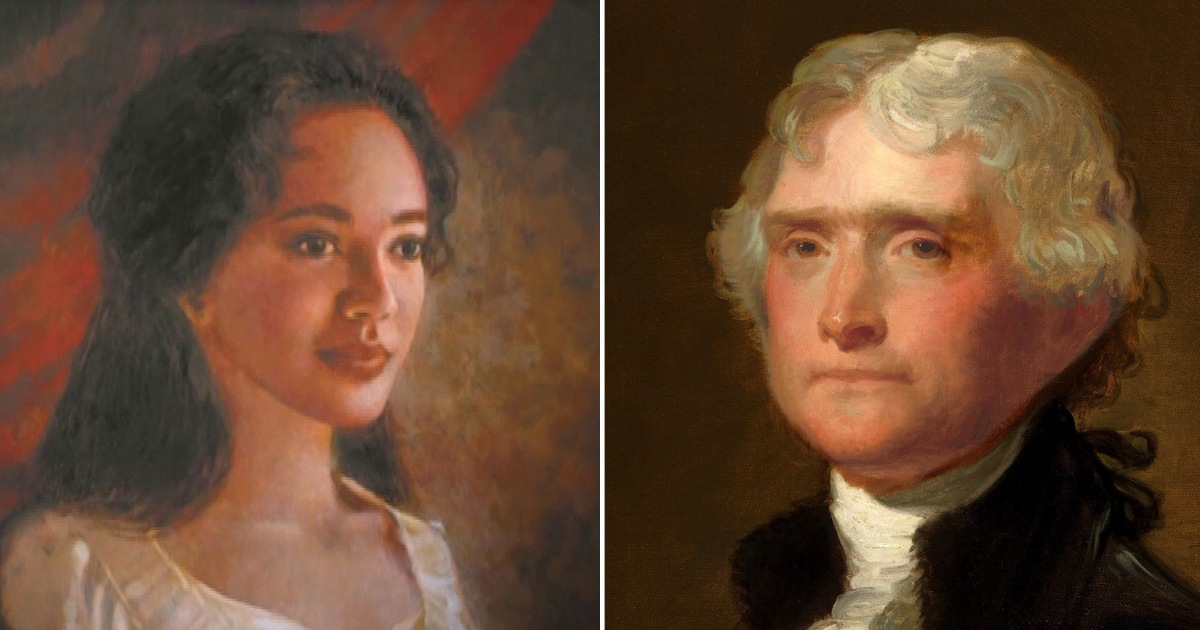
The Smithsonian and a team of researchers say they have the most definitive proof yet about whether former President Thomas Jefferson and a woman he enslaved, Sally Hemings, had children together.
The new book “History by a Hair: Thomas Jefferson, Sally Hemings & Solving a 200-Year-Old Mystery,” which will be released Sept. 22, aims to shed light on one of the biggest controversies involving the author of the Declaration of Independence.
Smithsonian scholar and co-author Richard Kurin spoke with NBC News senior legal correspondent Laura Jarrett in an interview that aired on TODAY Sept. 21. He discussed how researchers used preserved strands of Jefferson’s hair to prove the relationship between Jefferson and Hemings.
“There was 99.9% chance that Thomas Jefferson had fathered a child of Sally Hemings,” Kurin said about the findings.
The third president never acknowledged any relationship or children with Hemings during his lifetime.
Kurin’s interest first piqued in 2011 when he learned in a documentary that a single strand of Jefferson’s hair had been discovered in his personal Bible.
“If we can get Jefferson’s DNA, we can solve a 200-year-old mystery of American history,” Kurin said he thought. “That is that Thomas Jefferson fathered Sally Hemings’ children because we could compare his DNA … to living descendants of Sally Hemings.”
Jefferson’s involvement with Hemings has been widely reported and researched for years, but whether the two had children together has not been firmly confirmed.
“How can a man who writes, ‘All men are created equal’ have his own children, not equal, and not having freedom?” Kurin asked. “I knew people had a great stake in it.”
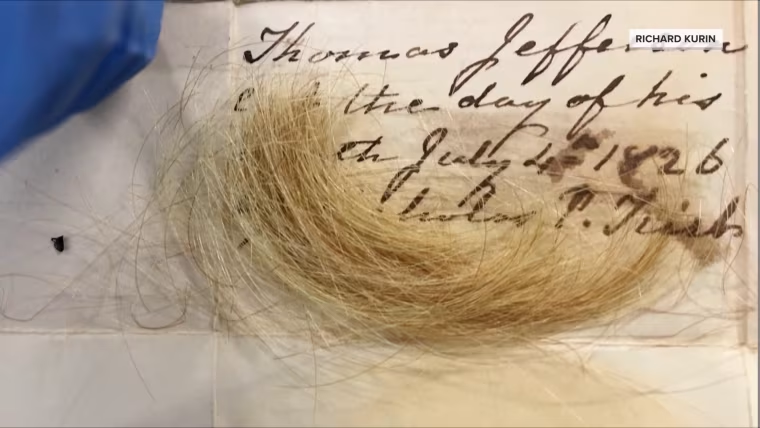 A packet of Thomas Jefferson’s hair found at his Monticello estate had played a crucial role in this DNA research.Richard Kurin
A team of scientists were unsuccessful in extracting anything definitive from the single strand of Jefferson’s hair in his Bible, but an entire packet of Jefferson’s hair that was recovered at his Monticello estate in Virginia proved to be crucial.
“That was the puzzle piece because it gave us his whole genome,” Kurin said. “We were able to get so much DNA. … We could go to each descendant and say, ‘OK, we need you to spit in a tube. So we can get your DNA, and then we can compare.’”
Kurin traveled across the country and met with descendants of Jefferson and Hemings like David Miller, Clara-Lee Nutt and Art Westerninen.
“My mother in college in the ‘50s did her genealogy, and she consulted with her uncle who had already done it,” Westerninen said on TODAY. “But he also said, ‘Don’t dig too deep. You’re not going to like what you find.’”
Nutt learned the sensitivity around the topic firsthand during a seventh-grade class trip to Monticello.
“We’re going through Jefferson’s house where we had his bed in his library, and I say, ‘Hey, so where did Sally Hemings sleep?’” Nutt recalled. “And the tour guide’s head spun around like a 180, and she looked at me and she goes, ‘There is no evidence that that woman ever set foot in this house.’
“I remember that bus ride home, where I thought, ‘I’m done. I will never talk of this again.’”
Decades later, Nutt joined the group giving Kurin her DNA in 2024. It showed that she shared roughly 5% of Jefferson’s DNA.
“It’s absolutely huge,” Kurin said. “It’s off the charts.”
The descendants felt like it was clear proof of what they knew.
“It’s really wonderful to have the validation for my children, and the fact that I could pass on the information to them without caution,” Nutt said. “I could speak boldly and just say, ‘This is who you are.’”
Kurin collected DNA for more than a dozen descendants, including Miller’s mother.
“I’m happy that my entire family is validated now,” Miller said.
The Smithsonian said it is still hearing from other descendants who want to be part of the project. Kurin hopes to one day post Jefferson’s genome online for all to access.
However, not all of the descendants who participated in the process were happy about it. Dr. Mary Lee Brady-Atkins, 98, the oldest living descendant of Hemings, told The Chronicle of Higher Education that she felt used by researchers and believes the research needs more vetting.
“If you choose not to believe it, science is not going to change that,” Nutt said.
Some of the descendants are hoping the results can bring them closer together as a family.
“I just feel blessed that I have this cousin here,” Nutt said.