
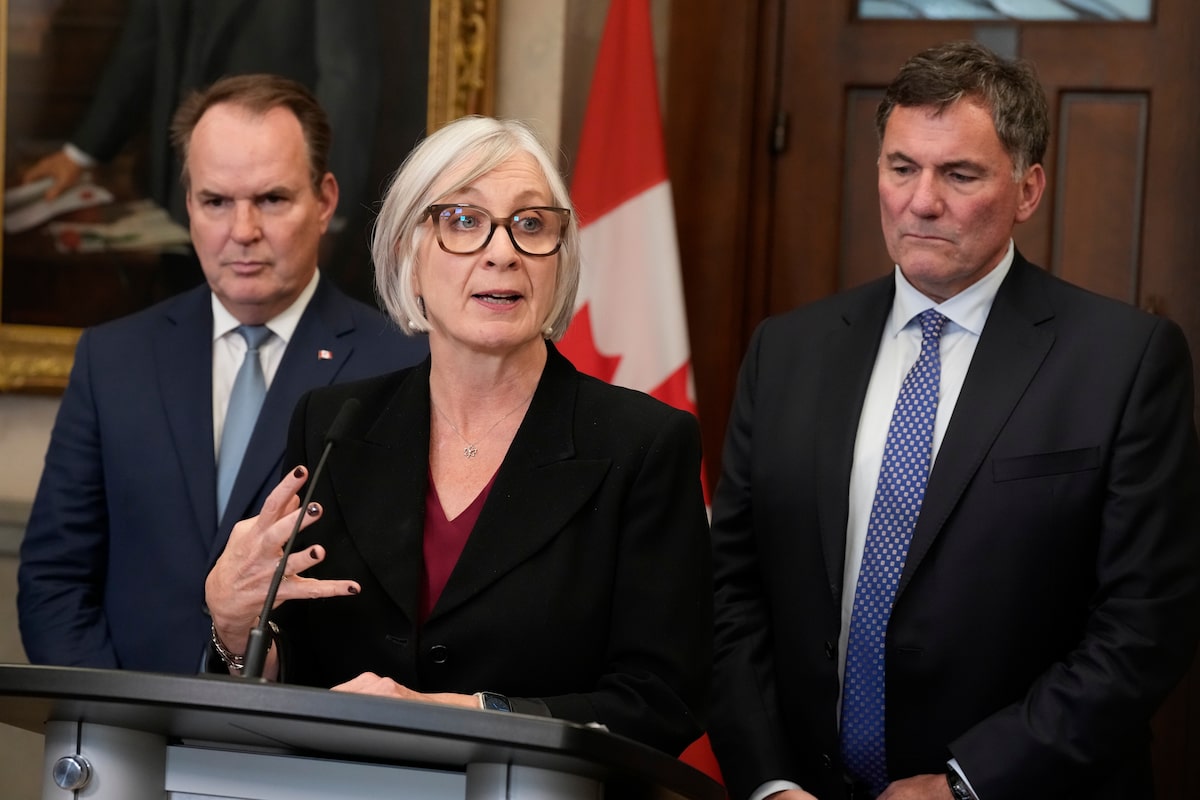
Transport Minister Steven MacKinnon, left, and Canada-U.S. Trade Minister Dominic LeBlanc, right, listen as Minister of Jobs and Families Patty Hajdu speaks during a news conference in the House of Commons in Ottawa, on Monday.Adrian Wyld/The Canadian Press
Ottawa’s proposed changes to the federal labour code are drawing the ire of unions and labour experts, who say that the amendments will effectively dilute federal employees’ right to strike by involving a special third-party mediator in high-stakes labour disputes.
On Monday, the federal government introduced sweeping legislative changes aimed at speeding up project approvals and limiting supply chain disruptions due to strikes. Part of those changes include additions to the Canada Labour Code, the result of months-long consultations with unions and employers and industry groups representing federally-regulated workers.
Specifically, the government is changing language around Section 107, a contested clause in the code that gives the federal minister of labour the authority to direct the Canadian Industrial Relations Board to force the resolution of a labour dispute and end a strike or lockout. The government will now create a new role of “special mediator” in negotiations where employers and unions are struggling to achieve a settlement. The Minister of Jobs and Families will have to consider the mediator’s assessment and weigh that against the country’s “national interest” before deciding whether to intervene in a strike.
Ottawa is framing the changes as new “guardrails” that prevent the government from intervening unnecessarily in a labour dispute, while still helping unions and employers reach an agreement at the bargaining table without having to strike. “These changes mean the labour minister must meet a higher bar before intervention is possible,” Patty Hajdu, the federal Minister of Jobs and Families, said at a news conference on Monday. “The minister will have to show his or her work and outline why arbitration is necessary.”
Ottawa tables bill to amend labour code, speed up project approvals
But unions vehemently disagree with that characterization of the changes to the code. They argue that the minister could, regardless, use the special mediator’s report as a justification to impose the terms of a settlement, undermining the right to strike.
The Canada Labour Code governs approximately 1.4 million federally-regulated employees who work in the public service and across banking, telecommunications, broadcasting and transportation.
“This bill gives the government the new and expanded power to end a legal strike when it decides the strike is, or could be, against the national interest,” Bea Bruske, president of the Canada Labour Congress, said in a statement issued Monday evening. “A strike has economic impact because that is how collective bargaining works. If the government can end a strike because it is having an economic impact, employers have less reason to compromise and reach a deal.”
Mark Hancock, national president of the Canadian Union for Public Employees, the country’s largest public sector union, said in a news conference on Monday that CUPE was worried about the legislation and noted that very rarely do unionized employees actually go on strike. “If the government thinks unions like CUPE are going to be happy with this legislation, they are in for a rude awakening,” he said.
The Liberals, under both former prime minister Justin Trudeau and Prime Minister Mark Carney have used Section 107 exactly 10 times between 2023 and 2025 to quash various strikes by federal workers in ports, railways, airlines and the postal service, much to the chagrin of unions and the broader labour movement. Prior to Monday’s legislation being tabled, unions had been calling for Section 107 to be revoked in its entirety, arguing that it had been misused by the federal government to intervene in strikes.
Ottawa will not interfere with workers’ right to strike, Hajdu says
Sean Strickland is the executive director of Canada’s Building Trades Unions, an organization that has been vocally supportive of Mr. Carney’s major projects initiative. The right to strike “must remain protected, with strong guardrails around any government intervention,” he said in a statement.
“When our members invoke job action, they are not doing so lightly. We need certainty for investment, and we need projects moving, but we cannot achieve that by taking away the very tool workers have to protect their livelihoods and their safety,” Mr. Strickland said.
Unions and employers have spent much of this past year sparring over potential changes to the federal labour code after the Carney government held multiple rounds of consultations on the issue. Federal employers, particularly in transportation and telecommunications, have long argued that strikes in key sectors like railways and ports cause catastrophic supply chain disruptions that impair the functioning of the economy, especially in a climate where Canada is embroiled in a trade war.
Unions, however, argue that any impediment to the right to strike will drastically alter the dynamics at the bargaining table, forcing workers to lose their leverage in demanding better wages and working conditions.
“Every effective strike is disruptive – that’s the whole point of labour disputes. They pressure both sides to come to an agreement,” said Larry Savage, professor of labour studies at Brock University. Prof. Savage said that the new special mediator provisions in the code could be helpful in resolving disputes, but the federal minister’s express power to direct the CIRB risks becoming a “back door to government-imposed settlements.”
“The Liberals are not modernizing labour relations,” he said. “They are moving toward a framework that would tilt the scales in favour of employers by normalizing ministerial strike intervention and binding arbitration.”
According to a report released by Ms. Hajdu’s office last week, approximately 95 per cent of negotiations are resolved without a work stoppage.
While it is often difficult to interpret strike data because the number of strikes in a given year fluctuates depending on which collective agreements are up for renewal, there was a clear and sustained uptick in strikes and lockouts between 2022 and 2025 as workers emerged from the pandemic into an economy grappling with decades-high inflation rates.
Federal government data shows that at its peak, in 2023 and 2024, there were 272 strikes across the country. That number declined to 229 in 2025. There have been 124 strikes so far between January and May of this year.
The frequency of strike activity over the last few years, especially involving federal workers, prompted employers and interest groups representing employers to begin lobbying the federal government to reconsider the labour framework. Today’s legislative changes come on the back of a Senate report published in June that recommended Ottawa introduce an alternative dispute resolution mechanism to reduce the likelihood of work stoppages.