
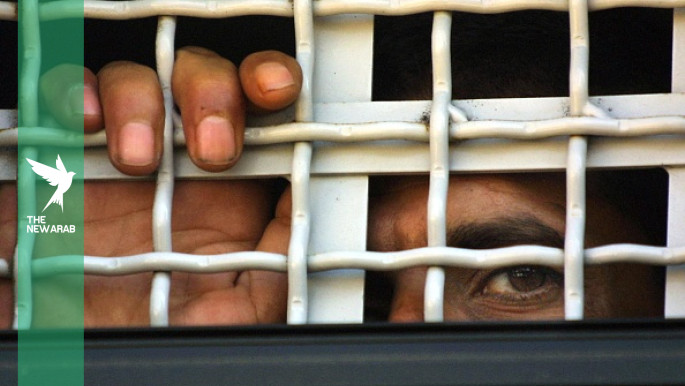
A Palestinian man could become the first person sentenced to death under Israel’s controversial new law after being accused of killing an Israeli settler near Ramallah [Getty]
A Palestinian man accused of killing an Israeli settler near Ramallah could become the first person sentenced to death under Israel’s new death penalty law, which rights groups have condemned as discriminatory and effectively designed to target Palestinians.
Qadri Muhammad Samara, 37, was arrested alive after Israeli authorities accused him of carrying out Sunday’s shooting, in which Israeli settler Netanel Shukrun was killed.
The case could provide the first test of the controversial law, passed by the Knesset in March, which makes death the default sentence for Palestinians from the occupied West Bank convicted by Israeli military courts of intentionally killing someone in an attack classified as terrorism.
Crucially, the provision excludes Israeli citizens and residents living in the same occupied territory. Rights groups have warned that the law entrenches a two-tier legal system in the West Bank and strips Palestinian defendants of basic safeguards.
Far-right National Security Minister Itamar Ben-Gvir, one of the law’s leading proponents, immediately called for Samara to be executed.
“This is the first incident that meets the criteria of the death penalty law in Israel that we approved,” Ben-Gvir wrote on X, arguing that because Samara was captured alive, the sentence should be applied.
Israeli public broadcaster Kan reported that Ben-Gvir raised the case during a security cabinet meeting on Sunday. Military representatives reportedly said there was, in principle, no legal obstacle to applying the law, while Prime Minister Benjamin Netanyahu said the issue would be “advanced” for further discussion.
‘The basic punishment is death’
Khaled Mahajneh, a lawyer and human rights activist specialising in Palestinian prisoners held by Israel, told The New Arab that Samara’s case appeared to meet the criteria laid down by the new law.
“This is the first case because this case occurred after the law was enacted, and all the provisions of the law apply to it,” he said. “The perpetrator is from the West Bank, the killing took place, and the victim is a Jewish Israeli.”
The Knesset passed the legislation on 30 March by 62 votes to 48, with one abstention.
Under the law, Palestinians from the occupied West Bank convicted by military courts of qualifying killings face the death penalty unless judges find exceptional circumstances warranting life imprisonment instead.
“The only and basic punishment is death, except in very exceptional cases,” Mahajneh said. “As for the basic punishment, it is death.”
The legislation has drawn fierce criticism from human rights groups over both the death penalty itself and its discriminatory application.
Amnesty International has said the military-court provisions effectively target Palestinians while excluding Israeli citizens and residents, and warned that allowing military courts to impose death sentences raises serious concerns over due process and fair-trial rights.
Israel’s military courts have long been criticised by Palestinian and international rights groups over their treatment of Palestinians living under occupation.
The law also stipulates that executions be carried out by hanging within 90 days of a final sentence and removes the possibility of clemency for those sentenced to death by military courts.
Mahajneh believes Samara is therefore at serious risk of becoming the first person executed under the legislation.
“Unfortunately, all the provisions of the death penalty law in Israel apply to this young man,” he said.
Fears over Gaza detainees
Mahajneh also warned that hundreds of Palestinians detained from Gaza over alleged involvement in the Hamas-led 7 October 2023 attacks could face the death penalty under separate legislation dealing specifically with those cases.
“Today there are between 300 and 400 detainees in Israel who were arrested by Israel in the first days of the war, after 7 October 2023,” he said.
Separate legislation has been advanced to establish a special tribunal for people accused of participating in the 7 October attacks, with the death penalty among the sentences it could impose.
Mahajneh said the prospect of executions was particularly alarming against the backdrop of widespread allegations of torture, sexual violence and other abuse of Palestinians in Israeli detention.
“We have become accustomed to the issue of beating prisoners, mistreating them and raping them,” he said. “It has become normal, whether among the public, human rights organisations or even international organisations such as the Red Cross.”
He also warned that the law’s scope could leave Palestinians vulnerable to broad interpretations of whether an incident constituted an ideologically motivated attack.
“One of the problems with the law is also that it is broad and unclear in its interpretation of cases,” he said. “For example, if a Palestinian from the West Bank runs over a settler, even accidentally, a traffic accident could be interpreted as having national, security and political dimensions.”
Mahajneh said the absence of a stronger response to the deteriorating conditions facing Palestinian prisoners had left him concerned that executions could soon become a reality.
“What is unfortunate is that there are no reactions at all today,” he said. “Before 7 October (2023), any event concerning prisoners would provoke great anger. Unfortunately, in this situation, we may see executions in the coming period.”