
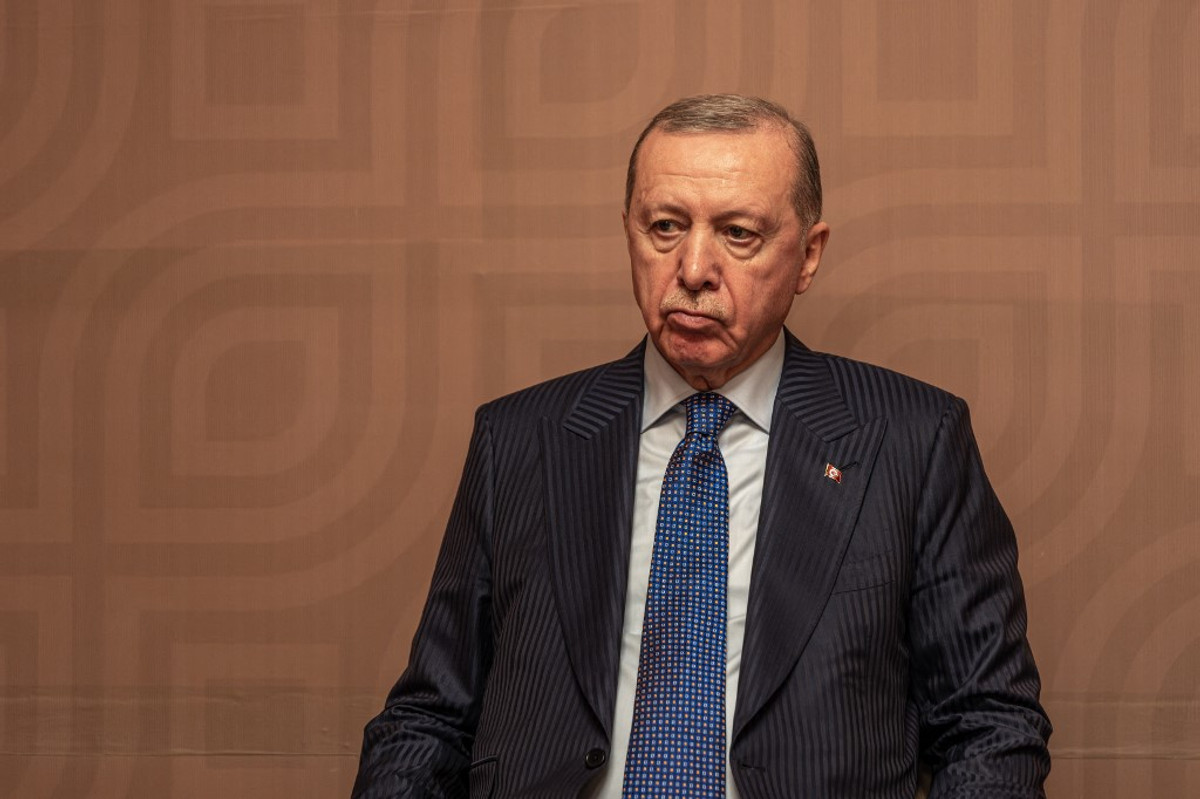
Turkish President Recep Tayyip Erdogan has called for the abolition of the UN Security Council’s veto power and an end to permanent membership, arguing that the body’s structure no longer reflects the realities of the modern world.
“The tragedies of recent years, including pandemics, energy crises, disruptions to supply chains and regional conflicts, have demonstrated that leaving the resolution of global crises to the will of a handful of capitals is no longer compatible with the realities of today’s world,” Erdogan wrote in an opinion piece published by Bloomberg ahead of the UN General Assembly’s annual session in New York.
JOIN US ON TELEGRAM
Follow our coverage of the war on the @Kyivpost_official.
“The adaptation of global decision-making mechanisms to today’s circumstances can no longer be postponed.”
The Security Council has five permanent members – China, France, Russia, the United Kingdom and the United States – all of which have veto power.
The arrangement was established in the UN Charter in 1945, when the five countries, then including the Soviet Union rather than Russia, were given permanent seats because of their central roles in establishing the UN and maintaining international peace and security.
Russia later took over the Soviet Union’s seat.
The council also has 10 non-permanent members elected by the General Assembly for two-year terms. A substantive resolution requires at least nine votes and cannot pass if one of the permanent members votes against it.
Other Topics of Interest
Ukraine, Russia, Hard to Reconcile on Black Sea, Turkish Minister Says
Turkey is seeking to mediate between Russia and Ukraine to stop the targeting of shipping in the Black Sea.
Erdogan said simply adding new permanent members would not address the concentration of power.
“Adding new privileged members to the Security Council would not resolve the problem of decision-making power being concentrated in the hands of a few states; rather, it would expand the scope of the privileged structure,” he wrote.
Instead, he proposed abolishing permanent membership altogether. Under his model, all Security Council members would be elected by the General Assembly on a rotating basis for fixed terms, with countries seeking another term required to win majority support again.
“The powers of the General Assembly should be strengthened, and the representativeness of the Security Council and its accountability to the General Assembly should be enhanced,” Erdogan wrote.
He framed the proposal as an extension of his long-standing slogan: “The world is bigger than five.”
“We must harness the experience, capacity and aspirations of different regions in efforts to address global and regional challenges,” Erdogan wrote. “In this respect, our call that ‘The world is bigger than five’ is a call for a broader understanding of responsibility.”
Reform has been discussed for years
The push for reform is not new, and the General Assembly has been discussing changes to the Security Council for years.
In September 2024, UN member states adopted the Pact for the Future, committing to reform the Security Council and make it “more representative, inclusive, transparent, efficient, effective, democratic and accountable.”
The agreement identified the underrepresentation of Africa as a priority and called for continued negotiations on the council’s membership and the future of the veto.
The General Assembly has continued intergovernmental negotiations on reform, but the council’s basic structure has not changed.
The reform process remains focused on questions including how many members the council should have, which regions should receive greater representation and whether the veto should be limited or otherwise changed.
How the veto can block the UN
The veto gives each of the five permanent members the ability to block a substantive Security Council resolution even if the measure has broad support among the other members.
Russia demonstrated that power in March 2024, when it vetoed a resolution that would have extended the mandate of a UN panel monitoring North Korea’s nuclear and ballistic missile programs, with Moscow and Pyongyang having fostered closer defense ties since Russia’s 2022 invasion of Ukraine.
The other Security Council members did not block the measure, but Russia’s veto was sufficient to prevent its adoption.
The mechanism has also been central to the Security Council’s response to major international conflicts, including Russia’s full-scale war against Ukraine, where Moscow’s status as a permanent member has prevented the council from adopting resolutions opposed by Russia.
Erdogan argues that such a system allows a small number of capitals to determine whether the UN can act on major international crises.
“We cannot build the international order of the future by preserving the hierarchies of the past,” he wrote.
“The developments of the last quarter century – a relatively brief period in world history – have demonstrated that no balance of power and no international order are permanent.”
Ankara says it will support efforts to abolish the veto, strengthen the role of elected Security Council members and give the General Assembly greater weight in international decision-making.
“Such a change requires international will on a broad scale,” Erdogan wrote.