
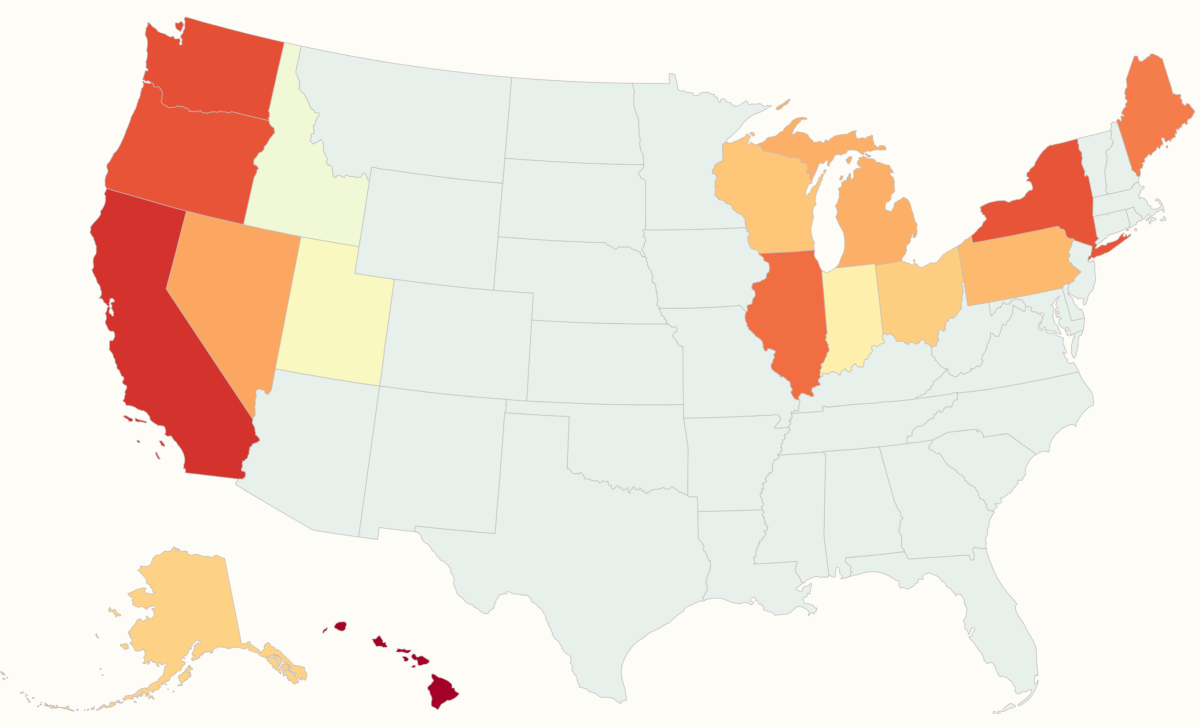
Diesel has risen to a record $6.50 amid ongoing supply constraints from the Iran war and other global pressures, exposing a significant political vulnerability for the Republican Party only weeks out from the midterms.
According to AAA data, diesel has risen to another all-time high of $6.53 as of Tuesday morning, up from $3.69 a year ago and a similar level in the days leading up to the U.S.-Israeli strikes on February 28.
With warnings from consumers and businesses about the impact of record diesel—which has reached as high as $8.44 in California—polls have shown declining faith in President Donald Trump’s stewardship of the economy, while GOP lawmakers have urged him to act quickly to avoid any further fallout.
Read More on Politics
Trump has blamed rising diesel on the Russia-Ukraine war, argued that expensive fuel is a small price to pay for a non-nuclear Iran, and that prices will fall rapidly once the conflict ends, while also boasting about his record on fuel affordability when compared to his predecessor, Joe Biden.

“President Trump has been clear and consistent for decades: Iran can never have a nuclear weapon. President Trump remains committed to unleashing American energy dominance, cutting costs, and putting more money back in the pockets of hardworking American families,” White House Spokeswoman Taylor Rogers told Newsweek on Tuesday, in response to recent polling on the president’s economic approval.
Which States Have $6.50 Diesel?
As of Tuesday morning, 16 states as well as the nation’s capital have seen diesel prices climb to over $6.50.
California ($8.4387)Washington ($7.4632)Hawaii ($7.1360)Indiana ($6.9138)Michigan ($6.8813)Oregon ($6.8720)Nevada ($6.8433)Illinois ($6.8276)Ohio ($6.8174)Alaska ($6.6627)Wisconsin ($6.6189)Pennsylvania ($6.6098)Idaho ($6.5902)Utah ($6.5642)Maine ($6.5159)District of Columbia ($6.5063)New York ($6.5038)
However, diesel remains significantly elevated across the rest of the country when compared to only a few months ago. Texas boasts the lowest per-gallon average in the nation at $5.97, though this is still more than $2 costlier than the nationwide average paid by drivers in the days before the Iran war began.
How Is Trump’s Approval Faring Amid Record-High Diesel?
Using the rolling, state-by-state tracker from the polling firm Civiqs, Newsweek mapped how Trump’s presidential job approval stands in states that are battling the highest diesel prices. Civiqs’s polling shows that, in many of those with $6.50 diesel, Trump’s approval has dipped even lower than the negative 28 percent net rating he enjoyed as of September 21.
Inflation and rising costs for gas and diesel have long been shown to have a significant impact on voter preferences, with the recent increases emerging as a key political vulnerability for the GOP only weeks out from the midterms.
A Reuters/Ipsos poll from April revealed that 77 percent of voters blamed the president for rising fuel costs to some extent, with 58 percent saying they would be less likely to support a midterm candidate who supported his approach to the Iran war.
More recently, a Data for Progress survey—conducted September 11 to 14 among 1,214 likely voters—found that 61 percent believe the Republican Party shoulders more of the blame for rising gas prices, compared to only 31 percent for Democrats.
This 30-point margin widened to 37 points among Independents, and 52 percent of voters said they would trust Democrats over Republicans to lower costs, versus 41 percent who chose their opponents.
The Economic Toll of Record-High Diesel
As well as political ramifications, record diesel has begun to tear through the economy, with Bank of America warning that diesel, rather than gasoline, is the “key real-economy pressure point” given its importance to sectors like logistics, construction and agriculture.
Since diesel surpassed its all-time high in early September, the agricultural sector in particular has been warning about the potential fallout.
John Boyd, founder and president of the National Black Farmers Association, told Newsweek last week that “struggling farmers” were “losing our profit margin and going out of business” as they attempt to fuel equipment during the height of crop-harvesting season.
The Department of Agriculture told Newsweek in response that Trump “recognizes that diesel powers American agriculture and this administration is not leaving any stone unturned to resolve this temporary challenge.”
And experts expect the issue to last at least until there is a resolution in the Iran war, though they note that other factors are weighing on global supply ahead of the winter heating season.
Bob Yawger, an energy futures strategist at Mizuho Financial Group, told Newsweek that blame lies with “problems exporting Middle East diesel because of damaged refineries and trouble transiting the Strait of Hormuz,” but also with Ukrainian drone attacks on Russian energy facilities.
“There will be a big peace push in the next few days,” Yawger said of the former, “but when that does not work out, there is a chance that diesel prices in particular will rally to new all-time highs.”
Tom Kloza, chief oil analyst at Gulf Oil, noted the new disruption to Red Sea flows, and told Newsweek that record prices for diesel, as well as jet fuel and heating oil, “are going to stick around for a while and could even be topped if there is more violence.”
Trump Weighs Diesel Export Ban Amid Price Surge
As diesel prices climbed above $6 per gallon, President Trump said Tuesday that his administration is examining whether restrictions on U.S. diesel exports could help boost domestic supply and ease costs for consumers.
“I’ve called for that too. I’ve said, let’s not send out the diesel,” Trump said, alongside Ukrainian President Volodomyr Zelensky, in response to a reporter’s question at the U.N. General Assembly. “I’ve called for it within my people. I’ve been talking about it.”
The proposal has drawn support from some lawmakers, including Republican Senators Dan Sullivan of Alaska, Chuck Grassley of Iowa and Mike Rogers of Michigan, who argue that keeping more diesel in the United States could help relieve price pressures as the Iran war continues to disrupt global energy markets. Treasury Secretary Scott Bessent said the administration is reviewing whether a full or partial export ban is feasible and could help curb inflation.
At the same time, industry groups and fuel analysts have questioned whether such a move would lower prices over the long term. Mike Sommers, president and CEO of the American Petroleum Institute, said an export ban “would only compound the problem,” arguing that increasing supply and maintaining market flexibility would be a more effective response.
Patrick De Haan, head of petroleum analysis at GasBuddy, said on X that the United States remains a net exporter of diesel and other distillate fuels, producing roughly 5.3 million barrels per day compared with domestic demand of about 3.6 million barrels. In his view, the recent price surge is being driven primarily by global supply disruptions rather than a shortage of diesel within the United States.
Contact Newsweek editors on this story: Daniel Orton and James Debens
The Associated Press contributed to this article.