

Listen to this article
Estimated 4 minutes
The audio version of this article is generated by AI-based technology. Mispronunciations can occur. We are working with our partners to continually review and improve the results.
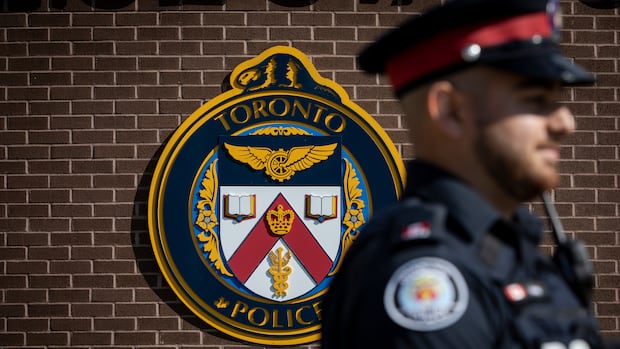
Toronto police are examining a policy requiring their officers to wear name tags over concerns of police officer safety and privacy, while some experts say the tags help ensure accountability.
In March, the RCMP updated its name tag policy to give officers the option of displaying their regimental number instead of their names, according to RCMP media relations director Jessica Kingsbury. The change was first reported earlier this month by the Globe and Mail, who cited a briefing note obtained through access to information legislation.
The change was made to “enhance member safety by reducing the exposure of personal identifying information in an increasingly digital environment, while maintaining accountability through a unique identifier,” Kingsbury said in an email to CBC Toronto.
“This change does not impact the RCMP’s ability to identify members or hold them accountable for their actions,” she said.
Asked if Toronto police are considering a similar change, spokesperson Stephanie Sayer said the force is examining its policy in light of similar safety concerns.
“We recognize the increasing concerns around the online identification and targeting of police officers, including the potential impact on members and their families,” Sayer said in an email to CBC Toronto. “Officer safety and privacy are important considerations.”
No such policy changes have been introduced to the Toronto Police Service Board, which has the final say in approving them, according to Bridget Cherry, senior advisor of the board.
“Should a proposed change come before the Board, it would be considered through the Board’s public process,” said Cherry in an email to CBC Toronto. “Including publication on a public meeting agenda and an opportunity for members of the community to make deputations.”
In emails to CBC Toronto, Halton, York and Peel’s police forces all wrote that they have no plans to reconsider their respective policies that require officers to wear name tags. CBC Toronto has reached out to Durham police.
Removing name tags would be ‘significant retreat’: expert
Toronto police officers have been required to don name tags as part of their uniforms since 2006, when the move incited strong backlash from the Toronto police union.
The Toronto Police Association had expressed concerns that name tags put officers and their information at risk, but the board said then that using name tags humanize the officers and hold them accountable for their actions.
Following the decision, Toronto police officers faced widespread public criticism in 2010 for removing their name tags while responding to the protests against the G20 summit of world leaders in Toronto.
The weekend of the G20 summit resulted in over 1,100 arrests in the largest mass arrests in Canadian history, according to the Office of the Independent Police Review Director, while a total of 90 TPS officers were found to have removed their name tags during the protests.
“There were incredible difficulties in identifying those police officers, and those incidents largely went under-investigated as a consequence,” University of Toronto criminology professor Patrick Watson told CBC Radio’s Metro Morning on Tuesday.
“We saw at that point reaffirmation of the TPS board that it would be treated as extremely serious if police officers were not presenting their names and their identification numbers to members of the public,” Watson said.
Murray Klippenstein, one of the two Toronto lawyers that led the decade-long class-action lawsuit of about 1,100 people arrested during the summit, said that removing name tags from uniforms would be a “significant retreat.”
“Officer uniform name tags are an open signal to members of the public,” he said to CBC Toronto this week. “A kind of quiet and constant everyday reassurance that there is accountability and a commitment to answerability.”
Klippenstein added that a name tag humanizes “both sides of the equation.”
“The public knows that the person they’re dealing with is a real person,” he said. “And police officers wearing name tags are reminded that they too are real people.”
“On both sides of the equation, there’s an incentive towards a little bit of humanity when there’s a name tag.”