
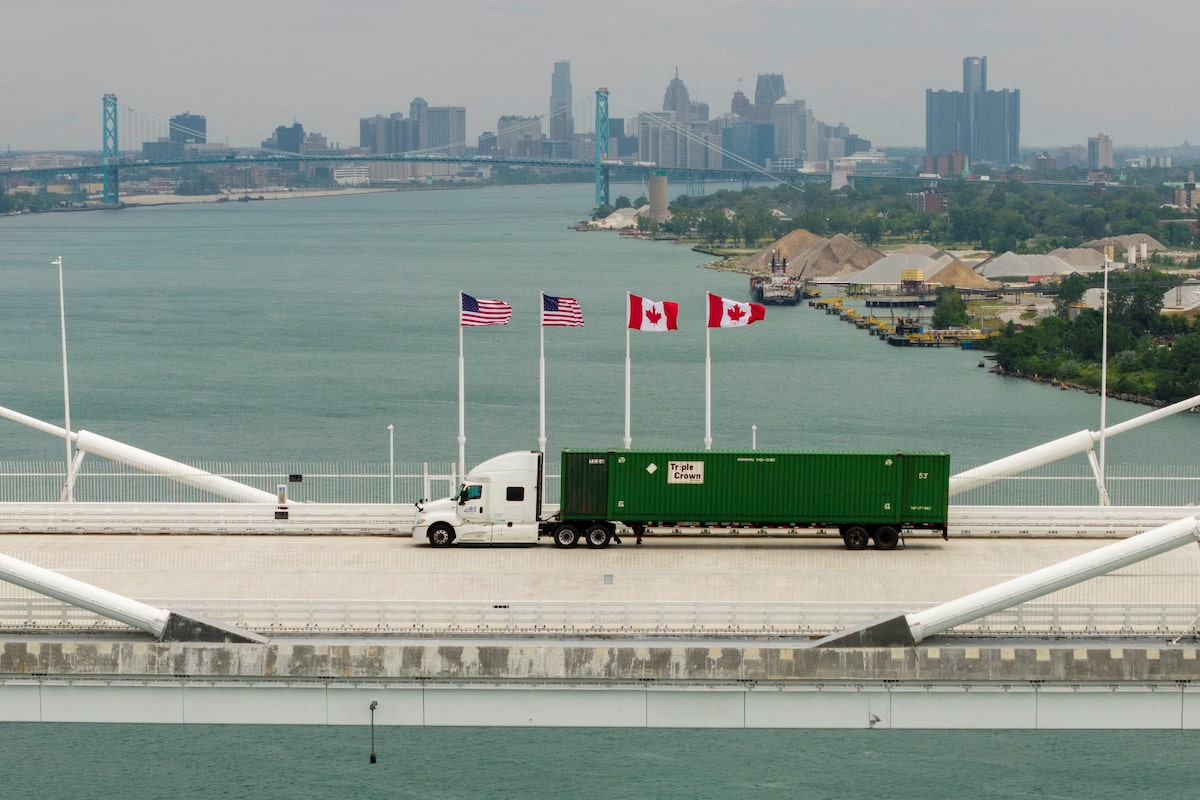
The Gordie Howe International Bridge, connecting Windsor and Detroit.Carlos Osorio/Reuters
Back in the day, multilateral trade negotiations resembled grandmaster chess tournaments: intense, yet everyone played by the same rules. But negotiating with the U.S. under President Donald Trump has demanded a totally different gaming analogy. Noah Fry, a Dalhousie University political scientist who studies the intersection of game theory and trade negotiation strategy, offers a legibly Canadian one to describe the first CUSMA negotiations with Trump in 2018—and perhaps, as of this past August, its successor.
Our side, he says, employed a hockey tactic dubbed “the trap” used by some NHL coaches in the early 2000s: tying up a powerful opponent in the neutral zone so they can’t get close enough to score. Canada dispatched a coalition of emissaries of all political stripes, and across sectors, to persuade U.S. leaders and industry groups that Trump 1.0’s tariff obsession was self-defeating.
“They lobbied American public officials, co-ordinated with American interests, tariffed sectors with geographic political significance and delayed the negotiations,” Fry wrote in a paper entitled “Playing the Trap,” published in the April 2026 Canadian Foreign Policy Journal. “Arguably, all of this led to the updated CUSMA, which looked considerably different from what the administration had envisioned when triggering the negotiations.”
On the front lines of trade war, cities begin to reckon with its financial toll
What lessons do Fry’s and others’ trade negotiations research reveal about dealing with an aggressively tariff-happy Trump 2.0—an encounter reminiscent of the anything-goes pummelling of Aussie-rules rugby with a surreal end-game? After all, the match-up that ended so dramatically in August saw an international bridge held hostage and uncontrolled wildfires recast as provocations. Accounts of the calamitous 11th-hour bargaining sessions suggested virtually everything in our fraught relationship was on the table. And what to make of a team willing to score own-goals in their quixotic pursuit of dominance?
In international trade, there’s a small library of scholarly literature on negotiating strategy, which has its roots in game theory, which, in turn, has as its origin story the “prisoner’s dilemma.” The problem, which explores the calculus of co-operation, involves two prisoners being interrogated separately by police. Both can stay silent or rat out the other. The reward for the informant is going free, while the other serves three years. If both stay silent, they each get one year. If both betray one another, both get two years.
Now, say the first one sings. What should the second one do? The answer offers a glimpse into the way trade negotiators reason: They tally up the best possible outcomes over many scenarios. A deal is struck when one side’s best outcome happens to be the other side’s best outcome.
Then there’s the “two-level game,” coined by Harvard political scientist Robert Putnam, which is like the prisoner’s dilemma squared, involving both external and internal players, whose dynamic interests must be simultaneously gamed out. “The two-level game is helpful for understanding, or at least beginning to theorize, the negotiations that we’re faced with,” Fry says. “There’s also the issue of asymmetry, and that certainly describes Canada’s place relative to the U.S.”
From his research, Fry concluded that the Liberals’ decision to build a Team Canada mission in 2018 was partially about mitigating the risk of infighting among Canadian stakeholders. The Carney government clearly pursued a similar strategy this time around. But dispatching emissaries was also about “restructuring the game,” another Putnam tactic that involves, as he wrote in a seminal 1988 paper, altering “one another’s perceptions of the costs of no-agreement and the benefits of proposed agreements.”
Opinion: Ohio is a microcosm of growing American angst over Trump’s trade war with Canada
There are a wide range of other tactics described in the literature, especially in research on lopsided negotiations. One of the best known is BATNA—the best alternative to a negotiated agreement. Governments in difficult trade talks seek out such alternatives, says John Odell, professor emeritus of international relations at the University of Southern California—in effect, working other economic or diplomatic fronts to dull the pain of a loss at the negotiating table.
Carney’s high-visibility international trade missions, as well as our defence procurements in Europe, signalled that Canadian negotiators weren’t fixated on CUSMA 2.0. “Improving one’s alternative to agreement away from the table is one of the most fundamental ways one can strengthen bargaining position,” Odell says. “That’s what Canada has been doing in trying to rally middle powers, to develop alternatives to trade with the U.S.”
At the bargaining table, however, the game is all about horse-trading: across the wide array of trade variables, from quotas and tariffs to sectoral side-deals and regulation. What makes Trump so difficult to bargain with is that he’s willing to violate agreements while issuing transactional demands in domains that have nothing to do with trade, such as the drug trafficking allegations against Canada he used to justify the first round of tariffs.
“Trump claims he does this deliberately—that it’s a strategy to claim value more effectively from everybody else, stronger or weaker,” says Odell. “Maybe it is deliberate. But my guess is that he’s not capable of negotiating any other way.”
Heading in to the August showdown, Team Carney seemed more strategic than Team Trump. Our side used tactical delays to frustrate the Americans, for example refusing, unlike other countries, to be drawn into serious talks for over a year—until Trump threatened 50% tariffs. Still, some observers have noted missteps. Veteran trade lawyer Barry Appleton, for example, argued that Canada failed to collect on concessions we’ve made, such as scrapping the digital services tax.
“There’s no question that one of the first rules in negotiating is not to agree to anything until you’ve agreed on everything,” says Mark McQueen, a Bay Street financier who worked in Brian Mulroney’s office during the first NAFTA talks. “It’s a hallmark of successful business people.”
Of course, trade negotiators don’t consult academic papers to figure out how to execute their moves, as Ontario Chamber of Commerce CEO Daniel Tisch, a former foreign affairs official and consultant, points out. Historically, Canada fared better in trade fora when all the players played by the same rules. “We struggle more when our rivals play the power game, and one reason we struggle is this attachment to rules-based multilateralism,” he says. “The other is the complexities of our federal governance structure.” But, Tisch adds, Canada has become adroit at “leveraging external stakeholders,” which is another way of talking about Putnam’s two-level game.
Going into the negotiations this past summer, some wondered if Canada could use the Team Canada trap again, given that we’ve been crowing about that play ever since former deputy prime minister Chrystia Freeland and former U.S. trade representative Robert Lighthizer signed CUSMA.
“I think it’s a repeatable move,” Fry mused. “The way in which you do it varies. It’s not always going to be lobbying governors and congressmen. In fact, it doesn’t appear like that’s very effective right now. Trump has a very firm grasp on the Republican party that he didn’t have in the first negotiations, so it’s not entirely clear that advocacy is going to make a huge difference.”
Indirect tactics—executed away from the table, as Odell puts it—may have been more effective in getting us to no. Case in point: the $70-billion renewable energy deal between Quebec, Newfoundland and Ottawa, which Carney framed as “the largest clean energy investment in North American history.”
In any event, this particular cage match has ended dramatically and inconclusively. As Fry observes (and the prime minister confirmed), “I’m not clear that there is such a thing as an agreement with the Trump administration anyway.”