
What is the biggest election issue for Arab citizens of Israel? An end to violent crime on their streets, they say—not, in other words, the future of Palestine.
Seventy-four percent of respondents said violence and crime was their biggest concern, while 7.6 percent noted the importance of resolving the Israel-Palestine crisis, according to a recent survey conducted on behalf of the Konrad Adenauer Program for Jewish-Arab Cooperation at the Moshe Dayan Center in Tel Aviv.
That does not mean they have abandoned the Palestinian cause, but they are instead making pragmatic decisions and no longer tying their daily well-being to a resolution that appears improbable in the current atmosphere in Israel. A majority of Israeli Jews oppose a two-state solution in the aftermath of Hamas’s attack on Oct. 7, 2023.
The more urgent needs of Israel’s Arab citizens—a fifth of the total population—are better policing, better education, and more housing.
“You cannot solve all problems at once,” said Arik Rudnitzky, the author of the survey and a researcher at the Israel Democracy Institute, in reference to attitudes among Arab citizens of the country. “The question is how long can Arab citizens wait for this external conflict to be resolved before focusing on how best to meet their daily needs.”
Arab citizens of Israel want to play a larger role in Israeli politics, seeking not mere representation in the Knesset but a seat at the table in the new government. An overwhelming 77 percent support the inclusion of an Arab party in the next government’s coalition.
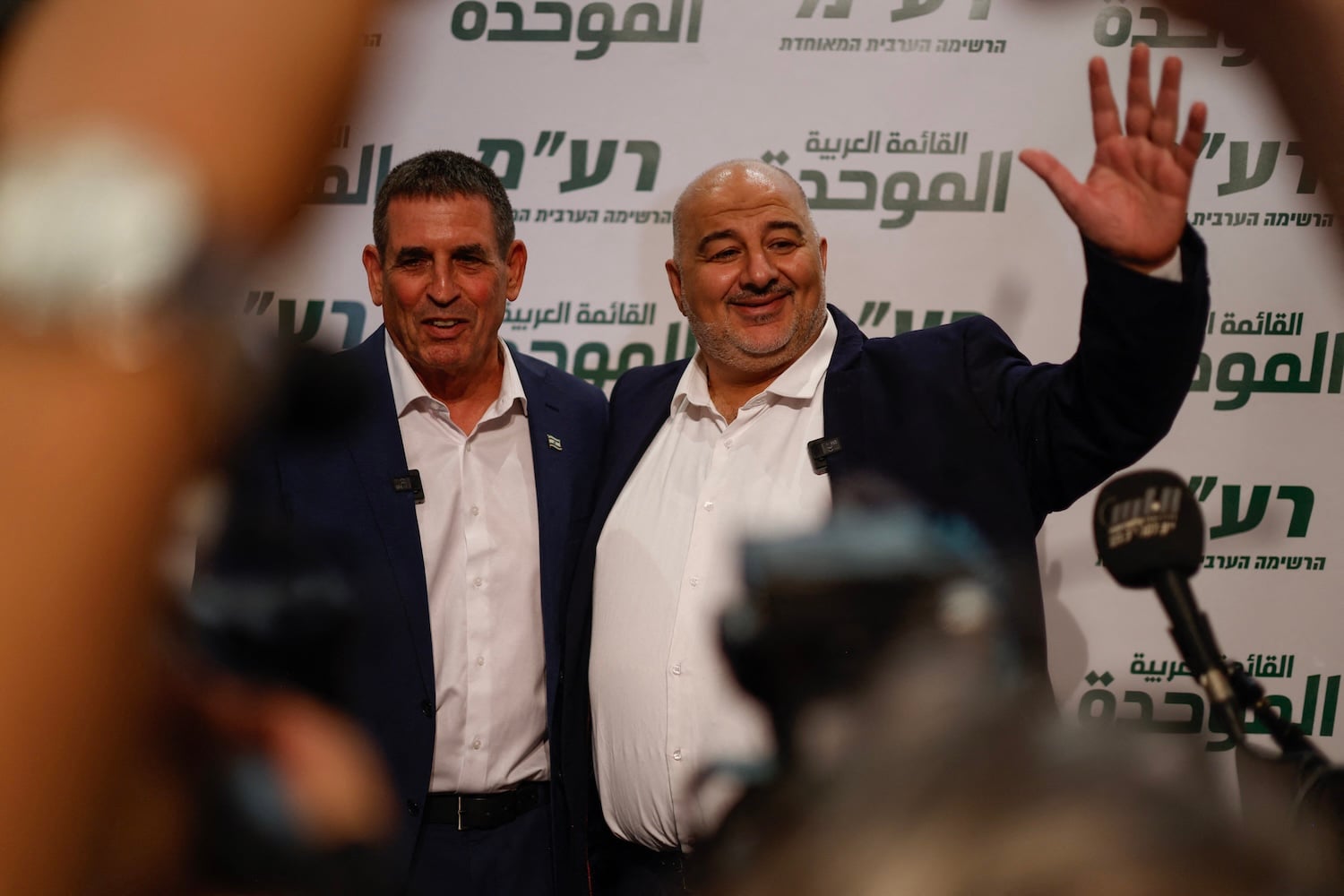
Mansour Abbas, the leader of Ra’am—the most conservative Arab party in Israel—has presented his political group as a potential coalition partner to whomever is prepared to tame criminals and offer more to Israel’s Arab citizens.
But, at a time when mistrust between Arabs and Jews runs especially deep, whether Arab Israelis will be allowed to take part in governing the country may be a decisive test of Israeli democracy.
Israel’s Central Elections Committee voted Wednesday to disqualify both Mansour Abbas’ United Arab List party and the Joint List— an alliance of Israel’s other three Arab parties—from running, including because of their alleged rejection of Israel as a Jewish state, which they deny. The committee’s largely political composition, made up mostly of members of PM Netanyahu’s coalition, was expected to approve disqualification requests against the Arab parties while rejecting requests against right-wing parties. As was the case in previous elections, these decisions will likely be reversed by Israel’s Supreme Court prior to the election.
In the meantime, the Arab parties are continuing to focus on the more prosaic concerns that their voters are concerned about. “The organizations that collect protection money from an Arab grocery-store owner also collect it from a Jewish garage owner,” Abbas said recently. “This is not the Arabs’ problem. This is the country’s problem.”
Abbas is right. Criminals don’t discriminate on the basis of religion or ideology. But Arab citizens of Israel inhabit a more dangerous world with a much higher crime rate. “Over the past 20 years, nearly 2,000 citizens have been murdered as part of the phenomenon of crime and violence within Arab society,” Abbas said in January. According to the Knesset’s National Security Committee, 241 Arabs were murdered last year compared to 47 Jews.
Palestinian Israelis also endure systemic hurdles in securing legal building permits and live in more cramped neighborhoods compared to their Jewish counterparts. Tens of thousands—especially those in Bedouin communities—live in “unrecognized villages.”
An OECD survey last year documented that many Arab schools were underresourced, which impaired “pupils’ employment, productivity, and wage prospects,” and it recommended equalizing “funding for Arab schools with other schools presenting similar socio-economic characteristics.”
Ra’am wants to change that dynamic by securing a place in the government—the country’s most powerful institution—encouraging the allocation of more resources for the Arab community and integrating Arab Israelis deeper into Israeli politics as partners in state-building.
But none of the Jewish mainstream parties have jumped at the offer. Instead, they are reluctant to join hands with an Arab party, at least until election results are out late next month and they absolutely need Ra’am, which is projected to win four to five seats.
“There are parties that are afraid of partnership. They are afraid of what people will say, afraid of what they will lose. Ra’am is not afraid of partnership. Ra’am advances it,” Abbas said.
Born inside Israel in the early 1970s, Abbas studied dentistry at the Hebrew University in Jerusalem and became involved in the southern branch of the Islamic movement that opted for electoral politics. Yet Arab citizens of Israel have had to juggle two distinct parts of their identity that are not always compatible, especially given the ongoing tensions between Israel’s security agencies and Hamas and Israel’s often disproportionate use of force. Abbas grew up in a milieu where national belonging was a difficult question. (Israeli Arabs are mostly descendants of Palestinians who remained within the territory that came under Israeli control after the 1948 war and subsequently acquired Israeli citizenship but have continued to back Palestinian demands for self-determination.)
Abbas focused on better amenities for fellow Arabs, such as more university accommodation for Arab students, from early days in student politics. Even though the far right in Israel has linked Abbas to the Muslim Brotherhood, casting doubt over his loyalty to the state, he is seen as someone who prioritizes a general improvement in the lives of Israel’s Arab citizens—especially when juxtaposed with the radical, militant path adopted by Hamas, which the United States and the European Union have listed as a terrorist outfit.
Abbas’s Ra’am was part of the Joint List alongside other Arab parties—Hadash, Ta’al, and Balad—but carved an independent path in 2021 and joined the Yair Lapid and Naftali Bennett-led coalition, which ousted Benjamin Netanyahu from office in 2021.
The government lasted only 18 months. But it gave Abbas a taste of power and perhaps showed him the futility of staying on the fringe. This October, as Israelis cast their ballots, his party might once again prove instrumental. Neither opposition camp is expected to gather the required 61 seats.
Abbas has distanced himself from Hamas—not quite calling it a terrorist outfit but accusing it of committing crimes on Oct. 7. He has recognized Israel as a Jewish state—not quite welcoming Zionist ideology but expressing loyalty to the state nonetheless.
To sweeten the deal and win the trust of hesitant compatriots, he has invited Yoav Segalovitz, a former top cop and deputy security minister, to be the second name on Ra’am’s electoral list.
“They will say to me, ‘What does an Arab need with a Jewish police major general?’ And they will say to him, ‘What is a Jewish police major general looking for with the Arabs?’” Abbas said. “My answer is simple. I am not looking for someone who is like me. I am looking for someone who knows how to do the job.”
Segalovitz led a special unit called Lahav 433 that investigated organized crime and slashed homicides by 16 percent and shootings by 30 percent in the Arab community. But crime spiked once again under the charge of far-right politician Itamar Ben-Gvir as security minister, and a record number of Arab killings were recorded.
Segalovitz intends to pick up where he left off and rejoin the government. He has called for community service as the panacea to the rise in crime. In an interview with the Times of Israel, he said, “As for crime among young people, two years of civilian service are among the things that are supposed to provide an answer to this.” Abbas has backed the idea to make up for the exemption from military service that Palestinian citizens of Israel enjoy.
Rudnitzky added that the program “would cover things like volunteering in hospitals, local councils, helping elderly people—a sort of community service for one or two years.” It is expected to build a sense of belonging among Muslim Arab citizens and soothe Jewish counterparts who allege that they don’t serve the country.
Ra’am’s immediate focus is to lower the crime rate and improve the lives of Arab Israelis. But much more is at stake for the country. Abbas and Segalovitz are ushering in a new kind of politics, one in which the security and well-being of all Israeli citizens come before religious affiliation or ideological allegiances. Their alliance places the human at the center of policy and could prove to be a model for improving Israeli-Palestinian relations—especially since Israelis emphasize the need for warm peace through enhanced economic cooperation. A place for Palestinian Israelis at the very top of decision-making could potentially soften Israel’s Arab neighbors to future normalization deals.
Instead of viewing them as fifth columnists, Israeli parties must see a coalition with Ra’am as a chance to demonstrate their commitment to democracy.
Gadi Eisenkot, the leader of Yaashav and former chief of army staff, is believed to be the toughest challenger to Netanyahu. He hasn’t quite shut the door on including Ra’am in a coalition, conditioning any alliance upon recognition of Israel as a Jewish and democratic country. Abbas and Segalovitz have made sure to meet that threshold.
A preelection alliance is unlikely, but such a gesture could send a message of communal unity that the country desperately needs. Increasingly, this election seems like it will be a test that determines the strength of Israel’s democracy.