
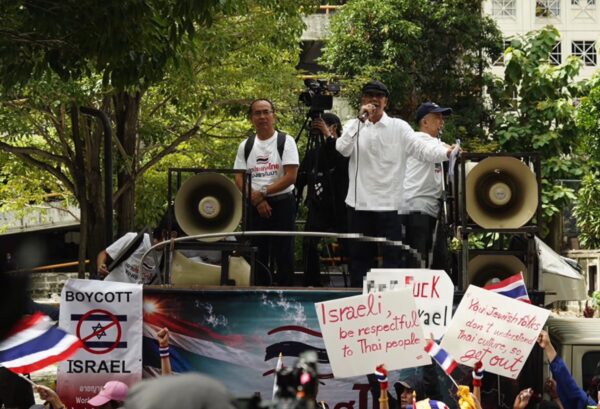
For three years, small-scale pro-Palestine protests, centered around Israel’s human rights abuses in Gaza, have become common in Thailand. A few dozen left-wing activists would turn out to chant slogans more commonly associated with the massive street demonstrations in the West, to little interest from the general public or international media.
But on September 10, something changed.
A few hundred protesters showed up at the Israeli embassy in Bangkok, with another 500 at the Chabad House in Phuket. These protests featured some explicitly anti-Semitic signs, like “Jews out,” and the protest in Phuket forced the cancellation of a small, private gathering for the Jewish New Year, due to security concerns.
“We are monitoring the situation surrounding the Jewish New Year event in the Patong area. These Jews are staying inside their mansions,” one protest organizer was quoted as saying by local media outlet Bangkok Post. The Chabad House did not respond to The Diplomat’s request for comment.
Left-wing activist groups said that these protests don’t represent them. Rather, the pro-Palestine cause has been hijacked by xenophobic far-right groups that also regularly target vulnerable migrant workers from neighboring countries.
The previous left-wing protesters had largely focused on Israel’s well-documented atrocity crimes against Palestinian civilians.
A Hamas-led attack on October 7, 2023 left over 1,000 people dead in Israel, including 39 Thai migrant workers. Israel responded with a massive air and ground assault on the besieged Gaza strip, killing over 70,000 people, including over 20,000 under the age of 18. The International Criminal Court has issued arrest warrants for crimes against humanity for Israeli Prime Minister Benjamin Netanyahu and then-Defense Minister Yoav Gallant.
“At that time, the Israeli military began carrying out increasingly severe measures that went far beyond what could reasonably be described as mere ‘retaliation,’ as the Israeli government claimed. We saw these actions as part of a deliberate process of colonization,” said Nai, a protester who first became active in the pro-Palestine movement in late 2023, as a 19-year-old university student.
The Boycott, Divest, Sanctions (BDS) Movement in Thailand calls for the Thai government to stop sending Thai migrant workers to Israel, screen Israeli tourists and arrest those suspected of war crimes, end all arms trade and military agreements with Israel, and ultimately sanction Israel and sever diplomatic relations.
“BDS Thailand abides by the same values as the international BDS movement: freedom, justice, and equality. Thus, we oppose the bigoted, anti-Semitic, racist/xenophobic, and nationalist rhetoric that such right-wing opportunists espouse. BDS Thailand is NOT affiliated with and does NOT approve of right-wing demonstrations or their signage,” added the BDS Movement’s Thailand chapter.
The right-wing protesters have focused more on domestic issues, accusing Israel of trying to seize Thai territory, and Israeli tourists of misbehaving or disrespecting Thai people, allegations that have little empirical evidence to support them.
The land seizure allegation is rooted in an extremely common business practice in Thailand. Foreigners are prohibited from owning land, but many skirt this law by buying property through a company started with a Thai frontman – known locally as a “nominee.” This is done both to purchase private residences and launch small businesses, or at times for more large-scale real estate developments.
The government is cracking down on this practice, and some Israeli companies have been targeted. But Israelis are far from unique in this, and are unlikely to rank among the highest offenders.
The Ministry of Commerce released data on land owned by businesses with foreign investors, finding Chinese nationals held by far the most land, at around 35,000 acres, more than double the next nationality – Japanese. The United Kingdom, Singapore, and Hong Kong rounded out the top five, while the ministry said 147 nationalities own shares in companies that own land in Thailand.
(Not all of these companies would be illegal. The legitimacy of a business can be very hard to determine, because the main factor is whether the Thai business partner is a legitimate partner or just a frontman. The government says it is in the midst of a close review of suspicious businesses).
Accusations of Israelis misbehaving or disrespecting locals are harder to quantify. To be sure, there have been some viral incidents on social media, such as a young Israeli woman arrogantly claiming that “my money builds your country.” In another shocking episode, four Israeli men caused property damage and allegedly threatened staff at a hospital where a friend was receiving treatment following a motorbike accident.
Still, the vast majority of the 400,000 Israeli tourists who visited Thailand last year came and went without incident. Out of context social media clips hardly prove a statistical trend, but they have contributed to rising xenophobic sentiment the world over. Thai media outlets have seemingly realized that articles about Israelis generate high engagement, providing a steady churn of social media posts about even minor disputes or arrests.
An Australian national’s recent murder of a 17-year-old sex worker, meanwhile, did not provoke protests outside the Australian embassy. A massive influx of Russians to Phuket since the invasion of Ukraine has similarly not sparked protests, despite a rise in organized crime, including multiple high-profile incidents of kidnapping, extortion, and murder.
The anti-Israeli protests can be contextualized as part of a broader, growing anti-foreigner sentiment, that has targeted both unruly Westerners and vulnerable migrant workers.
When a group of Italian students insulted a Thai woman on a train in Bangkok, for example, a mob of protesters descended on their hotel, while the Italian embassy was flooded with angry comments on social media, though faced no in-person demonstrations.
The protester Nai said focusing on personal dislike of Israelis is a distraction from the issue at hand.
“From my perspective, although nationalist and right-wing groups have succeeded in turning opposition to Israel into a national-level issue and have brought some sections of the pro-Palestine movement into their demonstrations, this does not necessarily make the Palestinian cause itself a central political issue,” he said.
“If this movement were eventually to lead to a boycott of Israel, for example, the message communicated to both the international community and Thai society could simply become that ‘Israelis are bad,’ which is essentially a form of generalized racial prejudice,” he added. “What would be missing is the argument that a boycott of Israel should serve as a political statement to the international community: that Israel, which we see as a fascistic colonial state responsible for genocide, should face international pressure and consequences until genuine justice is achieved.”
Amid a floundering economy, others have directed this same xenophobic anger towards vulnerable migrant workers. Some 900,000 Cambodians were pressured to leave the country following border clashes last year, which also helped sweep the conservative, pro-military Bhumjaithai party to power at a general election earlier this year. With the Cambodians gone, migrants from Myanmar seem to be the next target, having sought refuge in Thailand by the millions amid a massive civil war back home.
Royalist activist Akkarawut Kraisrisombat, who organized the Chabad protest in Phuket, previously launched a 2024 campaign to deport pregnant migrant workers, though this failed to gain parliamentary support. He has since started a vigilante group called “Thais Won’t Tolerate” mainly focused on monitoring and reporting suspected illegal migrants, and has accompanied police on immigration raids.
Influencer Siranudh “Psi” Scott was present at the more recent, nationalist anti-Israel protests in Bangkok. He previously made waves when he accused foreign migrant workers who are unable to speak Thai of “taking advantage of our home.” In a social media post, he said if he goes to a restaurant and the staff speak to him in English, he will only speak Thai and request a new server. Many Burmese migrant workers in particular work in the service industry in Bangkok, and are often more proficient in English than Thai.
The Bangkok protest was led by Sondhi Limthongkul, an infamous conservative firebrand. Sondhi played a key role in destabilizing successive, democratically elected governments in 2006 and 2008, accusing them of undermining the monarchy, among other alleged malpractice. In 2008, Sondhi’s followers created a political crisis by occupying government buildings and an airport, giving an opening for the conservative establishment to wrest back control. While unproven, many have suspected Sondhi of colluding with the military to this end.
BDS Thailand said it is not affiliated with these right-wing activists or the ruling party, and accused “warmongering opportunists” of co-opting the pro-Palestine cause to “spread bigotry.” It added that the protests by Sondhi were “largely performative” and “unconnected to Palestinian liberation.”
While the recent anti-Israel protests were relatively small, the ruling Bhumjaithai party has ensured that the issue doesn’t remain on the fringes. The party seems happy to capitalize on rising anti-foreigner sentiment, having benefited enormously from the surge in nationalism during the war with Cambodia. Party leader and Prime Minister Anutin Charnvirakul, also showed a degree of disdain for Westerners as health minister during the COVID-19 pandemic.
While historically an ally to the conservative establishment, the activist Sondhi has more recently also set his sights on the ruling party, accusing Bhumjaithai of corruption, rigging the 2024 Senate election and selling out the country. Anutin may therefore feel even more pressure to take strong action, lest this issue become a liability rather than a strength for his government.
In comments on September 17, Anutin slammed reports of an illegal cemetery and foreigners using a restaurant as a religious site – clear references to Israelis, though he didn’t name them explicitly. But then he set his scope more broadly, saying Thailand is happy to welcome foreigners only if it’s mutually beneficial and they don’t take advantage, which he said applies to people from all over the world.