
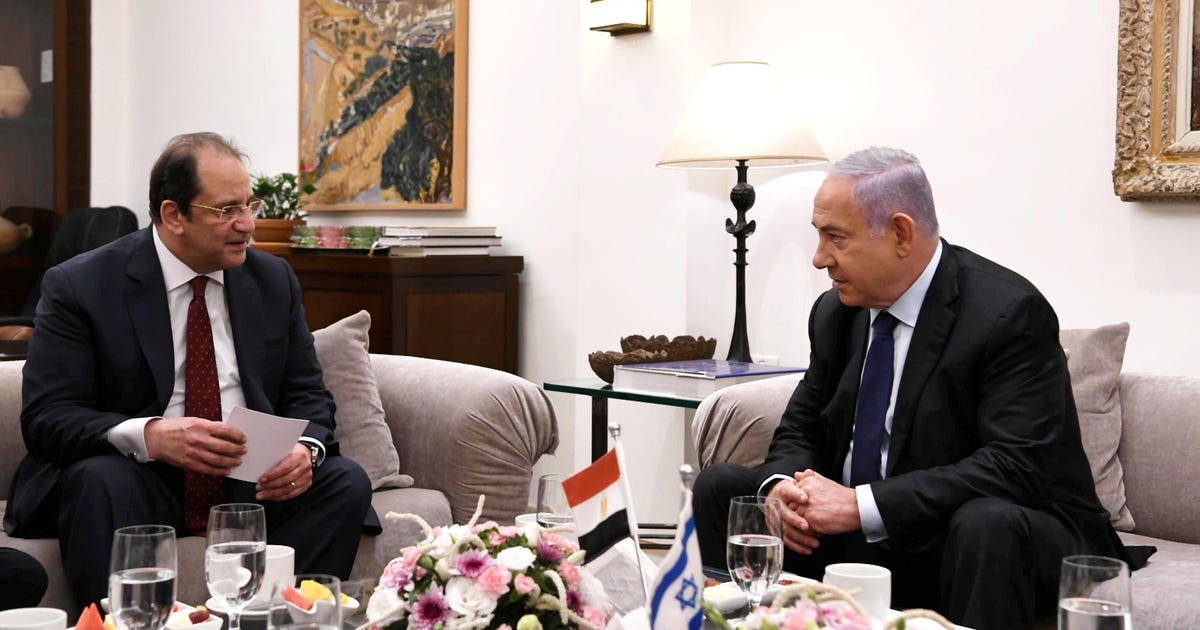
Egypt’s intelligence chief, Abbas Kamel, came to Israel 11 days before Hamas’ October 7 massacre and delivered a warning that the armed group in Gaza was preparing for a major attack and that the window of opportunity to prevent a disaster was closing, The Atlantic reported on Friday.
According to the report, which cites Israeli, Egyptian, Arab, U.S. and European officials briefed on his visit, Kamel recommended that Israel grant Hamas economic concessions to prevent a confrontation. He warned that if Israel did not change its course, “Gaza is going to blow up in your faces,” the report said, citing a former Israeli official later briefed on the visit.
Kamel arrived in Israel on September 26, 2023, the day the country’s leadership marked 50 years since the Yom Kippur War. A plane linked to Egypt’s intelligence service landed in an isolated area at Ben-Gurion International Airport and remained on the ground for 67 minutes before returning to Cairo. The plane’s landing had previously been reported in the Israeli media, but the identity of the person on board was unknown.

According to The Atlantic, it is unclear with whom Kamel met during his brief visit. Previous reports indicated that Israel’s then-National Security Adviser Tzachi Hanegbi, who was believed to have maintained contact with Kamel, was absent during those hours from a ceremony commemorating the Yom Kippur War. The National Security Council said at the time that his absence “was not related to the National Security Adviser’s schedule”.
The report notes that Israeli Prime Minister Benjamin Netanyahu, speaking at that very ceremony, described the 1973 surprise attack by Syria and Egypt as a cautionary tale of missed intelligence warnings and self-delusion. According to his public schedule, Netanyahu attended a classified meeting after the commemoration, and soon after approved some economic concessions to Hamas.
Hanegbi denied to The Atlantic this week that there had been a visit from Kamel or an Egyptian warning of any kind. The offices of Netanyahu and Egyptian President Abdel Fattah al-Sisi did not respond to The Atlantic’s repeated requests for comment.
 Close
Close
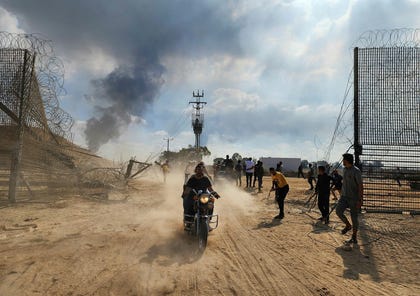
Palestinians infiltrate the Israeli side of the Gaza border fence on October 7, 2023. Credit: Hani Alshaer/Anadolu Agency via Reuters Conne
Palestinians infiltrate the Israeli side of the Gaza border fence on October 7, 2023. Credit: Hani Alshaer/Anadolu Agency via Reuters Conne
The Atlantic’s sources noted that the fact that Kamel personally came to Israel demonstrated the urgency of the situation. “The messenger was the message,” a former Israeli official was quoted as saying, stressing that “there is no world” where Netanyahu is unaware of a meeting with Egypt’s top intelligence official.
Netanyahu has denied previous reports that he was warned by Kamel, saying it was “a claim that was already debunked at the beginning of the war” and calling it “fake news.”
The Yedioth Ahronoth daily reported on October 9, 2023, that Kamel spoke with Netanyahu in the days preceding October 7 and warned him of “something unusual, a terrifying operation” about to be launched by Hamas. An Egyptian intelligence official told Yedioth Ahronoth that Kamel was “amazed by the indifference” his warning was met with in Israel. According to the report, Netanyahu told Kamel, “In Gaza, we are in the picture, we are in control. Our problem is with the West Bank, and that’s where we are also diverting forces.”
On Friday, two sources, including a person who spoke directly with United Arab Emirates President Mohamed bin Zayed, confirmed to The New York Times that the Emirati leader warned Netanyahu of a “major attack” by Hamas shortly before October 7.
 Close
Close
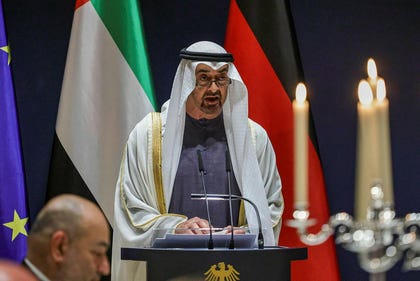
UAE President Mohamed bin Zayed delivers a speech during a banquet official toast at the official presidential residence in Berlin, Germany, in September. Credit: Omer Messinger/ REUTERS
UAE President Mohamed bin Zayed delivers a speech during a banquet official toast at the official presidential residence in Berlin, Germany, in September. Credit: Omer Messinger/ REUTERS
The report confirms a Haaretz exposé published earlier this month, according to which the Emirati president called Netanyahu in the days preceding October 7 and spoke with him for 45 minutes. He explicitly warned Netanyahu that Hamas leader in Gaza Yahya Sinwar was planning a major operation against Israel. Bin Zayed expressed concern that the event would lead to bloodshed and destabilize the entire region, undermining the Abraham Accords, and urged Netanyahu to take the matter seriously.
To bin Zayed’s surprise, Netanyahu reacted calmly to the information. The prime minister said he believed Hamas was planning to act in the West Bank and reassured bin Zayed that Israel was prepared for any scenario. Netanyahu did not brief the heads of the security establishment about the conversation.
Netanyahu flatly rejected the report at the time, with his office calling the investigation an “absolute lie,” and threatened to sue Haaretz and journalists Shlomi Eldar and Ruth Yuval over the report. “Prime Minister Netanyahu didn’t speak to the president of the UAE during the period in question and received no warning from him,” his response said. Haaretz said in response that it stands by its reporting.
Related Articles
Earlier this week, an Emirati official addressed the report, saying that heads of state do not discuss such matters at that level, according to the Emirati news site The National.
The source did not deny that Netanyahu and bin Zayed had spoken, but said: “UAE discusses security matters with other countries through the relevant entities, and does not discuss such details at the level of national leaders,” the source told UAE state-owned newspaper The National. The source did not deny that the two leaders spoke, nor Haaretz’s report.
In 2024, the Financial Times reported that The National is owned by Sheikh Mansour bin Zayed Al Nahyan, the UAE’s vice president and the president’s brother. It also reported that the site aligns with the government’s position and practices self-censorship on issues deemed sensitive or problematic by the authorities.