
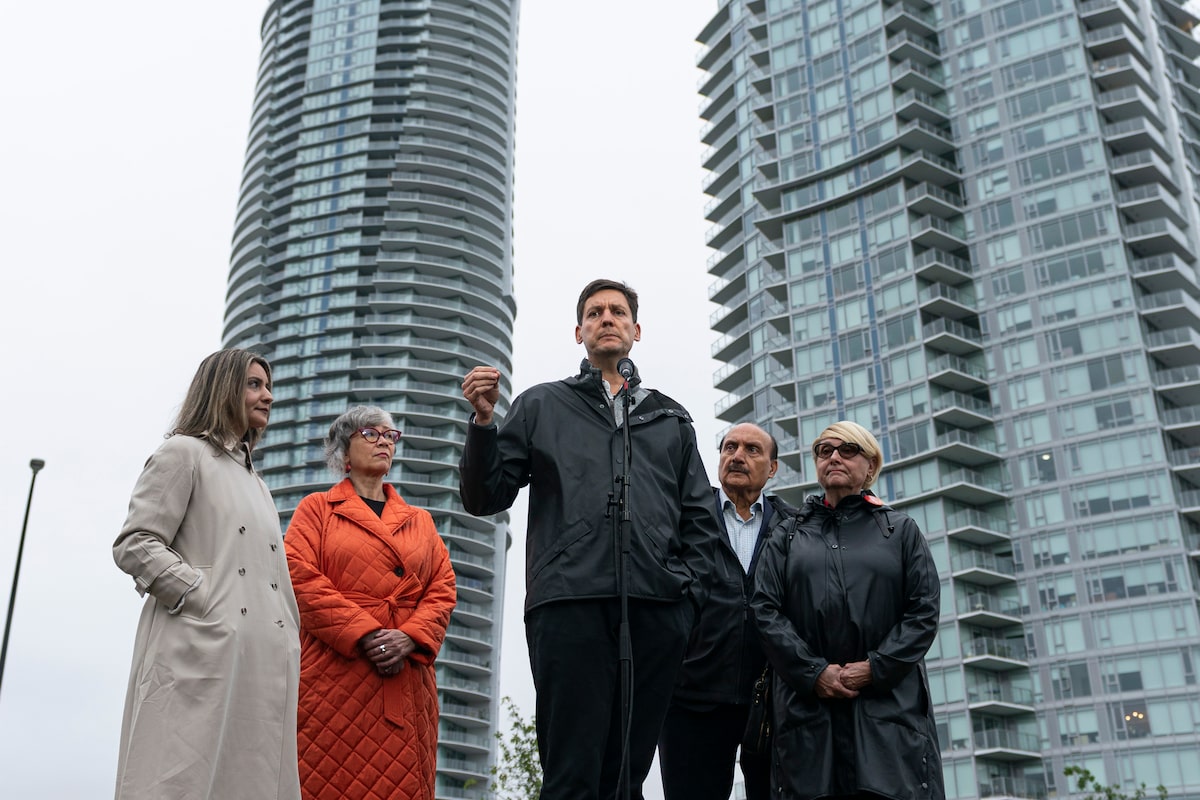
B.C. Premier David Eby speaks during an election campaign stop in Burnaby on Friday. Eby said developers may be able to wait out the market downturn, but ‘families can’t wait.’RXL/The Canadian Press
A new NDP government would slap a 2-per-cent tax on empty, unsold condos in British Columbia in a bid to force developers to cut prices and sell the units, party leader David Eby said on Friday.
There are nearly 4,000 newly built condos sitting empty in the Vancouver region, according to data from new-home research firm Zonda, as investors shun the units because they are no longer profitable.
At a Burnaby news conference during the first week of his re-election campaign, Mr. Eby said his government would impose the tax on newly built units that have been vacant for more than a year.
The tax would be on the assessed value of the condo unit, and the levy would increase by one percentage point for each additional year that the condo remained unsold.
That means if a new condo is empty for three years, the tax on the assessed value of the property would increase to 3 per cent.
Mr. Eby said that developers aren’t selling these units “at the price that people are willing to pay.” He said developers have deep pockets and can wait out the market downturn. “Families can’t wait. They need a place now.”
He cited an industry report that valued all the newly built and empty condos in the province at $4.5-billion.
B.C. Premier David Eby calls snap election
The development industry on Friday called the new tax proposal punitive.
“It would effectively be a penalty levied on developers for completing their projects at the wrong time in the housing market cycle,” said Ryan Berlin, chief economist with real-estate services company Rennie & Associates Realty Ltd.
“This adds risk and cost to future projects and creates yet another barrier to future construction,” he said in an e-mail.
Beau Jarvis, chief executive of B.C. developer Wesgroup, called the tax a “perfect example of the type of policy that results in the unintended consequence of homebuilders never wanting to build homes again.”
“To suggest that developers are purposefully sitting on empty condos and not trying to sell them is ridiculous,” he said. “The fact is there are no buyers, even at prices where developers are willing to take a significant loss.”
Mr. Eby also said Friday that a new NDP government would increase the province’s speculation and vacancy tax on empty homes. Canadians and permanent residents would see their tax on empty properties increase to 2 per cent from the current 1 per cent.
The tax has been in place since 2018 and was designed to push homeowners to rent out their homes. Each year, every B.C. homeowner must complete a declaration as to whether they’ve lived in their home for at least six months.
Value of unsold condos in Metro Vancouver put at $4.6-billion
At the news conference on Friday, Mr. Eby did not mention a previously announced proposal to buy $1.45-billion of unsold condos, which the province and Ottawa unveiled in the summer.
Under that proposal, the B.C. and federal governments would buy about 2,200 unsold new condos in the province and convert them to rentals for a rent-to-own scheme.
Asked about the status of the proposal, B.C. NDP campaign spokesperson Bhinder Sajan said in an e-mail on Friday: “There’s been no change.”
Industry officials have speculated the plan may have died, given that the Eby government has not provided details on how it would work.
The plan has been publicly derided as a bailout for developers, while developers have said they never wanted the government to buy their unsold units.
Vancouver and Toronto have been flooded with newly built condos as developers have completed constructing buildings while demand dropped.
The sales downturn is in part because of a lack of interest from investors, who used to account for the majority of purchasers. But a federal cap on temporary foreign workers and international students has also contributed to the slowdown in demand. And many prospective homebuyers simply cannot afford to buy, even though home prices have declined from their peak in 2022.