
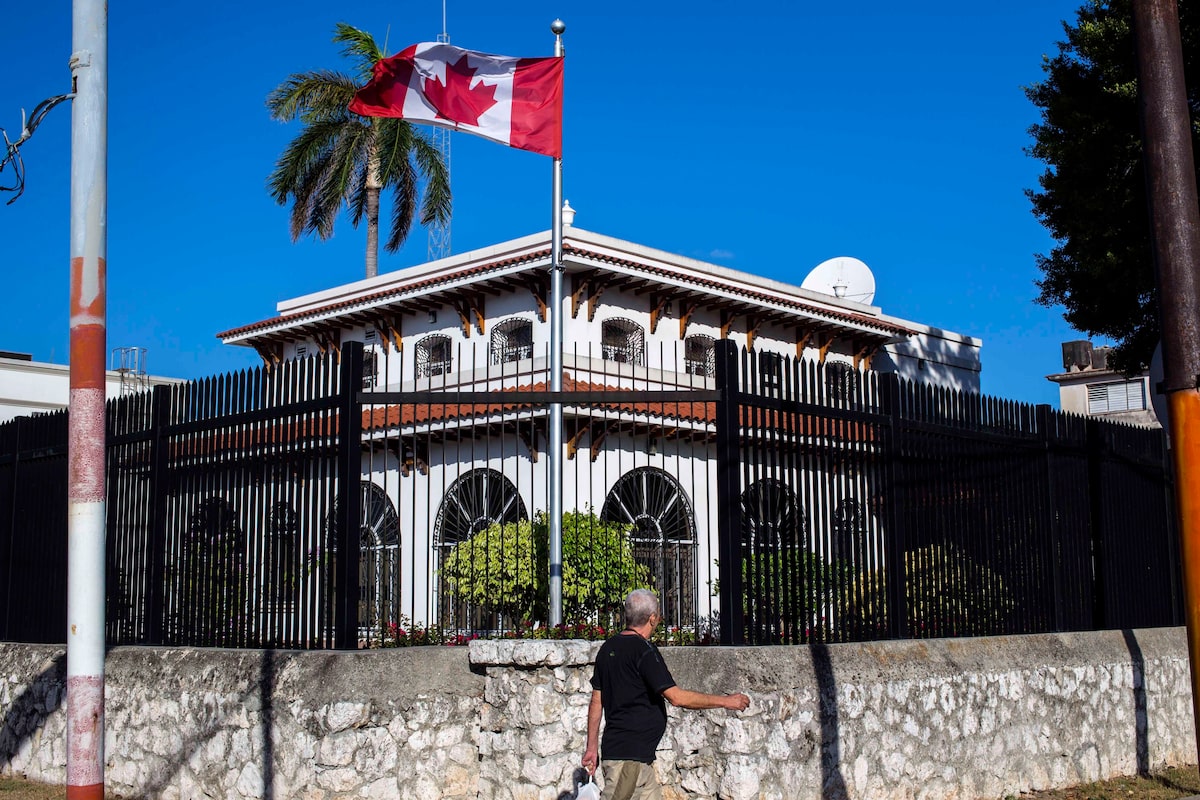
Canada’s embassy in Havana, Cuba, in 2018. Ottawa triggered a rare national security provision to keep secret the details of a lawsuit brought by Canadian diplomats who began experiencing debilitating symptoms while stationed in Havana.Desmond Boylan/The Associated Press
A Canadian diplomat was sharing intelligence with American spies in Havana and Canadians were using satellite equipment brought into Cuba by the United States when officials from both countries began experiencing debilitating symptoms caused by alleged sonic attacks linked to Russia, The Globe and Mail has learned.
Two sources tell The Globe that Canada and the United States were working closely together between 2016 and 2018 when diplomats and American intelligence operatives began reporting symptoms including nosebleeds, dizziness, headaches, blurred vision and memory loss.
One source described a Canadian diplomat gathering human intelligence and occasionally sharing information directly with American spies in Havana, while a second said Canadians were using satellite equipment brought in surreptitiously by the United States.
The allegations of Canadian spying in Cuba have not been reported before. The Globe and Mail is not identifying the sources, who could face charges under the Foreign Interference and Security of Information Act for disclosing government secrets.
Last year, Ottawa triggered a rare national security provision to keep secret new details of a multimillion-dollar lawsuit brought by Canadian diplomats who were stationed in Havana at the time.
The Department of Justice confirmed Friday that the government invoked Section 38 of the Canada Evidence Act in the case, a rarely used law that restricts disclosure of matters that could harm national security, national defence or international relations, and is typically triggered in terrorism cases and to protect classified information.
The Justice Department said it could not provide further comment on the case because it is before the courts.
From the archives: Inside Canada’s panicked response to ‘Havana syndrome’
In the spring of 2024, fresh investigative reporting suggested the set of symptoms known as Havana Syndrome could have been caused by sonic weaponry tied to Russian military operatives who were targeting adversaries’ intelligence operations.
An amended statement of claim in the Canadian lawsuit was submitted in Federal Court in August of that year. The court order to seal information was issued in April, 2025.
Paul Miller, the lead lawyer for the diplomats, declined to discuss specifics of the case, citing the court order. “There was a fear that things could be said in court that could be of a national security sensitivity,” he said.
In a statement Friday, Global Affairs Canada disputed the allegations that Canadian diplomats in Cuba shared intelligence with U.S. spies.
Asked about the lawsuit, the department said there is “no definitive common cause” to the illness that affected those serving at Ottawa’s embassy. The department said it could not comment further because the matter is before the courts.
The Globe reported on the initial filing of the lawsuit in 2019. It contained allegations from 10 diplomats and their families that Ottawa denied leading-edge health care, withheld critical information and downplayed the seriousness of brain injuries caused by the attacks.
In 2023, the diplomats and government agreed to mediation, but it was not successful. At that time, the diplomats’ legal team quoted John Bolton, U.S. President Donald Trump’s national security adviser in his first term, as saying the Canadians were targeted by Cuban hard-liners “with co-operation” from another unnamed country.
Mr. Bolton was quoted as saying the hard-liners and the other country did not “appreciate Canadian involvement in normalizing relations between the U.S. and Cuba.”
The U.S. has already paid out nearly US$3-million in compensation to Americans who reported the same symptoms.
Mr. Miller said his clients, who are not allowed to discuss the case, are frustrated by Ottawa’s unwillingness to settle and its use of national security law to keep the public from knowing what happened to them. “It’s a great delay tactic,” he said.
The United Nations Vienna Convention on Diplomatic Relations requires diplomats to respect the laws of countries in which they operate. They are not allowed to engage in espionage.
A source said a diplomat working for the Global Security Reporting Program at the Canadian embassy in Cuba between 2016 and 2018 gathered intelligence on behalf of allies, including from outside of the capital of Havana.
The source said the information was passed on to the security and intelligence division at Global Affairs Canada, the Canadian Security Intelligence Service and Canada’s Five Eyes partners: the U.S., Britain, Australia and New Zealand.
“Sometimes they could be asked to service the information directly” with a CIA agent at the U.S. embassy, the source said.
The U.S. Embassy in Havana in 2017. The U.S. government acted swiftly after learning of a wave of mysterious illnesses among diplomats in Cuba in 2016, arranging for testing and treatment at first-class facilities.Desmond Boylan/The Associated Press
The GSRP is an elite unit within Global Affairs Canada that is mandated to obtain overt security and political information. GAC said in a statement Friday that its officers in the program are not covert intelligence operators and do not recruit, handle or pay sources.
“Canadian diplomats, including those assigned to a Global Security Reporting Program (GSRP) role, are accredited by the host country and conduct diplomatic activities overtly, legally and in compliance with the Vienna Convention,” the statement said.
GAC added GSRP “is not an intelligence collection program.”
But the unit was criticized by a federal national security watchdog in 2023 for lacking “sufficient oversight” and strong safety rules.
The report by the National Security and Intelligence Review Agency said the program operated in a “distinctly grey zone,” and officers in some cases liaised with foreign intelligence agencies and appeared to collect classified information from sources.
A second source said the U.S. sent satellite equipment in diplomatic sea containers for Canada’s use in late 2016. Under the Vienna Convention, which forbids the search of diplomatic packages, the Cubans were not allowed to open the containers.
The source said the electronic equipment was later alleged to have been picked up by a Canadian diplomat and set up on the roof of the Canadian embassy and homes of certain Canadian diplomats. The source said the satellites “could be used for anything. It could be used for the internet. It could be used for whatever you wanted to use it for.”
The two sources said the Canadian embassy’s intelligence-gathering was valued by the U.S. because of Canada’s longstanding friendship with Cuba. Unlike the Americans, Canadian diplomats had better access to Cuban officials and were allowed to travel outside of Havana. At the time, Washington had a chargé d’affaires, and not an ambassador.
In 2015, then-president Barack Obama re-established full diplomatic relations with Cuba. President Dwight Eisenhower had broken off diplomatic ties in 1961.
A former senior GAC official who oversaw the department’s security and intelligence operations maintained that Canadian diplomats did not engage in spying.
The former official said Global Affairs believed Russia was behind the sonic attacks, but the department could not say so publicly because it had no proof. The Globe is not naming the former official, who was not authorized to share details about high-level discussions on the Havana Syndrome case.
Although Ottawa has never acknowledged there was a hostile attack against the diplomats, the former official said many inside GAC believed Russia was trying to disrupt thawing relations between the U.S. and Cuba, in which Canada had played a role.
Russia was believed to have gone after Americans and Canadians with ties to intelligence-gathering, the source said.
Scientists have offered conflicting explanations for what could have caused the set of symptoms that became known as Havana Syndrome.
Researchers at the University of Pennsylvania examined 21 of the American diplomats and concluded that their injuries were similar to a concussion, but with no blow to the head. The findings were published in early 2018 by the Journal of the American Medical Association. “We are collectively convinced that these individuals as a group sustained a neurological injury,” Dr. Randel Swanson, the lead author, said in a podcast published by the journal.
Other theories were put forward about pre-existing medical issues, psychosomatic conditions and even environmental factors such as noise made by chirping crickets. A study by Dalhousie University in 2019 suggested the Canadians could be facing symptoms from neurotoxic pesticide spraying.
In 2019, Global Affairs Canada cut the number of staff who remained in Havana by half, down to eight people.YAMIL LAGE/Getty Images
Dr. James Giordano, a professor at the departments of neurology and biochemistry at Georgetown University Medical Center, has suggested the U.S. and Canadian diplomats were exposed to some form of sonic or ultrasonic stimulation.
In 2023, the U.S. Office of the Director of National Intelligence released an assessment that said five of seven U.S. intelligence agencies found it “very unlikely” a foreign actor had used a “novel weapon or prototype device” to injure personnel and their families. Two unnamed agencies were cited saying there was a “roughly even chance” a foreign adversary could have developed such a device.
The U.S. House of Representatives Intelligence Committee concluded in 2024 that the assessment had “lacked analytic integrity.” The Office of the Director of National Intelligence has since said it is conducting a review of its previous investigation.
In its Friday statement, GAC pointed to a February, 2024, department report that concluded the unexplained health ailments “were not the result of any malicious act of a foreign power.”
But a joint investigation in April, 2024, by CBS’s 60 Minutes, Germany’s Der Spiegel and Russia-focused The Insider linked the mysterious illness to a radio-frequency-based energy weapon employed by a Russian military intelligence unit known as GRU Unit 29155.
Earlier this year, 60 Minutes also reported that the U.S. had obtained and tested a similar sonic weapon – from a Russian criminal network – that can inflict injuries associated with Havana Syndrome.
And Mr. Trump said in January of this year that American forces used a “secret sonic” weapon during their capture of Venezuelan President Nicolás Maduro that month.
The U.S. government had acted swiftly after learning of a wave of mysterious illnesses among diplomats in 2016.
It arranged for testing and treatment of Havana Syndrome at first-class facilities and offered to monitor the symptoms of affected diplomatic families for life. The U.S. State Department also cut its staff in Cuba by 60 per cent in September, 2017, and evacuated spouses and children.
After Canadians reported similar symptoms beginning in 2017, the Canadian government asked the RCMP to investigate. Six years later, a heavily redacted RCMP report was released that said the national police force had no conclusive findings.
Ottawa did not send family members home until April, 2018. That July, Global Affairs changed the hardship rating for Cuba to its highest out of five rankings – the same as missions in Iraq and Afghanistan. In 2019, GAC cut the number of staff who remained in Havana by half, down to eight people.
In the meantime, the Canadian diplomats and their families were told there was nothing the government could do for them.
Mr. Miller, the plaintiffs’ lawyer, said they were told to go through the standard workers’ compensation system, “which was not set up for the types of injuries that were suffered by these diplomats.”
Seven years after the lawsuit was first launched and months after the U.S. issued its first payout to compensate the alleged American victims, Mr. Miller said of the decision to seal the case: “I think the Canadian government is just so fearful of starting an international incident that they are willing to throw people under the bus.”