
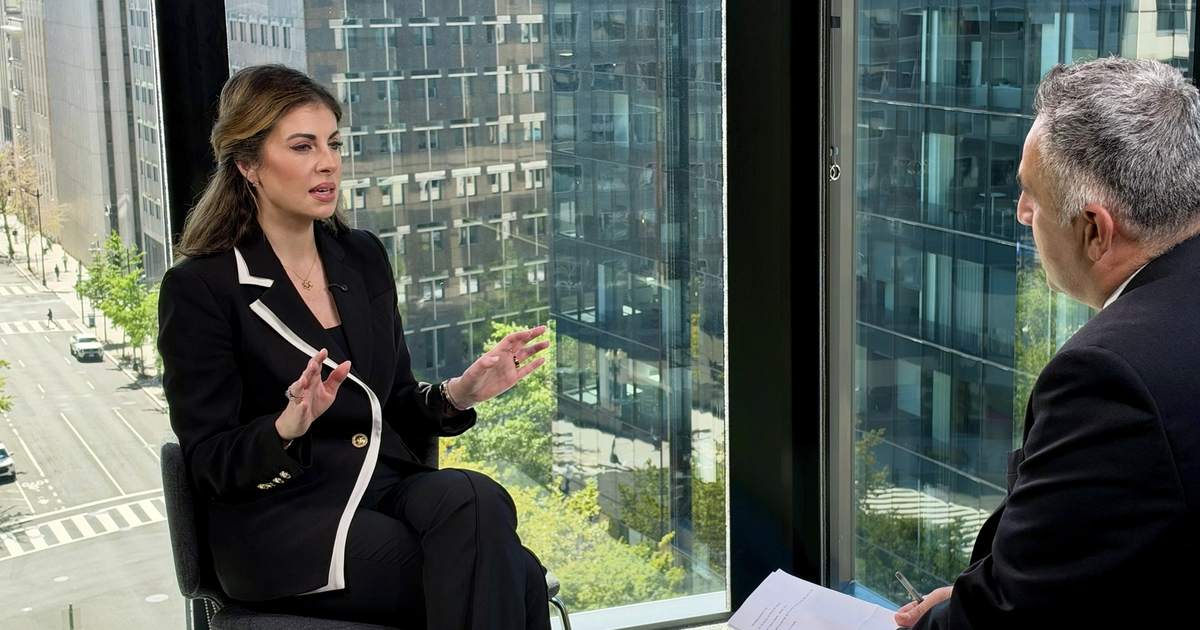
Ortagus pointed to Trump’s first term, when Democrats took control of the House in the 2018 midterms but his administration continued its “maximum pressure” campaign against Tehran and ordered the 2020 killing of Qasem Soleimani.
“Any fallacy that they have that President Trump is going to limit his decision-making authority… based off a change in the Congress is a miscalculation by a regime who still fundamentally does not understand this president.”
Congressional debate over war powers was “healthy for our democracy,” Ortagus said, but did not change the president’s authority “to take any action against Iran that he deems necessary for the safety and the security of the American people.”
Ortagus, who held senior roles in both Trump administrations, said the United States has been in a conflict with the Islamic Republic “not for seven months, but for 47 years,” and argued that economic pressure alone would not have prevented the current military confrontation.
She described Trump’s first-term maximum pressure campaign as “incredibly effective,” but said it was interrupted during Joe Biden’s presidency and has amounted to less than four years in total.
“Sanctions are not a silver bullet,” she said. “Sanctions are a tactic. They’re a way in which you pursue a larger strategy.”
That strategy, she said, should prevent Iran from obtaining a nuclear weapon, cut funding to its proxy groups and stop Tehran from becoming “the next North Korea,” with missiles capable of threatening US bases, regional states and the American homeland.
Ortagus said Trump ordered military action beginning in June last year because Iran was “intransigent” in negotiations and “weeks away from getting a nuclear weapon.” The president had given Tehran a deadline, she said, and Iranian leaders may have believed he was bluffing.
“They learned pretty quickly that he wasn’t.”
Asked whether the campaign would have happened without a closely aligned Israeli government, Ortagus said it would have. Israeli operations had “complemented” US action, she said, but “these have been American decisions and American decisions alone.”
She cited Trump’s decision to order the killing of Soleimani in 2020 as an example of an action he took “by himself.”
On diplomacy, Ortagus said Trump had “always… extended the hand of diplomacy” during both administrations.
“It’s the regime that keeps rejecting that hand.”
She was skeptical that an agreement signed with Iranian officials in New York would hold if the real decision-makers remained in Tehran, echoing Secretary of State Marco Rubio’s doubts about the authority of Iran’s UN delegation.
“What you have to do is to make the thugs in the IRGC understand that everything, their livelihoods, everything that they possess, is going to be put at risk,” Ortagus said.
Trust was not the issue, she added. The question was what mechanisms Washington would establish “so they know… if you backtrack on this, there actually will be a consequence.”
She said she did not see how any future arrangement could work “without some sort of American verification process.”
Hezbollah and Lebanon
Ortagus rejected the argument that Hezbollah should be accepted as part of Lebanon’s social and political fabric.
“Bullshit,” she said.
She said the group was led by the Islamic Revolutionary Guard Corps, had been “indoctrinated, trained, equipped and brainwashed” by Tehran and had dragged Lebanon into “perpetual war,” with Shia communities among the main victims.
President Joseph Aoun and Prime Minister Nawaf Salam had been “very clear,” she said, that Hezbollah must be disarmed and that Lebanon cannot have “a parallel state within a state.”
Dismantling that structure would take time, Ortagus added.
“It wasn’t created overnight, and it won’t be expunged overnight.”
Ortagus said the Abraham Accords had endured the turmoil since October 7, pointing to a meeting of Accords countries on the sidelines of the UN General Assembly this week.
By contrast, she said a Mecca-centered regional alignment “looks pretty weak right now,” after Houthi attacks on Saudi Arabia, including toward holy sites, drew no meaningful response from its signatories.
“Anybody who does that and says they speak in the name of Islam are the worst hypocrites imaginable,” she said.
She declined to discuss current private exchanges between Riyadh and Washington but warned against seeking security through accommodation with Tehran.
“Pacifying this regime is not going to protect you in the long run,” she said. “It will buy you time. It might be a temporary salve, but it won’t heal the wound.”
Ortagus also described the current blockade of Iran as a harder form of enforcement than previous sanctions.
“Nothing’s coming in, and nothing’s going out.”
Asked about the broader US endgame, she listed four goals: preventing Iran from obtaining a nuclear weapon; curbing its ballistic missiles, drones and conventional arms; cutting funding to proxy groups; and supporting the Iranian people.
A final conversation about Iran
Ortagus closed the interview by recounting an unpublished story about the late Senator Lindsey Graham.
In January, she said, she had “Make Iran Great Again” hats overnighted to Graham at Mar-a-Lago so he could give one to Trump on the golf course.
She said she spoke to Graham an hour or two before his death, and that their last conversation was about Iran.
“He never stopped believing in the people of Iran,” she said.