
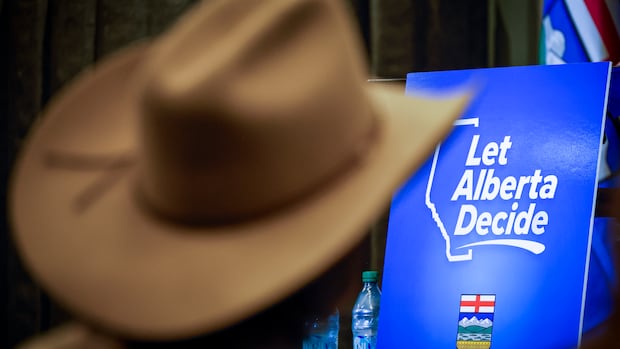
While some separatists on Friday were downplaying a new poll suggesting support for Alberta independence is softening, others in the movement say it’s giving them motivation to keep working hard as the province closes in on the Oct. 19 referendum.
Janet Brown Opinion Research surveyed 1,200 Albertans between Sept. 8 and 21. Seventy-two per cent of respondents said they’d vote for Option 1, to remain in Canada, while 23 per cent said they’d vote Option 2, favouring a second, binding referendum on secession.
After months of pro-independence campaigning and rallies, the numbers marked a slight drop from the spring, when the pollster asked a similar question about support for secession.
“It’s showing that the Option 2 side has its work cut out, you know, we’ve got to reach more people,” said Cory Morgan, who heads the third-party advertiser Pathway to Independence.
That means more in-person interactions in the final weeks of the campaign.
“I think it’s going to shift more to getting to the doors and getting face-to-face with people. It’s mostly been reliant on rallies and town halls, which have been great, but they’re now getting to a point of preaching to the converted,” Morgan said.
Gordon Larson, a Calgary resident who supports separation, said he and many others in his camp do not put much stock in polls, or in outlets reporting them like CBC News, for that matter.
“I don’t like polls. They’ve proven to be unreliable, like consistently in the last 10 years,” Larson said. “Everyone that I know who’s in [the] separatist movement has not wavered once.”
Lawyer Keith Wilson, who co-leads the group Let Alberta Decide, also believes public confidence in polls is down, but said either way, his focus is on the campaign.
“From a strategic point of view, I always assume that we are needing to do more to win. Even if a poll came out and said we were winning, I would ignore it and keep going as though we’re not,” he said.
Wilson said the primary focus of campaigning until recently has been on persuading people to come around on the idea of independence. Now, in the home stretch, the focus will increasingly shift to getting out the vote.
All eyes on turnout
With many minds perhaps made up, both sides seem to agree turnout will play a significant factor in the result.
“Everyone that’s in the movement that I’m aware of or whatnot will walk across broken glass, dodge bullets, and fight to get to that voting station,” said Larson.
Both Morgan and Wilson agree motivation to vote is high among separatists.
WATCH | Kenney says ‘hardcore separatists will crawl over broken glass to send a message’: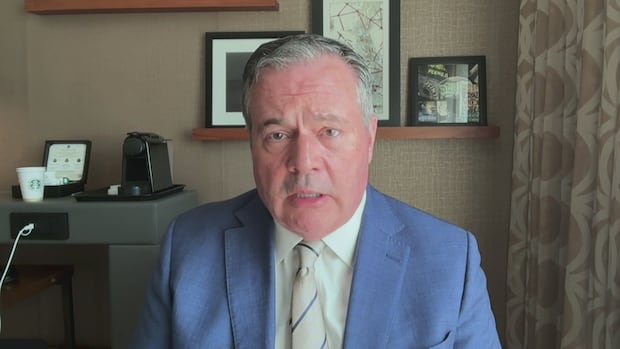
Former Alberta premier Jason Kenney says Alberta separation would be ‘economic catastrophe’
As the Clarity Act is confirmed to not apply to Alberta’s referendum question, former Alberta Premier Jason Kenney tells Power & Politics ‘the hardcore separatists will crawl over broken glass to send a message.’
Stephen Carter, who heads the federalist group Alberta’s Voice, said he’s seeing signs turnout will be strong on his side, as well.
“We’re starting to see a shift in commitment levels and those who want to remain in Canada are becoming just as committed as those who want to leave,” said Carter.
Whether that is the case is where the math comes in.
John Santos, data scientist with Janet Brown Opinion Research, has been crunching the numbers.
If the current poll results are correct, and if for example 85 per cent of separatists show up versus only 30 per cent of federalists, Santos estimates the federalists would still win by five points.
“If [separatists are] sort of waning in their energy and in enthusiasm, and if they’re slipping a little bit in terms of their soft support, then they might need to have even higher turnout rates than what they were shooting for before, in order for them to walk their path to victory, [so] to speak,” Santos said.
But ultimately, he says it comes down to how many actually cast a ballot.
“Even though I make my living from trying to figure out what the electorate thinks, ultimately what matters on referendum day will be the people who show up,” Santos said. “There’s that adage, the only poll that matters is on election day, and that’s true 10 times over for the referendum.”
If Option 1, to remain in Canada, does get the majority vote, Morgan said that will not mean the end of the independence movement.
“No matter what the vote is, I’ll be committed to pursuing independence for Alberta. It’s regrouping and studying and seeing why we couldn’t convince a majority of Albertans to go that way and start to work on how we could change that,” he said.
The CBC News random survey of 1,200 Albertans was conducted using a hybrid method between Sept. 8 and Sept. 21, 2026, by Edmonton-based Trend Research under the direction of Janet Brown Opinion Research. The sample is representative of regional, age and gender factors. The margin of error is +/- 2.8 percentage points, 19 times out of 20. For subsets, the margin of error is larger.
The survey used a hybrid methodology that involved contacting survey respondents by telephone and giving them the option of completing the survey at that time, at another more convenient time, or receiving an email link and completing the survey online. Trend Research contacted people using a random list of numbers, consisting of 30 per cent landlines and 70 per cent cellphone numbers.
Telephone numbers were dialed up to five times at five different times of day before another telephone number was added to the sample. The response rate among valid numbers (i.e., residential and personal) was 11.3 per cent.