
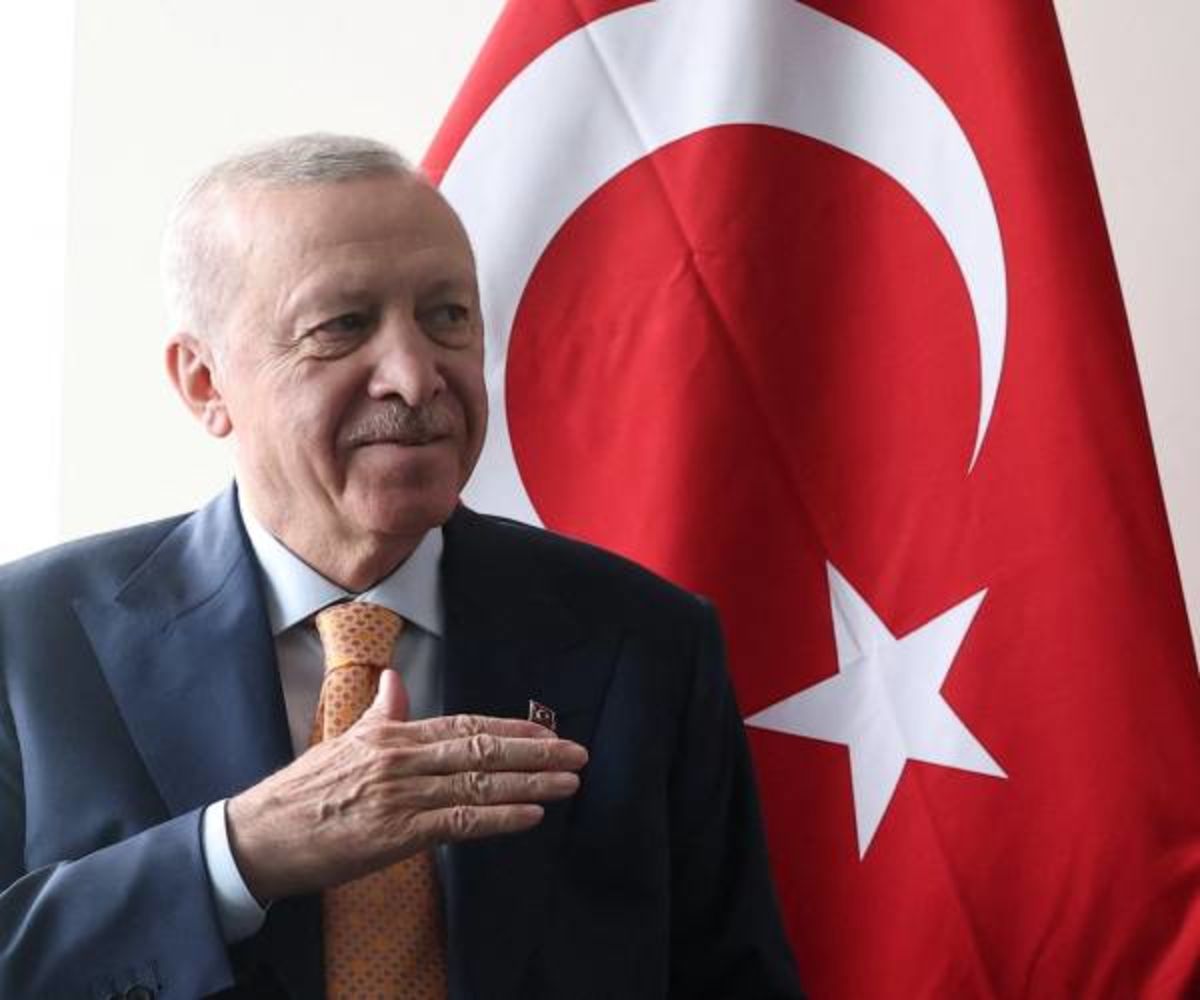

(Getty Images)
Turkish President Recep Tayyip Erdogan rejected suggestions that Turkey is emerging as a new threat to Israel, accusing the Israeli government of promoting a “misguided narrative” as tensions between the two U.S. allies deepen across the Middle East.
In an exclusive interview with Newsweek published Saturday, Erdogan acknowledged that Ankara and Jerusalem have “serious differences of opinion” but argued that increasingly confrontational rhetoric from Israel was being driven partly by Israeli domestic politics.
“Recently, a misguided narrative aimed at portraying Turkey as a new source of threat has been fueled in Israel,” Erdogan said.
“We consider this rhetoric to be linked to Israel’s domestic political dynamics and the electoral climate.”
Erdogan said Turkey harbors no hostility toward Israelis, while maintaining Ankara’s opposition to Israeli policies it considers violations of international law.
He also played down the possibility that the escalating dispute would lead to war, saying Turkey does not construct its foreign policy around scenarios of “inevitable” military confrontation.
The comments followed a blistering attack on Erdogan by Israeli Prime Minister Benjamin Netanyahu at the U.N. General Assembly on Thursday.
Netanyahu called Turkey the latest “superspreader of antisemitic lies,” labeled Erdogan a “tyrant” and accused Ankara of hosting Hamas leaders, threatening Greece and seeking greater influence over Syria. Turkey rejected the accusations.
The increasingly bitter rhetoric reflects a broader strategic competition between Israel and Turkey that has become particularly visible in Syria.
Erdogan has strongly backed the government of Syrian President Ahmad al-Sharaa and says Ankara wants Syria’s sovereignty and territorial integrity preserved.
Israel, meanwhile, has carried out military operations in Syria and has expressed concern about hostile forces and growing foreign military influence near its borders.
Those competing interests have also complicated Washington’s relationships with two important regional partners.
Turkey has been a NATO member since 1952, while Israel remains one of America’s closest Middle Eastern security partners.
President Donald Trump has maintained close relationships with both Erdogan and Netanyahu, even as the two leaders have moved further apart.
The Trump administration has found common ground with Ankara over the new government in Damascus, while Washington and Turkey are also discussing longstanding defense issues, including Ankara’s interest in returning to the F-35 fighter program.
Israel has traditionally viewed preservation of its U.S.-backed qualitative military edge as a central security priority, adding another dimension to the debate over advanced American weapons for Turkey.
Erdogan, however, rejected the idea that Israel should define Ankara’s relationship with Washington.
“I do not define Turkey-U.S. relations through a third country,” Erdogan told the outlet. “Our counterpart in Washington is the administration of the United States.”
Erdogan said his relationship with Trump allows the two leaders to communicate directly about disputes involving Gaza, Iran and other regional issues.
The confrontation also extends beyond Syria. Israel has strengthened defense cooperation with Greece and Cyprus, longstanding Turkish rivals in the Eastern Mediterranean, while Ankara has expanded its own regional security partnerships.
Erdogan nevertheless told Newsweek that Turkey does not automatically consider other countries’ bilateral relationships to be threats, while warning Ankara would closely watch developments affecting its security interests.
The tension between the two countries is not, strictly speaking, a confrontation between two nuclear-armed powers, although there is a nuclear dimension.
Turkey does not possess or control nuclear weapons of its own, but it hosts U.S. nuclear weapons at Incirlik Air Base under NATO’s nuclear-sharing arrangements.
Independent estimates have placed the number of U.S. B61 nuclear gravity bombs at Incirlik at roughly 20 to 30, although the United States does not publicly confirm the number. The weapons remain under U.S. custody and control.
For Washington, the widening Israel-Turkey divide presents an unusual challenge, managing two strategically important partners whose interests increasingly collide in Syria, the Eastern Mediterranean and the wider regional security order.
Erdogan’s comments suggest Ankara wants to prevent that rivalry from becoming a direct military confrontation, even as the political rhetoric between the Turkish and Israeli governments continues to intensify.
© 2026 Newsmax. All rights reserved.