
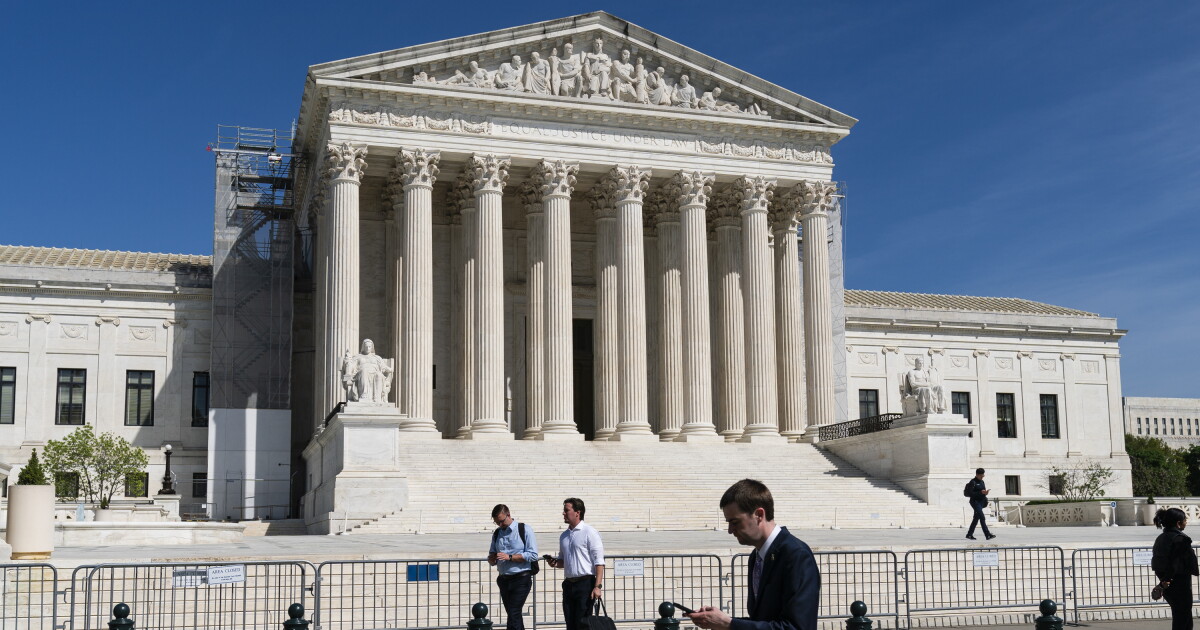
The U.S. Supreme Court on Friday blocked an attempt to implement a President Donald Trump-backed congressional map aimed at netting Republicans another seat in the U.S. House.
This is the third time the high court has prevented congressional lines drawn to oust Congressman Emanuel Cleaver from going into effect. And, barring more legal challenges, the Supreme Court’s action could shut the door this year on efforts to use the map designed to defeat the Kansas City Democrat.
“The District Court and Court of Appeals should not enjoin or otherwise prohibit the use of the 2022 map in the 2026 congressional election in Missouri,” the unsigned decision said. “And the District Court and Court of Appeals should not order or otherwise require Missouri to use the 2025 map in the 2026 congressional election in Missouri.”
The decision follows weeks of contradictory rulings in state courts and federal courts.
The Republican-controlled Missouri legislature passed the new map last year at the behest of Trump as part of a nationwide strategy to draw more GOP-leaning seats to prevent Democrats from winning control of the U.S. House in the November elections. Currently, Republicans just hold just a slim majority.
But opponents of the Missouri map successfully gathered signatures to place it up for a vote.
The state Supreme Court ruled earlier this month that meant the 2025 map never took effect and was never law – even though it had been used in the Aug. 4 primaries. The court blamed Missouri Secretary of State Denny Hoskins, a Republican, for sticking with the GOP map even though it wasn’t approved by voters.
Republicans appealed to the U.S. Supreme Court, which declined two times to intervene in the state court’s ruling.
Simultaneously with that process, though, Republicans sued in federal court and won backing for the GOP map from a federal judge and then, last week, a federal appeals court. That sent the case back to the U.S. Supreme Court for Friday’s ruling.
In the flurry of legal twists and turns, Republicans argued that their map should be followed because it was used in the primary in which more than a million people voted. Opponents of the redistricting argued the map required the approval of voters and should never have been used. They blamed Republican officials for dragging out the process and trying to force through the new map.
The group behind the redistricting referendum, People Not Politicians, appealed the 8th Circuit’s decision to the U.S. Supreme Court, arguing the appeals court overstepped its bounds by ordering Judge Stephen Clark to issue a permanent injunction. People Not Politicians attorney Abha Khanna wrote in her emergency appeal that directing Missouri to use the 2025 map when election officials were told to use the 2022 map would cause chaos, since early voting and military voting are already underway.
The U.S. Supreme Court cited a brief from an association of county clerks and election authorities that the election was already underway — and that putting the 2025 map back in place would be disruptive.
“The election is not merely upcoming; it has already started. Ballots using the 2022 map have been printed and mailed. Absentee voting has already begun, as has military and overseas voting,” the court wrote. “According to local election officials in Missouri: ‘At this point, it is practically impossible to revert to the’ 2025 ‘map.’”
The U.S. Supreme Court backed up the Missouri Supreme Court’s reasoning — and added that Republicans like Hoskins should have known that the referendum could prevent the 2025 map from going into effect.
“In an opinion back in May 2026, well before the primary election, the Missouri Supreme Court stated that the 2025 map would not take effect until approved by the voters in an intervening referendum, at least if the referendum petition was legally sufficient,” the court wrote. “So in the several-month period before the August primary election, the Missouri Secretary of State was well aware that conducting the August primary election with the 2025 map carried significant risks. The Secretary nonetheless chose to proceed with the 2025 map for the primary.”
The high court also slammed the 8th Circuit for going forward with its injunction, adding that U.S. Supreme Court Justice Brett Kavanaugh’s two other moves to put the 2022 map in effect should have provided them with a clear hint.
“Given this Court’s two prior orders in this litigation, our conclusion that this was error should come as no surprise,” the opinion stated.
The Missouri Supreme Court issued a statement on Friday night that noted this was the third time that the U.S. Supreme Court had upheld its Sept. 3 opinion.
“Because House Bill 1 (the legislature’s 2025 act to establish new congressional districts) is subject to a legal, sufficient, and timely referendum petition – HB 1 ‘is not and never has been the law,’ cannot become law until and unless approved by voters at the November 2026 election, leaving only the 2022 congressional districts are in full force and effect for the November 2026 general election,” the Missouri Supreme Court’s statement said.
Charlotte Keene
/
St. Louis Public Radio
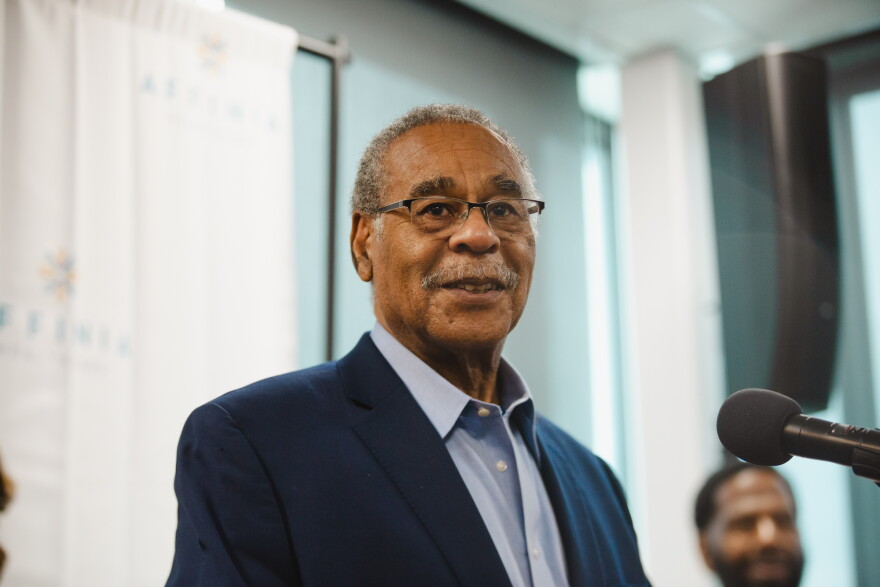
Rep. Emanuel Cleaver speaks at a campaign rally for Rep. Wesley Bell at Affinia Healthcare in Ferguson on July 24.
An optimistic Cleaver wants to change redistricting
In an interview with St. Louis Public Radio, Cleaver expressed relief that the seemingly endless litigation over which map was in effect appeared to be over for the 2026 election cycle. He will now be heavily favored to win reelection in November against state Sen. Rick Brattin, R-Harrisonville.
“I feel relieved, because the confusion over this mid-decade redistricting had become a talking point around the country that, frankly, wasn’t that healthy for Missouri,” Cleaver said. “The joy I feel now is generated by the fact that the people won this battle.”
Cleaver also said he was pleased that Kansas City, at least for this election cycle, won’t be divided into three largely rural congressional districts.
He said that he had been especially upset last year when the 2025 map split Missouri’s 4th and 5th districts along Troost Avenue, which has historically been the racial dividing line in Kansas City. Residents, he said, had gone through years of work to revitalize Troost — and bring economic opportunity to the previously underserved area.
“There have been a lot of us, white and Black and brown Kansas Citians, who for years have been working on trying to erase that stain of Troost being a wall separating the races in this community,” Cleaver said.
Cleaver told St. Louis Public Radio last July that he feared that Trump’s push to draw enough GOP-leaning seats to keep Republicans from losing the House would spark a mid-decade redistricting frenzy. And he was correct: Democratic states like California and Republicans ones like Florida, North Carolina, Louisiana, Alabama and Tennessee overhauled their maps in the run-up to the election.
He said Congress should seriously consider legislation curtailing redrawing congressional lines in the middle of the decade — and making the redistricting process less partisan.
Brian Munoz
/
St. Louis Public Radio
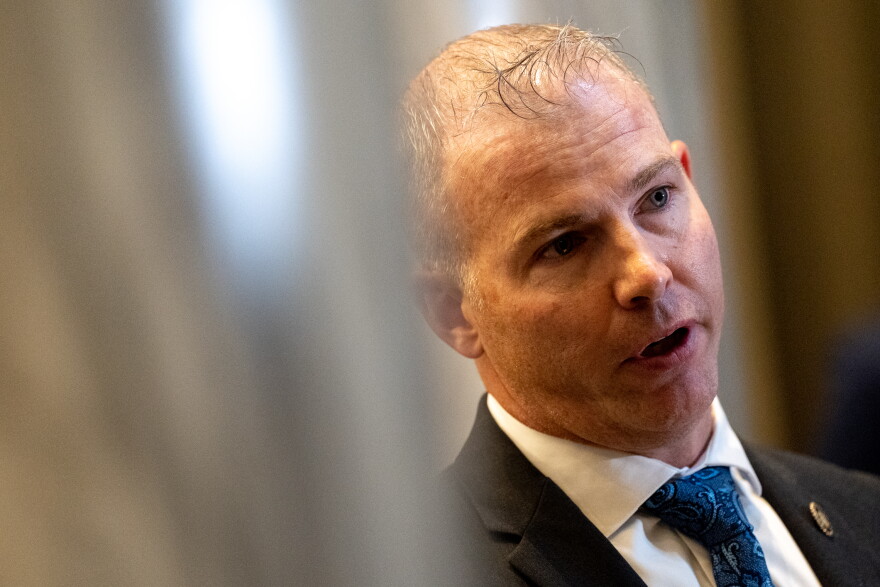
Sen. Rick Brattin, R-Harrisonville, speaks on May 17, 2024, during the last day of the legislative session in Jefferson City.
For his part, Brattin said in a statement that the result of the U.S. Supreme Court decision is “the most unprecedented form of voter disenfranchisement in American history, and Missouri voters deserve far better.”
He also slammed the Missouri Supreme Court’s decision as part of “a dangerous pattern of courts asserting power that belongs to the people and their elected representatives.”
“Judges are not kings, and courts are not legislatures,” Brattin said. “Our system of government depends upon each branch respecting the constitutional authority of the others. The Missouri Supreme Court abandoned that principle in this case, usurped the authority of Missouri’s duly elected legislative and executive branches, and left Missouri voters paying the price.”
Cleaver isn’t the only Democratic candidate who could benefit from keeping the 2022 maps in place.
The 2022 lines include a more Democratic-leaning 2nd Congressional District taking in St. Louis, St. Charles, Franklin and Warren counties. That could give a boost to Democrat Fred Wellman’s efforts to unseat Congresswoman Ann Wagner, especially if he can be the first of the Ballwin Republican’s opponents to decisively beat her in St. Louis County.
“Now Republicans have to compete, and we’ve been ready since day one,” Wellman said in a statement. “We’re organizing everywhere in this district, and we’re showing up in every community they thought they could carve up and ignore.”
But the Supreme Court’s decision also makes Congressman Bob Onder’s 3rd District more Republican — and includes a more GOP-leaning 6th Congressional District that encompasses most of northern Missouri.
Brian Munoz
/
St. Louis Public Radio
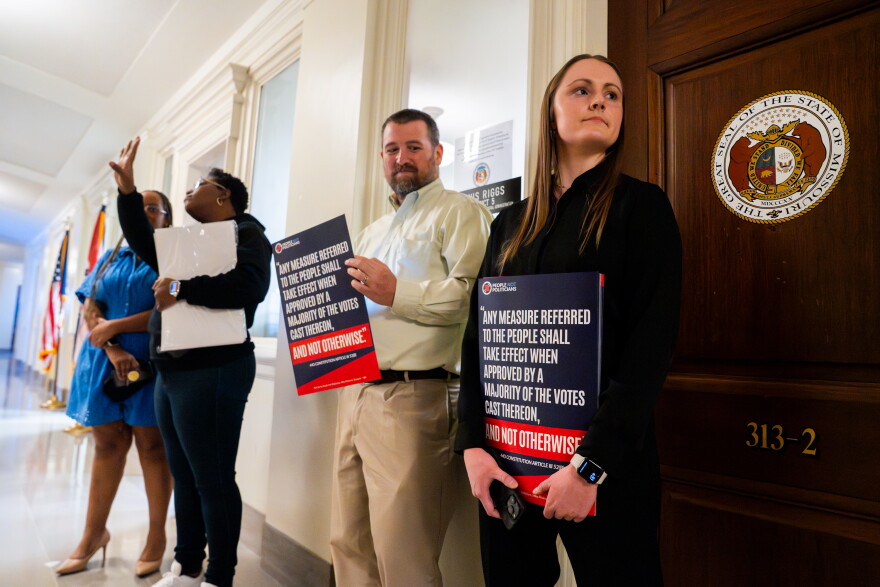
People Not Politicians Deputy Director Emily Gerber, right, and Executive Director Richard von Glahn, second from left, hold signs decrying the state’s attempt to gerrymander its congressional map to favor Republicans on Jan. 13 at the Capitol in Jefferson City.
Referendum proponents forge ahead
In a statement, People Not Politicians’ Richard von Glahn said that the ruling was a victory for Missourians who want a say over whether to keep the map that Trump backed.
He said that his group is now ready to persuade Missourians to completely reject the 2025 map.
“We are done with corrupt politicians trying to force their map into effect outside the process outlined in the Missouri constitution,” von Glahn said. “We have said from the beginning, people, not politicians will be the final deciders on this DC power grab. We are moving forward to vote NO on Proposition A.”
Missouri Democratic Party Chairman Russ Carnahan said the Supreme Court’s decision was a repudiation of how Hoskins acted — and how Republicans sowed confusion in the run-up to the 2026 election cycle.
“Republican politicians have wasted enough taxpayer dollars on this effort when they should have been working to address the rising costs facing regular Missourians across this state,” Carnahan said. “This gerrymander was never about serving the Missouri families or seniors who are facing rising grocery bills and rising healthcare costs under Republican control.”
Gov. Mike Kehoe, who called the 2025 redistricting special session, said in a statement Missouri will “follow the Court’s order.”
“It is disappointing that today’s decision by the United States Supreme Court means Missouri will conduct its November general election under a different congressional map than its primary election,” Kehoe said. “Voters deserved consistency and certainty, and not for the rules to be changed between elections.”
Hoskins said while the Supreme Court decision is “a disappointing blow to representative democracy, I appreciate the final clarity.”
“My Office will of course comply with the law. I have every confidence in our local election authorities and that they will administer a seamless general election,” Hoskins said. “I am proud of the fight I put up to defend the virtues of our constitutional republic, upon which our Founding Fathers built this great country. I hope Missourians know I left nothing on the field — and I never will.”
Brian Munoz
/
St. Louis Public Radio
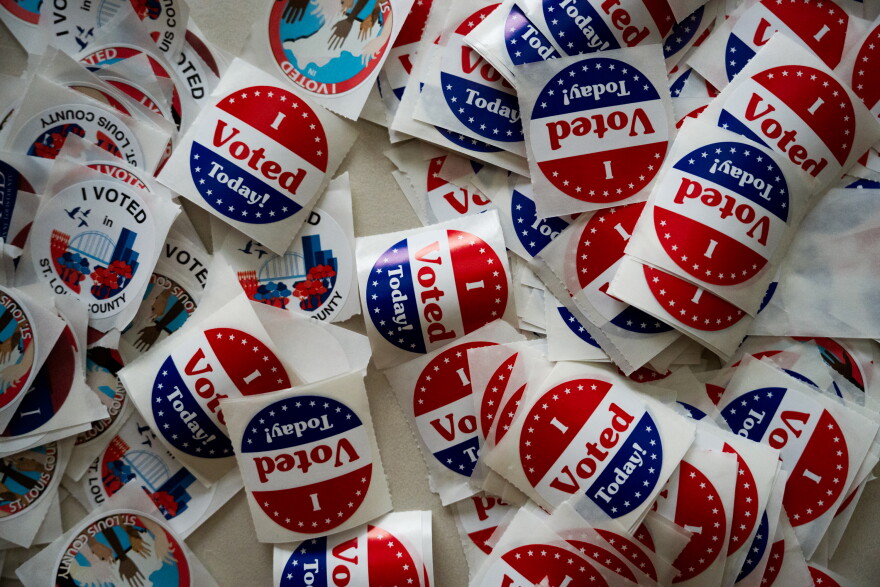
St. Louis County voting stickers are laid out for voters during the general election on Nov. 5, 2024, at Holy Name Community Center in Bellefontaine Neighbors.
Election officials express relief
The decision also provides clarity to Missouri’s election officials, who had to prepare for the Nov. 3 midterms during an often bewildering stream of litigation.
Since absentee ballots had already gone out to voters using the 2022 maps, there was a real chance that some Missourians who had voted already wouldn’t have their ballot counted in congressional elections.
“I did not realize until that opinion came down how much stress had been in my body that is now relieved,” said Boone County Clerk Brianna Lennon. “So yes, the fact that we can now confidently tell absentee voters that their vote will count, they can be confident that their vote will count, and that the ballots are not going to change is a huge relief.”
Lennon said that she had a lot of voters expressing confusion to her as the redistricting litigation wound through the courts.
“I received an email from a pretty distraught voter that was just incredibly confused and very upset,” Lennon said. “He had heard that he was in one district. He looked himself up on the congressional website, and he was in a different district. He looked himself up on our website, he was in a different district. And all he wanted to do was research who he would be potentially voting for in the congressional race.”
“So, just knowing that I can give voters that kind of finality and certainty is great,” Lennon added.