
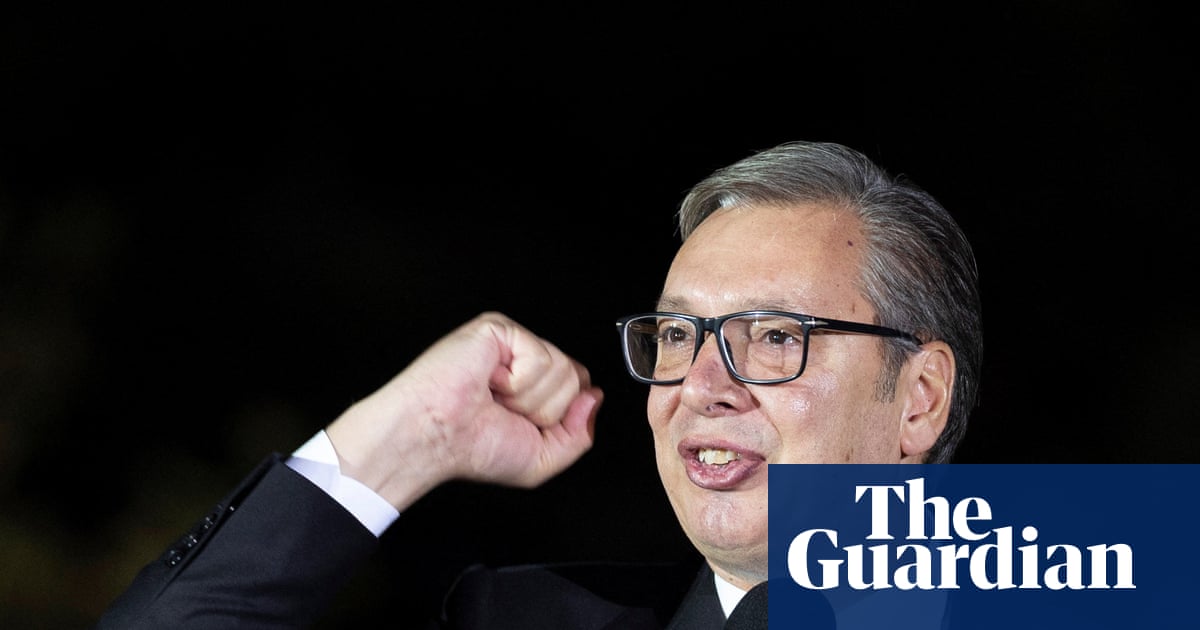
Serbia’s populist president, Aleksandar Vučić, has resigned to pursue an attempt to become prime minister in an early parliamentary election that will test his firm rule in the Balkan country after nearly two years of protests.
Vučić’s second presidential term would otherwise end in May next year. He is banned by the constitution from seeking a third term and said he was resigning to lead his rightwing Serbian Progressive party (SNS) in the 25 October ballot.
The governing populists face a major challenge from a youth-backed movement that led protests triggered by a train station canopy collapse in November 2024 that killed 16 people in the northern city of Novi Sad.
University students demanded accountability for the tragedy. Their struggle for justice and against corruption has grown into a strong movement that will attempt to oust the SNS after 14 years in power. Vučić has been either prime minister or president for the past 12 years.
“I am resigning the duty of the president of the republic,” Vučić said, reading the text of his resignation.
The ballot in October will be held against a backdrop of high political tensions as Vučić’s populists seek to remain in office despite widespread discontent. His decision to run for prime minister is seen as an attempt to retain a top position and boost his party’s chances against the student movement.
Vučić supporters light flares outside the presidency in Belgrade after his resignation. Photograph: Đorđe Kojadinović/Reuters
Vučić has toured the country in recent weeks with live coverage on pro-government media. He has opened new roads, offered assistance money and cheaper medicines and visited voters in their homes.
The prime minister in Serbia is formally more powerful than the president, but Vučić still played a dominant role during his two five-year terms, sometimes presiding over government sessions and routinely announcing all important decisions and plans.
Serbia’s independent Bureau for Social Research has filed a complaint alleging that Vučić has abused a public institution as president to promote his party, which he has dismissed. There has been no response from the anti-corruption authorities, which are under government control.
The new acting president will be Ana Brnabić, a close Vučić ally and former prime minister who is the outgoing speaker of parliament. Once a new parliament is elected, the new speaker will take over from Brnabić, appoint the prime minister and schedule a presidential vote.
Vučić and his party have been accused of rampant corruption, organised crime links and a clampdown on democratic freedoms, including critical media. The SNS has gradually taken control of all state institutions since coming to power in 2012, while denying abuse of office and repeatedly pledging to fight corruption.
The student-backed election list includes little-known experts, professors, teachers, athletes and other individuals from all walks of life. Groups of students have been touring the country on bicycles as part of their campaign urging the rule of law and an end to corruption.
Analysts say the student group and Vučić are polling closelyin a referendum-like atmosphere. Also running are Vučić’s allies, the Socialist party, a pro-EU opposition alliance and several smaller groups.
Authorities have pushed hard against protesters with police violence and detentions, as Vučić, without offering evidence, has accused his opponents and critical media of intending to destroy the state under unspecified foreign influence.
He told Serbia’s state RTS television on Sunday that foreign powers and unidentified people in the country planned to stir unrest on election night.
Serbia’s efforts to join the EU have stalled under Vučić because of democratic backsliding and a refusal to join sanctions against Russia over the war in Ukraine.