
President Trump has made it clear that he wants control over the Western Hemisphere.
He demonstrated this in Venezuela, seizing its president, imposing an unelected government, and ensuring US access to some 65 billion barrels of crude oil reserves. He has also meddled in Argentina’s recent elections, imposed an oil blockade and other sanctions on Cuba, and threatened Colombia with military action.
Trump wants more. He has threatened military action to seize Greenland from Denmark. And he wants to make Canada the 51st state using economic force if necessary, despite claiming that the United States does not need anything from Canada.
We see this with Trump’s imposition of tariffs on Canadian exports into the United States. In response, Prime Minister Carney is attempting to increase the export of goods and services to other countries to reduce dependence on the United States. In this article, I examine how Trump could use crude oil, Canada’s most valuable export, to, in the words of the Prime Minister, ‘break Canada to own it.’
Canada’s Crude Oil Exports
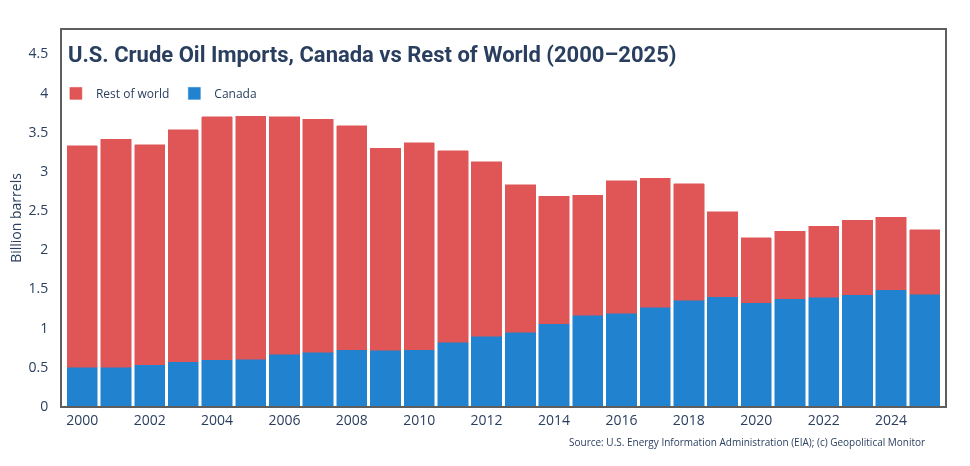
Contrary to President Trump’s assertion that the United States does not need anything from Canada, US crude oil import data from the Energy Information Administration (EIA) would suggest otherwise. Between 2000 and 2025, the United States reduced its imports of crude oil by about one billion barrels. Despite this decline, crude oil imports from Canada increased by over 900 million barrels, from 493 million barrels in 2000 to 1.43 billion barrels in 2025; meaning Canada was responsible for almost two-thirds of US crude oil imports:
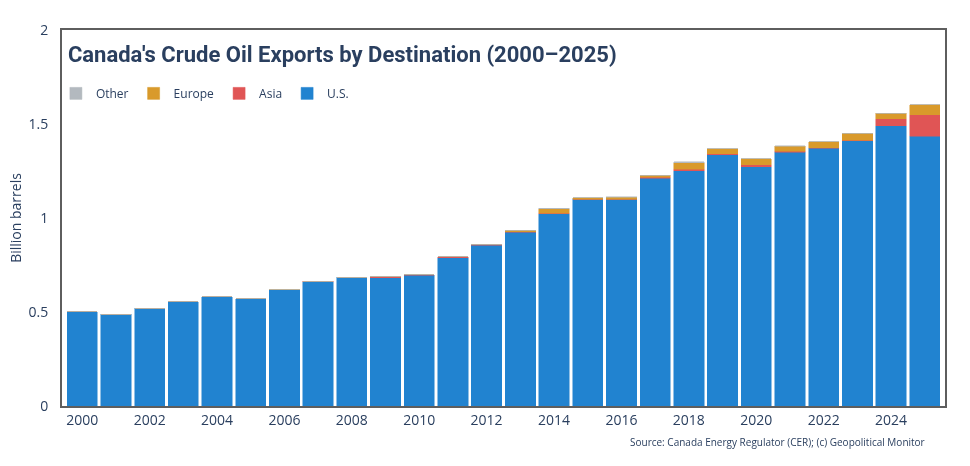
Although most of Canada’s crude oil exports are destined for the United States, a growing volume is being sent to Asian and European markets. Canada’s non-US exports of crude oil have increased from less than one per cent in the early 2000s to over 10 per cent by 2025:
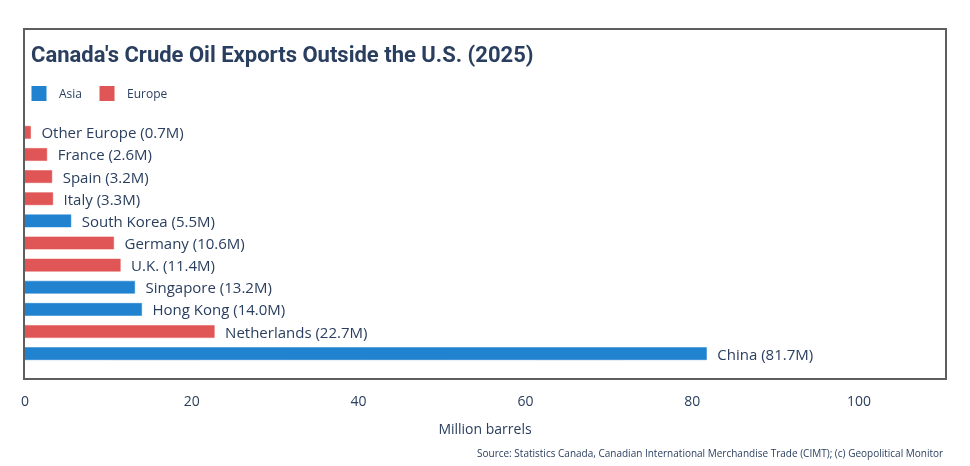
In 2025, Canada’s non-US crude oil exports totaled about 169 million barrels, about two-thirds of which went to Asian markets, with China receiving almost half:
Canada, which presents itself as a more reliable source of crude oil than countries in the Middle East, plans to continue increasing its crude oil production over the next quarter century for both domestic and foreign markets:
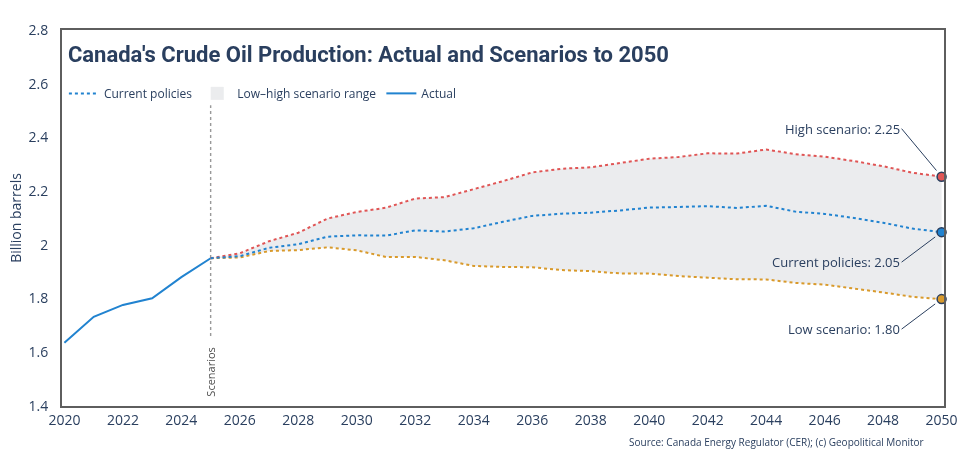
Exporting crude oil is part of Prime Minister Carney’s objective of doubling Canada’s exports of its natural resources, goods, and services over the next decade. Although geography means that most of Canada’s trade will remain primarily with the United States, increasing exports, especially of crude oil and natural gas, are seen as essential to trade diversification.
During recent trade negotiations with the United States, one of the demands made by the US negotiators was that the United States be able to limit Canada’s ability to negotiate trade agreements with other countries. The prime minister ultimately instructed Canada’s negotiators to refuse this, and other demands, and walk away from the negotiations.
This year, we have seen Trump impose crude oil blockades on the Venezuelan, Cuban, and Iranian regimes to make them meet his demands. If Trump decided that these countries should not trade with a specific country (such as China or France) or a region (such as Europe), could he do the same to Canada?
Blocking Canada’s Crude Oil Exports
Canada currently exports crude oil from its west and east coasts and has plans for creating an Arctic shipping route.
West Coast
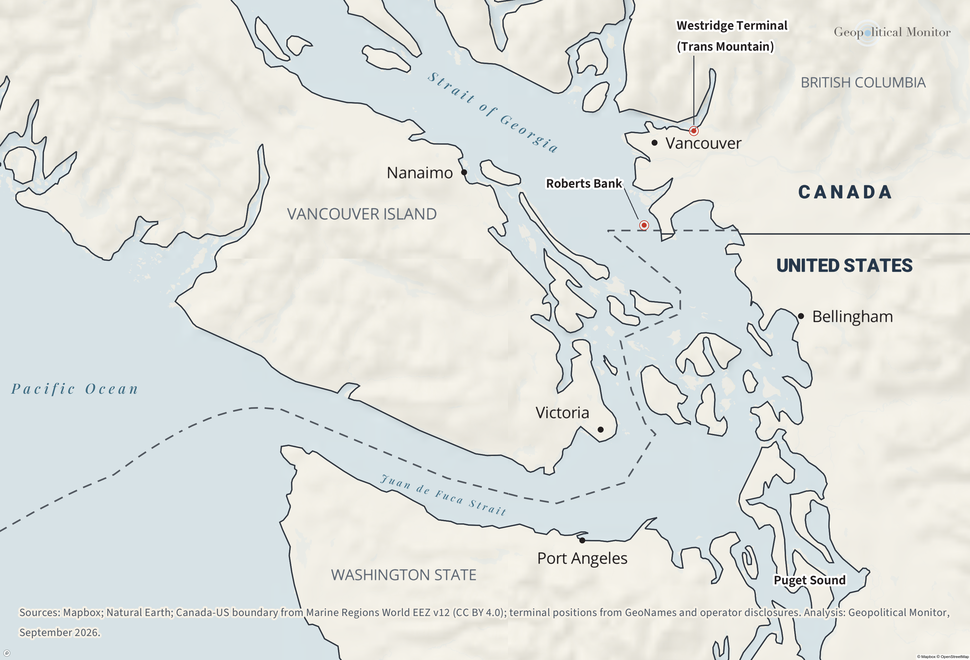
On the west coast, the 1,500-kilometre Trans Mountain System consists of two pipelines designed to bring up to 890,000 barrels/day of both crude and product from Edmonton, Alberta to the Westridge Marine Terminal in Burnaby, British Columbia. A new 1 million barrels-a-day pipeline has been agreed to by the governments of Canada and Alberta. The pipeline is expected to follow the existing Trans Mountain System route; however, it will end in a new terminal to be constructed at Roberts Bank, British Columbia.
Both terminals are in Vancouver. Ships destined for Vancouver or departing from Vancouver must pass through the Juan de Fuca Strait, a body of water shared by Canada (Vancouver Island) and the United States (Washington State). The Strait is about 20 kilometres wide and 90 kilometres long, narrower and shorter than the Strait of Hormuz, passage through which has been disrupted by the Iran war. The size of Juan de Fuca Strait means that tankers, or other vessels, could be stopped by US Navy (USN) ships and refused entry to ports in Canada or redirected to a US port, thereby cutting off Canadian crude oil (and other goods) from Asian markets. The USN has a nuclear submarine base in Puget Sound at the southeastern end of the Strait:
East Coast
Canada’s east coast crude oil production occurs off the island of Newfoundland (part of the province of Newfoundland and Labrador). Production from existing fields is increasing; in 2026, production averaged about 292,000 barrels/day or 5.4 per cent of Canada’s total production. Further increases are expected if Equinor’s Bay du Nord project begins in 2031:
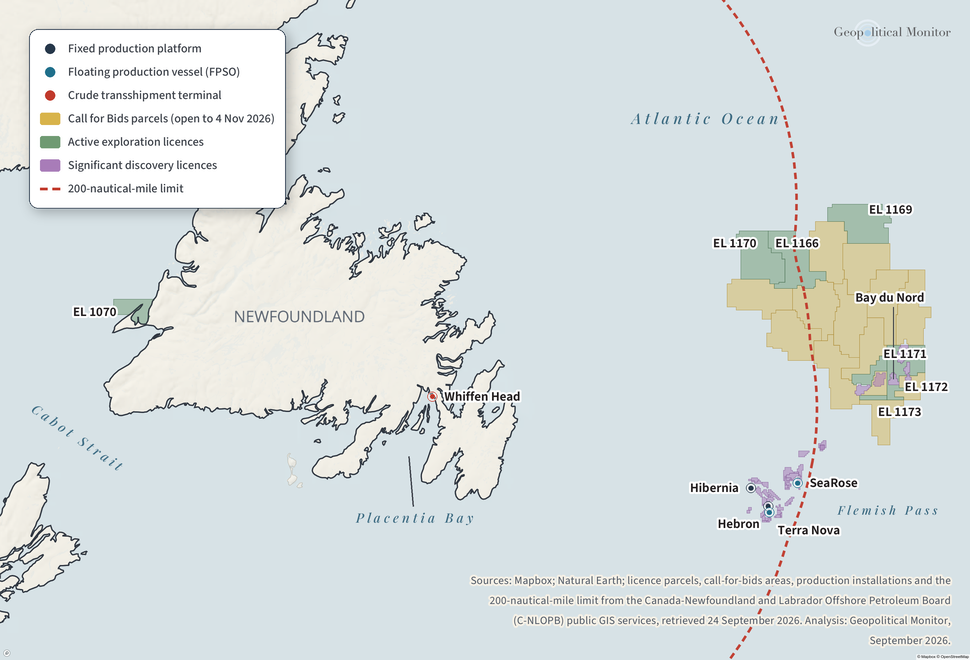
Crude oil extracted from the offshore fields is stored in offshore platforms (Hibernia and Hebron) or on site FPSO (Floating Production, Storage, and Offloading) vessels (Terra Nova and Sea Rose) to be retrieved by shuttle tankers. These tankers move the oil from the offshore to the Whiffen Head transshipment port in Placentia Bay; from there the crude oil is exported to Europe and the United States.
There are several ways in which the USN could intercede in Newfoundland and Labrador’s offshore crude oil production. For example, block inbound tanker traffic destined for Whiffen Head. Another is the location of the new offshore projects; for example, the Bay du Nord project is outside Canada’s 200-mile limit. The USN could seize the offshore platform or FPSO, claiming, for example, environmental concerns over oil spills in international waters.
Western Canadian crude oil could be shipped to Europe through the Port of Montréal. Montréal receives crude oil from Alberta via the Enbridge Mainline consisting of the Canadian Mainline and the US sections of the Mainline (the Lakehead system and Line 5). Line 5 connects to Line 9 in Sarnia and runs to Montréal through southern Ontario.
Free Analysis in Your Inbox
Start with this week’s Geopolitics Weekly for free.
The fact that much of Eastern Canada’s crude oil supply runs through the United States has been an energy security issue for many Canadians. An all-Canadian route, the Northern Shield project, has been proposed by the province of Ontario to connect it with Alberta, running through the Canadian provinces of Saskatchewan and Manitoba rather than the United States; it is unclear whether the project will proceed.
Any tankers leaving Montréal with crude oil for export would sail up the Saint Lawrence but could be blocked by the USN in the 110-kilometre-wide Cabot Strait between Cape Breton Island, Nova Scotia and the Island of Newfoundland.
The Arctic
Canada also has plans to export crude from Western Canada through the port of Churchill in northern Manitoba on Hudson Bay. From Churchill, tankers would proceed north to the Hudson Strait. The Strait has an average width of about 150 kilometres, with a minimum width of 70 kilometres at its eastern entrance connecting the Strait to the Labrador Sea.
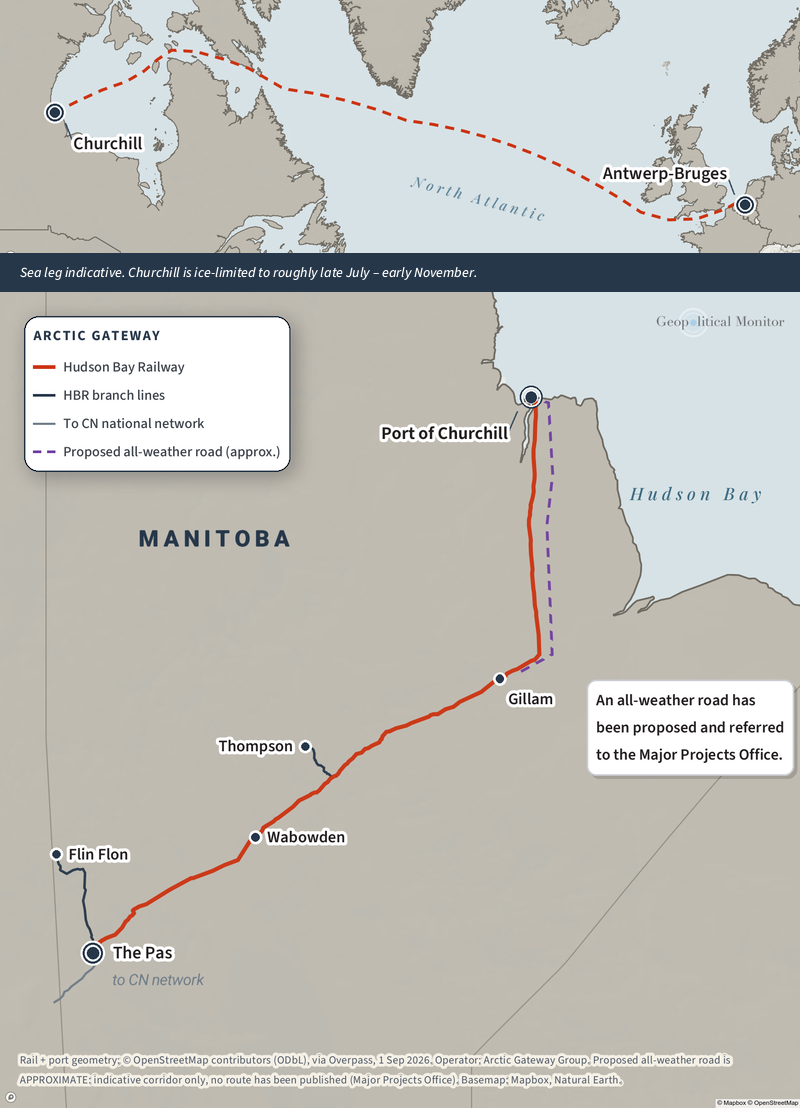
As in the case of Juan de Fuca Strait, Placentia Bay, and Cabot Strait, the USN could block vessels attempting to enter or leave through the Hudson Strait.
Other Bodies of Water
Canada is also increasing its exports of liquefied natural gas to Asian markets. Canada currently produces LNG in an LNG liquefaction facility in Kitimat, British Columbia, and moves the LNG through the Hecate Strait to the Pacific Ocean, and then to countries in Asia. Other LNG facilities are being built or planned on Canada’s west coast intended to supply Asian markets.
As with crude oil exports shipped by tanker, the USN could block the Hecate Strait, or any other body of water through which Canada exports energy products.
“Break Us to Own Us”
Prime Minister Carney has noted on several occasions that Trump is trying to “break us so they can own us.” The Prime Minister’s solution is to increase trade with other countries, much of it through a limited number of waterways, diversifying away from the United States. The success of this approach assumes that neither Trump nor his successors will attempt to keep his policies in place.
If Trump objects to our trading partners, it would not be to his advantage to attack Canada’s export infrastructure, as he has done in Iran. By leaving the infrastructure intact but blocking oceangoing trade, he can dictate to which countries he wants Canada to move crude oil (or any other Canadian commodity for that matter).
The strength of the United States’ military would probably deter countries from defending Canada’s trade routes. Canada’s limited naval strength restricts possible actions that the country could take against the Americans.
Geography has been both a blessing and a curse for Canada. Canadians are blessed with an abundance of natural resources that have allowed the country to grow and prosper. Canada is cursed because, ultimately, it is vulnerable to the whims of the Americans, as President Trump is demonstrating.
Larry Hughes is a Research Fellow with the MacEachen Institute for Public Policy and Governance at Dalhousie University. His research interests include energy security and climate issues.
The views and opinions expressed in this article are those of the author alone and do not represent those of Geopoliticalmonitor.com