
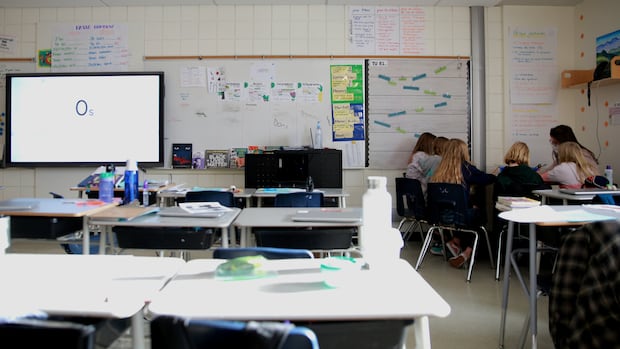
A University of New Brunswick researcher says the math skills of Canadian youth have dropped significantly over the past two decades.
In New Brunswick, the decline looks like an “avalanche.”
Lucia Tramonte said that in 2003 about 14 per cent of New Brunswick 15-year-olds fell below a United Nations numeracy standard and could not perform basic mathematics. By 2025, that share had more than doubled to 38.5 per cent.
That means two out of every five 15-year-olds “are functioning somehow at Grade 4-level math skills,” said Tramonte.
The students are not functionally innumerate, said Tramonte, but are working at levels “much lower than they should be at their age and grade.”
The results come from the Programme for International Student Assessment, or PISA, a long-standing international survey conducted by the Organisation for Economic Cooperation and Development.
PISA results don’t just show ballooning numbers of students lacking basic math competency; they also show a shrinking number scoring in the highest proficiency level.
The share of New Brunswick 15-year-olds strong enough in mathematics to be considered ready for a university STEM program — in science, technology, engineering or math — was 35.5 per cent in 2003, said Tramonte. But in 2025, it’s down to 15.8 per cent.
“This deterioration has consequences for Canada’s future talent pipeline,” wrote Tramonte and co-author Herb Emery this September in an “intelligence memo” published by the C.D. Howe Institute.
“As our aspirations for a knowledge economy went higher, our educational outcomes sank steadily lower,” observed Emery and Tramonte.
Wealthiest group sees fastest decline
In New Brunswick’s PISA results, Tramonte said a unique and “alarming” pattern is evident, where the decline in STEM-readiness happened “fastest among the children of the wealthiest families.”
“The gap between rich and poor has narrowed in New Brunswick,” said Tramonte, “not because disadvantaged students had improved but because advantaged ones had come down to actually meet them.”
The fact that students from wealthier socioeconomic groups were “hit so hard” despite their advantage of opportunity is concerning, said Tramonte, and opens up questions about curriculum decisions, school dynamics, and other factors.
‘Mudslide of competencies’
Tramonte has been working with PISA data since 2000 and highlighted that the trend of decline in math competencies is now decades long.
And it’s not just something that will affect STEM careers, she said, but also the number of youth and young adults that end up “stuck” without clear paths in either education or employment.
According to a June report from the Atlantic Economic Council, there are already more than 58,000 15- to 29-year-olds in Atlantic Canada who are not in employment, education or training, the so-called NEET population.
Tramonte is concerned there are now two generations of youth who have been “part of the mudslide of competencies,” who are at risk of growing that group.
And that makes finding a solution more complex.
“We cannot just wait to do better with the new ones coming into the system,” said Tramonte, and leave previous cohorts struggling with employability and post-secondary preparedness.
“We should do something now.”
Looking for causes and solutions
While New Brunswick’s decline is particularly steep, declines in math competencies are also happening across Canada and internationally, said Tramonte.
 Lucia Tramonte is a researcher and professor of sociology at University of New Brunswick, who has been studying PISA results since 2000. (Submitted/Lucia Tramonte)
Theories about what’s happening include changes to the quality or difficulty of math curriculum, methods of teaching that don’t translate well into long-lasting competencies, and a generally reduced focus on math, said Tramonte.
Despite the widespread decline, there are countries maintaining strong results, and there are examples of countries that have turned things around, said Tramonte.
Countries that have gone through “PISA crises” and “come out strong” are the ones who have re-established a “healthy relationship with data,” said Tramonte.
The PISA data alone “cannot identify a cause,” she warned.
“We cannot settle some of the super spiky questions that I think people have in the back of their minds in New Brunswick,” she said, such as debates over inclusive education and curriculum.
But Tramonte said “open conversations” around PISA data in other places has led to accountability mechanisms, involving more targeted research.
“We can collect data on school resources, on staffing, on so many other things that an educational system is putting in place,” said Tramonte.
And that data can help verify how changes in policy, curriculum changes, or re-organization directly and clearly promote “better skills and stronger competencies for all.”
“This change is possible,” said Tramonte.