
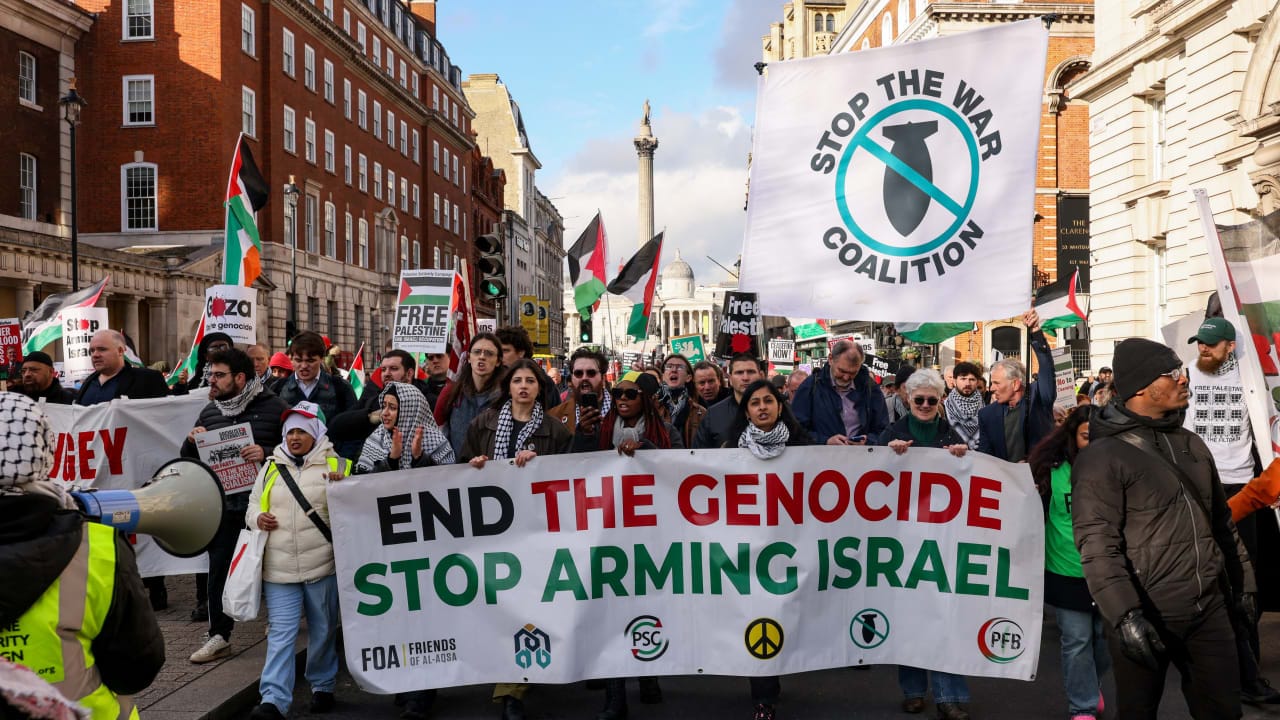
A new academic study published last Thursday examines legal and historical evaluations of charges labeling Israel as an apartheid state, a settler-colonial project, or guilty of genocide, concluding that “apartheid and genocide are not established and that settler colonialism is an inadequate classification, including in the settings where each accusation is strongest.”
Authored by Philippe Karpe, a Senior Researcher and International Expert at CIRAD, and Gunther Jikeli, an Associate Professor at the Institute for the Study of Contemporary Antisemitism at Indiana University Bloomington, the paper was published on SSRN.
Study acknowledges that ‘racism’ persists in Israeli society
The authors examine the legal definitions governing apartheid under the 1973 Apartheid Convention and the Rome Statute. According to the study, while “racism and substantial disparities persist” within Israel’s citizenship regime inside the Green Line, Arab citizens participate in national elections, litigate in courts, and serve in the Knesset.
The authors state that applying the apartheid label here “equates ethnonational inequality with a system of legally enforced racial segregation and political exclusion that does not exist there.”
 Israeli soldiers clash with Palestinians as they hold Friday prayers during a protest against Israeli settlement expansion and land confiscation near Bethlehem in the West Bank, July 3, 2026. (credit: WISAM HASHLAMOUN/FLASH90)
Regarding the West Bank, the authors note that prolonged occupation, settlements, and unequal administrative arrangements present “the strongest case” for the accusation. However, the study states that the evidence does not establish the required purpose or intent to maintain “systematic racial domination and oppression.”
The authors point out that the West Bank’s administrative divisions originate from the negotiated Oslo Accords, noting that “Palestinian non-citizenship and Palestinian Authority jurisdiction supply a national-territorial explanation for part of the legal differentiation.” Furthermore, the study notes that Gaza’s distinct internal governance and subsequent military actions “must still be distinguished analytically from an institutionalized racial regime.”
Turning to settler-colonialism, the authors evaluate the framework across pre-state settlement, the 1947 to 1949 displacement, and the post-1967 West Bank settlement enterprise.
While acknowledging that the framework illuminates aspects of land acquisition and settlement expansion, the authors argue it fails to account for “Zionism’s national and refugee character, Jewish historical attachment, or the absence of a conventional or functionally equivalent metropole.”
The study notes that, even within the West Bank, “divergent territorial strategies and negotiations over withdrawal complicate the claim of a continuous project of permanent incorporation.”
Additionally, the study notes that the survival and incorporation of approximately 160,000 Arab residents who remained inside Israel after the 1948 war “complicate the claim that state formation was conceived and executed as a preexisting comprehensive program of Indigenous removal.”
On the accusation of genocide, the study evaluates conditions in Gaza against Article II of the Genocide Convention, focusing on provisions concerning the deliberate infliction of conditions of life calculated to bring about physical destruction and measures intended to prevent births.
Analyzing data from the Coordinator of Government Activities in the Territories, the authors note that the dataset records “at least 1,341,904 tons of food associated with 63,191 truckloads on land and maritime routes,” which “weaken the inference that deprivation resulted from a food-entry policy calculated to bring about the population’s physical destruction.”
While addressing the March to May 2025 suspension of aid, the authors state that “the suspension by itself [does not] establish a purpose of physically destroying the population,” noting that the broader record supports “a competing inference that the restrictions served military or operational purposes.”
Examining the destruction of the Al-Basma IVF clinic, the study notes that the UN Commission of Inquiry found that the strike used “a large caliber projectile, most probably a shell fired from an Israeli security forces tank” and relied on “the precision of the strike,” but the authors argue that “intent to destroy a clinic or reproductive material is not by itself intent to prevent births so as to contribute to the physical or biological destruction of the protected group.”
The researchers focused on legal and historical precision
The authors also analyze how these three accusations function collectively in public discourse, arguing that “expansive definitions and selective evidence allow the three accusations to reinforce one another, shift the burden of proof, and erode the distinctions they are meant to capture.” When presented in their totalizing forms, the authors write that they function “less as descriptions of specific wrongdoing than as instruments for stigmatizing and delegitimizing Israel as such.”
Karpe and Jikeli told The Jerusalem Post: “Our argument is fundamentally about legal and historical precision, but also about the way these accusations are increasingly combined in public discourse and what this combination does to the way Israel and the conflict are understood. Apartheid and genocide are not simply descriptions of particular conduct; they are legal classifications with specific elements, including requirements concerning purpose or intent.
“Settler colonialism is a different, historical-comparative framework. We, therefore, examine each accusation on its own terms, rather than allowing the three labels to reinforce one another.”
The authors added: “Applying the relevant legal and historical criteria, our conclusion is that the evidence does not establish apartheid or genocide, while settler colonialism does not provide an adequate overall classification of Zionism and Israel. But the article is also concerned with what happens when these categories are detached from their limiting criteria and presented as mutually reinforcing descriptions. They can then cease to distinguish particular conduct, periods, and legal questions and instead, become part of a broader, totalizing account.”
Karpe and Jikeli emphasized, “Our broader concern is, therefore, not to replace one narrative with another, but to examine the claims being made, the evidence on which they rest, and the way these claims interact in contemporary discourse. Analytical clarity – distinguishing legal findings from historical interpretation, and both from moral or political judgment – is essential if the complex realities at issue are to be understood rather than reduced to competing labels.”
Read more about Philippe Karpe and Gunther Jikeli’s study here:
https://papers.ssrn.com/sol3/papers.cfm?abstract_id=7501120