
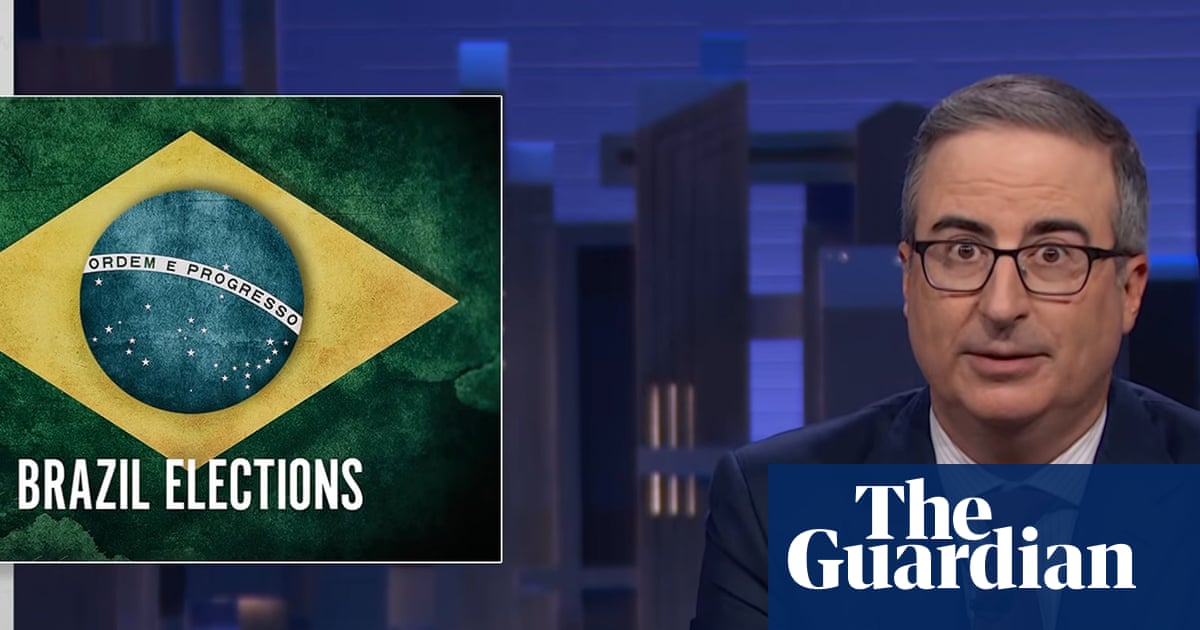
On the latest Last Week Tonight, John Oliver looked ahead to Sunday’s major election in Brazil, where 160 million people will vote to determine the country’s president, as well as state governors, two-thirds of the senate and every member of the lower house.
“Yet again, Brazil finds itself having to choose between Lula and a guy named Bolsonaro for president, and many do not seem thrilled that those are their main choices,” the host explained of the two candidates for president, Luiz Inácio Lula da Silva, known as Lula, and Flávio Bolsonaro, the son of the disgraced former rightwing president Jair Bolsonaro.
All signs are pointing toward an extremely close race, “which is worrying, because that means the world’s fourth-largest democracy and the home to, not insignificantly, the rainforest that is key to meeting the world’s climate goals, could yet again be run by a dangerous dipshit named Bolsonaro,” said Oliver.
The host then traced how we got to this moment, after Lula defeated Jair Bolsonaro by two percentage points in 2022, the smallest margin for a Brazilian presidential election since the fall of the military dictatorship in 1985. Bolsonaro fled to Florida, but months later, violent rioters clashed with police as they vandalized government buildings, claiming Bolsonaro did not actually lose the election. “It turns out history doesn’t repeat itself,” said Oliver over footage of January 6, 2021 in the US, “but sometimes, it does get dubbed in Portuguese.”
After collecting significant evidence that he was planning to stage a military coup, Bolsonaro was convicted and sentenced to 27 years and three months in prison, and barred from ever running for president again. He was released from prison after four months, however, to serve the remainder of his sentence on “humanitarian house arrest”, owing to his failing health.
“If you’re seeing a lot of parallels to Trump here – an authoritarian leader who lost an election, only to then go sulk in Florida and plot his revenge – you’re not alone in that,” said Oliver. “Trump clearly sees a reflection of his own experiences in all this, and during Bolsonaro’s trial, he even seemed to try to sway the outcome.”
Trump called the trial “a witch-hunt that should end immediately” as he threatened Brazil with 50% tariffs. “Of course he called it that!” said Oliver. “Trump overuses the term ‘witch-hunt’ the way the internet overuses the word ‘iconic’.”
Trump’s attempted meddling in Brazilian affairs may backfire; Lula has seen a boost in popularity whenever he denounces Trump’s tariffs as infringements on Brazilian sovereignty. “And to be honest, he could do with the help,” said Oliver. “Because if Bolsonaro is reminiscent of Trump, Lula can unfortunately be pretty reminiscent of Joe Biden, and not just because they both have big ‘I have a Werther’s original in my pocket’ energy.” Like Biden, Lula is a career politician who has generally governed as a center-left pragmatist, prioritizing social programs and supporting oil drilling in the Amazon while still attempting to curb deforestation.
The 80-year-old has also combatted concerns about his age via a steady stream of workout videos posted to social media. “I think I speak for everyone when I say that that is truly inspiring,” said Oliver. “Specifically, it has inspired me to stay the fuck off of Instagram, so I don’t risk witnessing an 80-year-old with his pits out filming geriatric thirst traps.”
“The problem for Lula is that many voters see him as an establishment candidate,” he added, and even though unemployment in Brazil is currently at its lowest level since 2012, affordability remains a major concern.
He also faces a candidate half his age in Flávio Bolsonaro, who has tried to paint himself as a newer, “vaccinated” version of his father without some of the baggage. But Flávio shares many characteristics with his father, whom he has invoked at his rallies via AI-generated videos skirting around rules that Jair Bolsonaro not address the public. Like his father, Flávio has a history of homophobic statements and a penchant for defending Brazil’s military dictatorship, which killed and tortured its political rivals. He has also aligned himself with rightwing world leaders such as Israel’s Benjamin Netanyahu and Argentina’s Javier Milei.
“But maybe the biggest similarity between Flávio and his dad concerns their rich history of being connected to scandals,” said Oliver, turning to the huge scandal around shady financing for a movie called Dark Horse. The English-language movie starring Jim Caviezel paints Jair Bolsonaro as the victim of a conspiracy of elites, and is now at the center of a corruption scandal after documents revealed that Flávio received 61m reais ($12m) from a disgraced banker to finance the less than expensive-looking film.
“This suspiciously expensive movie was pretty clearly designed to reset Jair Bolsonaro’s image among Brazilians and in doing so, boost Flávio’s campaign,” Oliver explained. “Which is what makes it so funny that amid all of the controversy, the film’s distributor decided to postpone the release until after the election. So Flávio’s not going to get any of the propaganda benefits of Dark Horse, but he’s still having to deal with the scandal surrounding its financing,” which has become a major headline in Brazil.
But Flávio Bolsonaro still has a very real chance of winning the election, which is “not good”, said Oliver, noting that the son has already promised to pardon the father if elected. “There is clearly a lot at stake in Brazil right now,” he continued, “and I’m not just saying that because I’m not a big fan of the Bolsonaros, which is about as much of an understatement as me saying ‘the movie Dark Horse probably won’t win an Oscar.’”
Oliver conceded that “the only thing more annoying than me ending a story telling you to go vote is telling you to go vote if you’re in Brazil,” where voting is mandatory. “So all I’ll say is that hopefully next Sunday, Lula’s message of defiance and gym lunges will end up gaining a lot more traction that Flávio’s fearmongering and flagrant daddy issues.”