
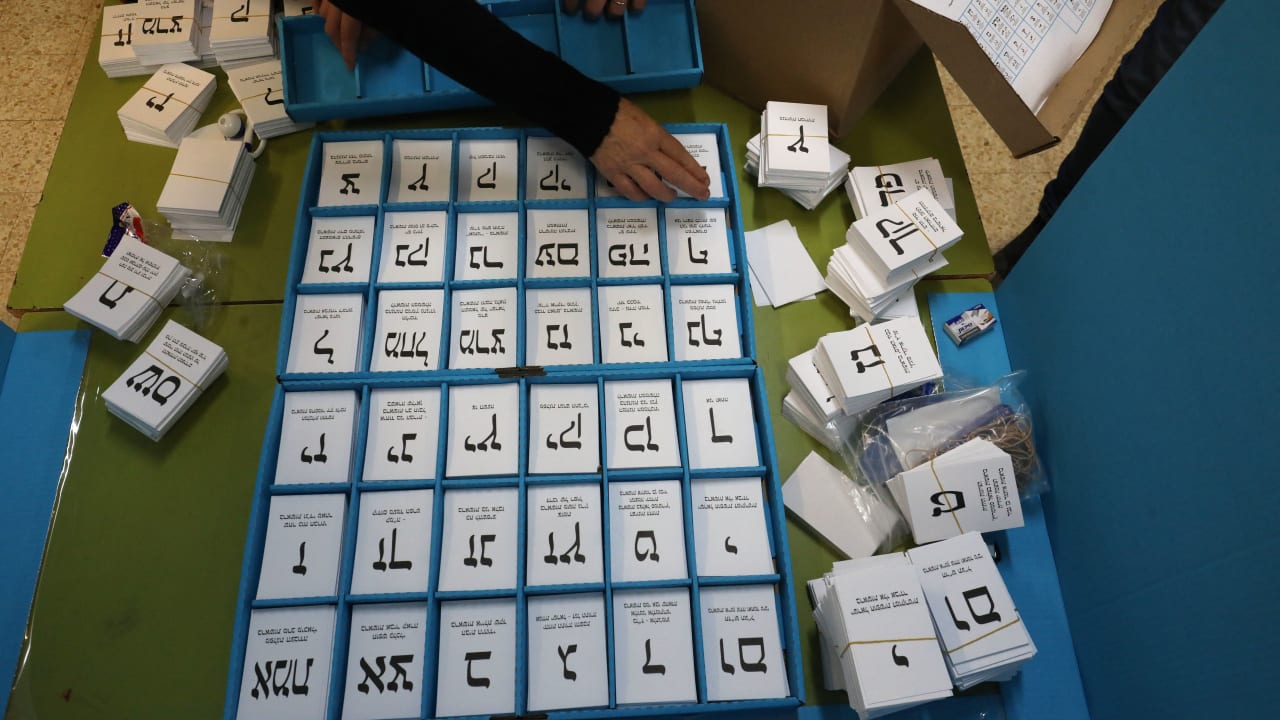
As a result, each general election is followed by weeks of negotiations, as the party with the largest mandate attempts to assemble a majority in the Knesset and form a coalition government.
A coalition is by its very nature a compromise. Usually, the smaller parties use their prospective support to secure policy concessions or ministerial posts. The party seeking to govern may, in turn, press potential partners to moderate or defer some demands. As a result, many electors find that the policies they originally voted for are so modified that, even if they are pursued, they are pale shadows of what they were.
The policies ultimately pursued by the governing coalition may bear only a limited resemblance to the political programs that voters endorse at the ballot box.
This is one of the democratic deficits of the present system.
Unknown candidates
Another problem is that the people voted into the Knesset are virtually anonymous to most Israeli electors. Apart from the party leaders, most of the candidates on party lists are totally unknown to most voters. Once they become members of the Knesset, they have no connection, and feel no obligation, toward those who voted them into power.
This is because Israel’s electoral system differs from that of most other Western democracies, including the US, in one vital respect – it lacks any constituency-based element. It is, for example, radically different from that of the UK, the system favored by Israel’s founding prime minister David Ben-Gurion in the 1950s, but never introduced.
Britain is divided into 650 constituencies. Each elects one member of parliament. Any political party may put up a candidate, but party lists are an unknown phenomenon. The candidate who wins the most votes is elected, regardless of how many votes were cast for others. In this system, known as “first past the post,” proportional representation does not feature. The idea of instituting proportional representation was put to the UK electorate in 2011 in a national referendum and was overwhelmingly rejected.
Britain’s system nearly always results in one or the other of the two major parties – Conservative or Labour – obtaining a clear majority. Its leader becomes prime minister. Except in rare cases, which do arise from time to time, there is no need for the leader of the winning party to negotiate with anyone about anything. The day after the election, the winning party takes power.
As for elected members of parliament, each is regarded by their constituents as “their” MP. All MPs hold regular “surgeries” in their constituency where members of the public with problems can speak to them personally and ask for advice or help. The personal connection between MPs and their local areas is very strong.
A possible compromise
This electoral system, like all others, is far from perfect. Its main disadvantage is its failure to match the national voting pattern with seats in parliament – undoubtedly a democratic deficit.
Ben-Gurion had advocated dividing Israel into 120 single-member constituencies – but he never had a sufficiently large coalition to overcome the parties that benefited from proportional representation.
His idea was revived in June 1980 by MKs Yigael Hurvitz and Zalman Shoval, and was subsequently embodied in a bill introduced in February 1981. It did not survive the legislative process.
Reform proposals that combined the constituency concept with the proportionality of the present system were advanced in 1958, 1972, and 1988. The 1988 proposal, sponsored by MK Mordechai Virshubski and supported by 43 other MKs, included a model in which 60 MKs would be elected in constituencies and 60 through the current system. Under that arrangement, voters would effectively cast two votes – one for a constituency candidate and another for a party list. The bill passed a first reading but subsequently foundered.
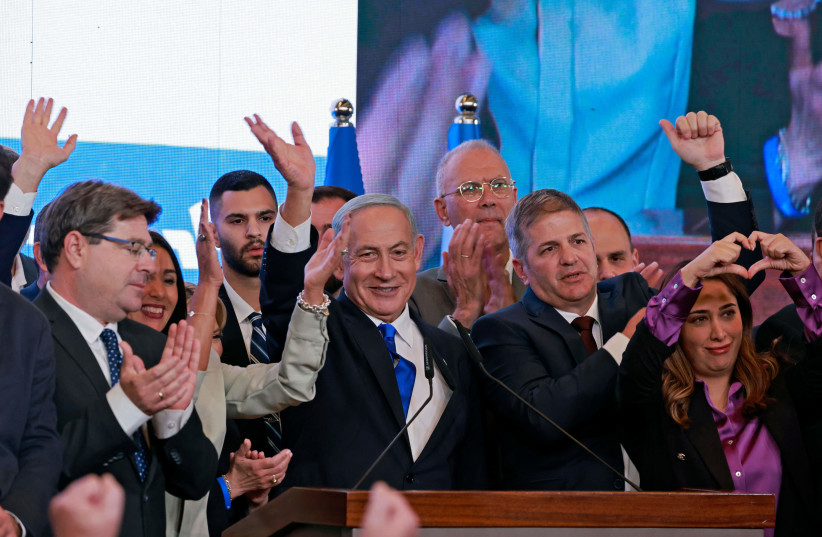 Prime Minister Benjamin Netanyahu, flanked by members of his Likud party, addresses supporters at campaign headquarters in Jerusalem during the 2022 election. (credit: Menahem Kahana/AFP via Getty Images)
In 2005, the president himself – Moshe Katsav – took the initiative. He set up a commission composed of the country’s leading political scientists and chaired by Hebrew University of Jerusalem President Menahem Magidor. It met regularly for more than a year, and it too finally favored a combined system.
Highlighting the lack of “clear linkage between an elected person’s performance and their chances of being reelected,” its report recommended that half of the Knesset should be elected directly in 17 regional constituencies based on Interior Ministry districts, while the other 60 would continue to be elected through the nationwide proportional system.
Resistance to reform
The commission’s recommendations, like the earlier parliamentary bills proposing electoral reform, were not followed up. Nor, indeed, were subsequent attempts, such as the determined effort by Prof. Menahem Ben-Sasson. Appointed chair of the Knesset Constitution, Law, and Justice Committee in 2006, Ben-Sasson set to work with a will.
Undeterred by all the previous unsuccessful attempts, he declared: “This generation might be ready. At least I have to try.” Try he did, but his bill, presented to the Knesset in 2008, was blocked by those who feared a loss of influence in any revised system.
Vested interest is the great enemy of change in any electoral system. For those benefiting from any current procedure, reform carries with it the danger of a loss of power. Even though for many years there has been a general recognition that Israel’s electoral system is far from perfect and that change is desirable, time and again the parties in power have declined to grasp the nettle of reform. And so we journey on, as Shakespeare put it, “with all our imperfections.”■
Neville Teller is a former senior civil servant. Follow him at: www.a-mid-east-journal.blogspot.com