
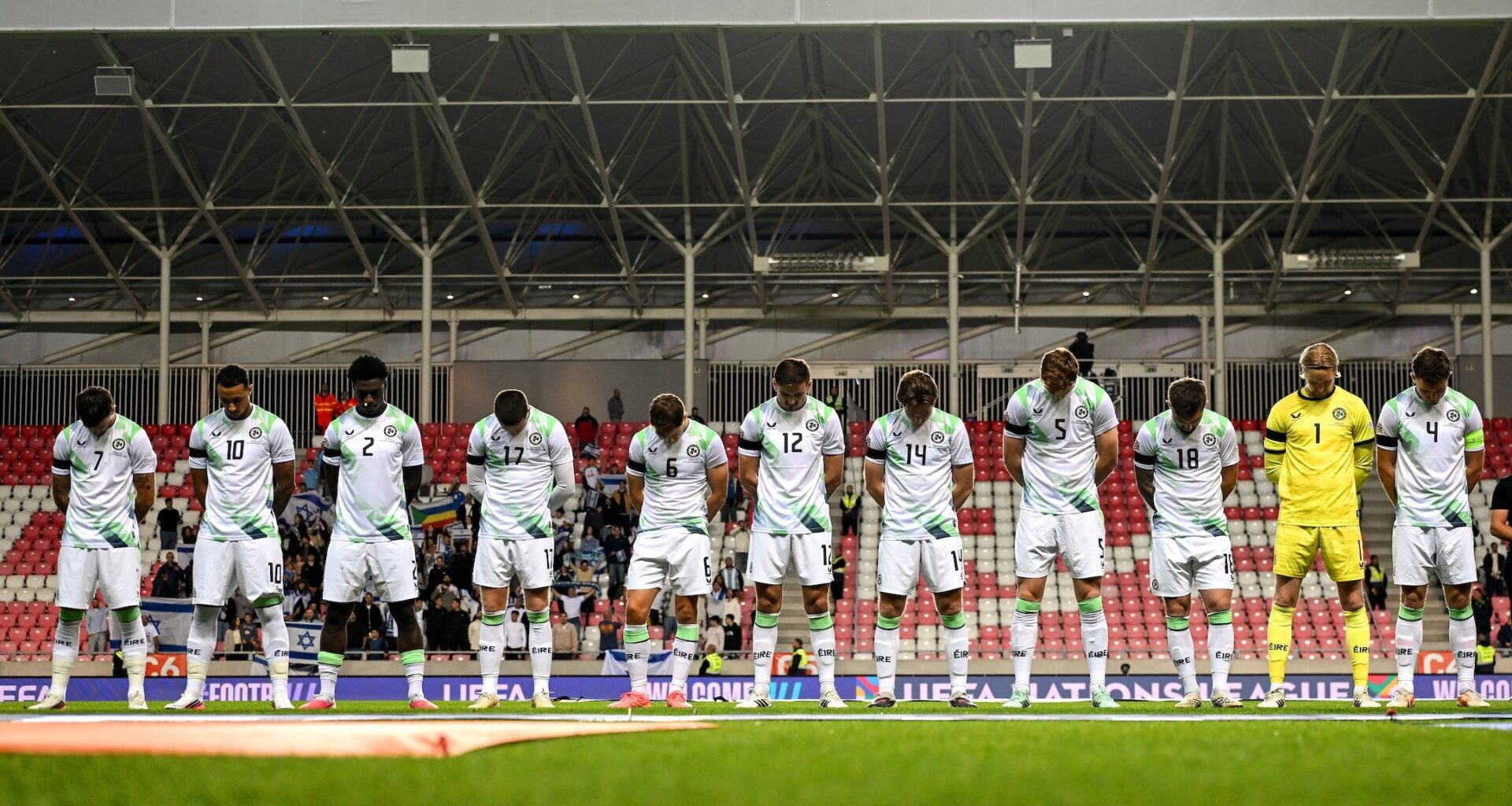
It only took 25 minutes of play for the Irish national soccer team to build a 3-0 lead over Israel in the countries’ UEFA Nations League B match on Sunday. But there were decades of bad blood that preceded Ireland’s shutout victory in a game dominated more by the geopolitics of the Gaza war than about sports. One soccer writer described it as “arguably one of the most contentious football matches of this century.”
At the match, held in a mostly empty stadium in the neutral site of Debrecen, Hungary, the Irish players wore black armbands and bowed their heads in protest during the Israeli national anthem. There were no pre- or postgame handshakes, and one Irish player declined to participate altogether, citing his “personal belief that the killing of innocent people is wrong.”
Ireland’s soccer federation did not reserve tickets for its fans, and the country’s public broadcaster scaled back its coverage of the game. The teams are set to meet again on Oct. 4 in Serbia, this time with Ireland as the “home” team.
Ireland and Israel have a long history of icy relations. Ireland became the first member of the European Union to call for an independent Palestinian country in 1980, and was among the first of the Western European countries to recognize an official Palestinian state in 2024. Israel closed its embassy in Dublin in response. Irish Prime Minister Micheál Martin has rejected claims that his country’s sharp criticism of Israel bleeds into antisemitism.
In the months leading up to Sunday’s match, Ireland’s football governing body faced intense pressure to boycott the match. At a meeting in July, the Football Association of Ireland voted 75-32, with three abstentions, in favor of proceeding with the match, “while acknowledging the strength of feeling regarding support for Palestine.” The motion also noted that a boycott would come with UEFA sanctions, both financial and competitive: In League B matches, mid-tier nations seek to advance to the top division and boost their chances of qualifying for the quadrennial World Cup tournament. The Irish team itself also held a last-minute vote over whether to participate.
Earlier this month, more than 160 Irish athletes and sports figures signed an open letter calling on the national team to pull out of the match. The signatories included former Irish national team head coach Brian Kerr — who had led Ireland to a 2-2 draw against Israel in a 2005 match in Dublin that also took place amid protests.
Former Irish national team star Kevin Kilbane also authored a column in The Irish Times, writing, “Ireland should not play Israel. Not in Dublin, not in Hungary, not in Serbia. Not when Israel is committing genocide.” Israel denies the charge of genocide.
There were also a number of public barbs exchanged between leaders of the two countries and their football associations.
At a press conference last week, Irish coach Heimir Hallgrímsson replied to questions about the match by saying, “We are not playing with genocide, we are playing against genocide. We are playing against Israel; we are not playing with Israel.”
Israel’s football association responded to that comment with a post on X, writing, “We have contributed to the world and humanity in countless fields, earning an impressive number of Nobel Prizes along the way. Unfortunately, we have not yet found a cure for stupidity, ignorance and hypocrisy displayed by the @IrelandFootball team coach. We’re not playing with ignorance, hypocrisy and stupidity. We’re playing against the coach who embodies them.”
That drew a rebuke from Martin, who told reporters, “They are unacceptable remarks and should be withdrawn.”
And on Sunday, the morning of the match, Israeli Foreign Minister Gideon Sa’ar posted a lengthy tweet referencing the 1939 Irish squad that gave a Nazi salute before a game against the German national team.
“Almost 90 years have passed. Ireland’s unique talent for finding itself on the wrong side of history remains intact,” Sa’ar wrote. “Back then, they gave the Nazi salute. This time, they stand on the side of Palestinian terrorism. Above the black armbands the Irish players will wear tonight flies the black flag of jihadism.”
After the match, Israeli captain Manor Solomon said the Irish players who bowed their heads during the Israeli anthem “don’t interest me.”
“We have a country 10 times better than theirs, stronger, an amazing country with amazing people,” said Solomon, who plays in the English Championship league. “We are proud to wear the team shirt and to be Israelis. We are proud of our state and of our soldiers. [The Irish] can play all their tricks. We are Israelis and love the country. And that will always be the case.”
As the Year Turns, Support the Journalism You Trust. JTA covers the stories shaping Jewish life around the world — with the depth this moment calls for. As you reflect on the year ahead, consider a gift that keeps independent Jewish journalism strong.
One-time
Monthly
Choose an amount to donate
$72$180$360$500
Support Us