

Listen to this article
Estimated 4 minutes
The audio version of this article is generated by AI-based technology. Mispronunciations can occur. We are working with our partners to continually review and improve the results.
Franklyn Clarke said he was impressed with 16-year-old Nash Dunlop’s skill set competitiveness on the basketball court when he met the teen in late August during tryouts.
“It felt like I knew him much longer than the time we spent together,” Clarke said. “He was just a great kid and we were looking forward to him playing with us.”
Clarke, a coach with Vanguard North Basketball, a basketball academy in the GTA, told CBC News Dunlop was set to play in the academy’s prep-season this fall and was supposed to be with the team the morning for strength and conditioning work the day he died.
The teen died suddenly on Sept. 19 and is being mourned by the Guelph and surrounding community, as tributes and online messages pour in across social media. Clarke and the Guelph Youth Basketball Academy (GYBA), which Dunlop was a member of, confirmed to CBC News he was a student at John F. Ross Collegiate Vocational Institute in Guelph.
Clarke said he spoke with Dunlop’s father, Brady, that afternoon, where he learned Dunlop had been struck by a vehicle late Friday night.
“I couldn’t believe it. I had to pull over, I was driving and I didn’t text him back I just called him on the phone and I spoke to him,” Clarke said.
“He was happy that I called and I was happy to just hear his voice as well, but it was extremely difficult.”
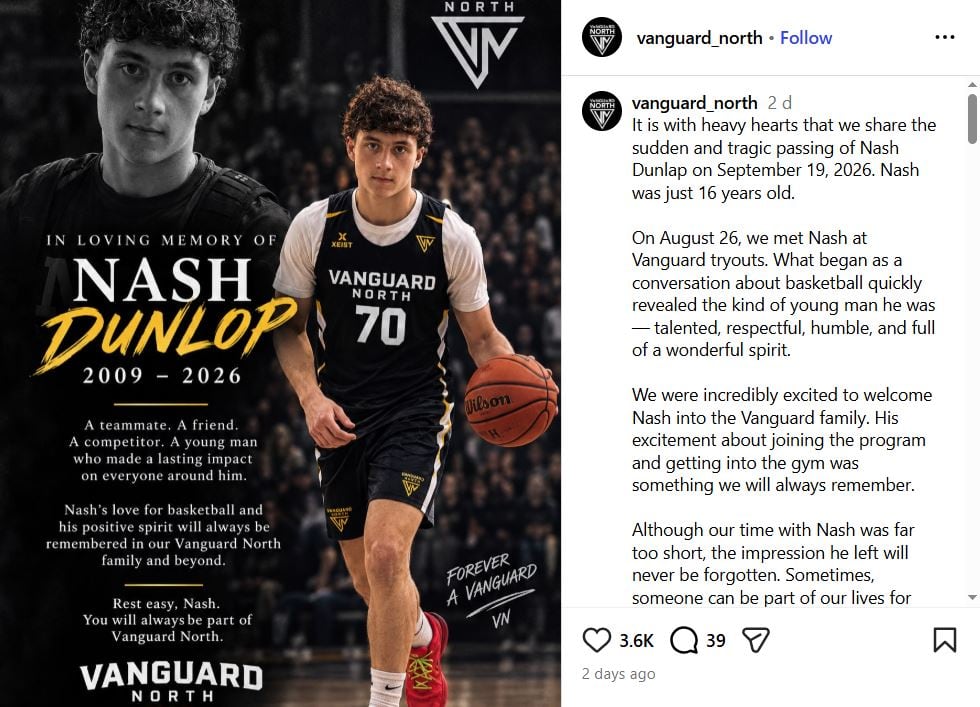 Vanguard North Basketball is among several basketball groups paying tribute to 16-year-old Nash Dunlop, who dies on Sept. 19. Dunlop was supposed to join the academy in the fall. (Vanguard North Basketball)
He said Dunlop’s death is tragedy.
“He had his whole life ahead of him and beside him being a good basketball player, from what I saw when I met him, he was just a phenomenal kid,” he said.
In a statement to CBC News, GYBA said “Nash was a gifted athlete who brought energy, determination and passion to everything he did.”
“He loved basketball and was known for his athleticism, competitive spirit and commitment to his teammates,” GBYA said.
“We are heartbroken for his family, friends and community. In moments of tragedy, we are reminded of the power of community and the importance of coming together in a time of need.”
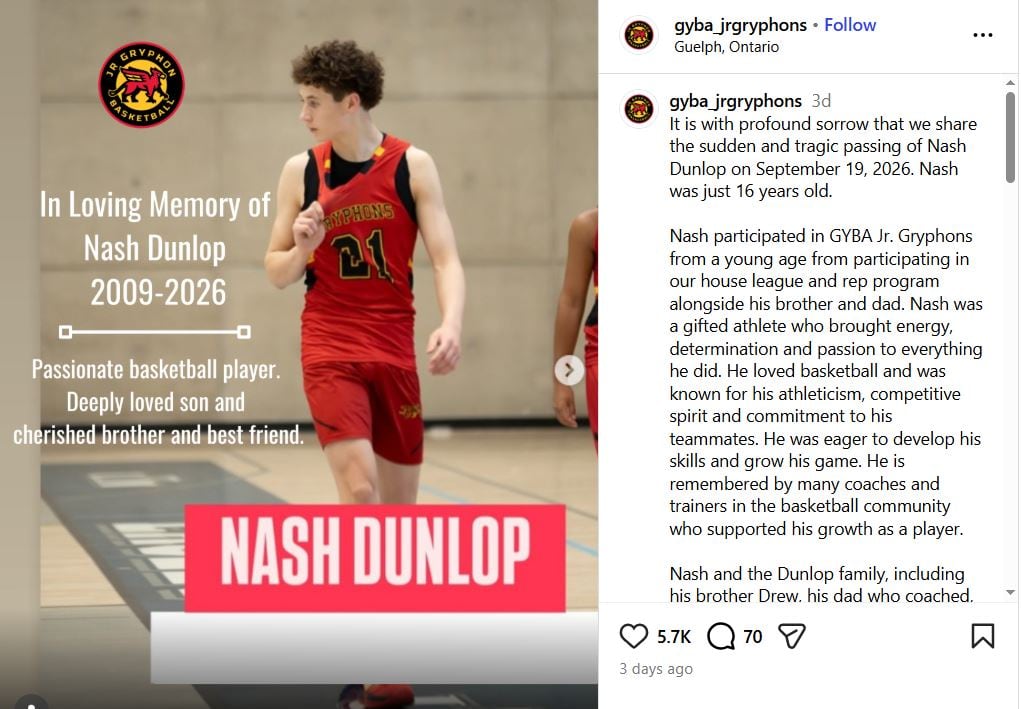 Nash Dunlop was part out the Guelph Youth Basketball Association. The group said “he loved basketball and was known for his athleticism, competitive spirit and commitment to his teammates.” (Guelph Youth Basketball Association)
A fund was also started on Dunlop’s behalf through the Guelph Community Foundation, where funds will go to support basketball at his school and across Guelph.
Community members across Guelph are putting basketballs on their front porch to remember Dunlop.
In a letter sent to students and their families on Sept. 20, the school said it was sadden to share that a “senior student” had died “following an accident” on Sept. 19 and counsellors and support staff available at the school.
The Upper Grand District School Board did not confirm to CBC News whether the student attended John F. Ross Collegiate Vocational Institute.
Mental health clinic at Guelph high school
The Waterloo-Wellington branch of the Canadian Mental Health Association (CMHA) is making sure students at Guelph’s John F. Ross Collegiate Vocational Institute have the supports they need as the school grieves Dunlop’s death.
CMHA will provide a mental health walk-in clinic at the school Tuesday evening in partnership with The Nightingale Centre, a not-for-profit that provides grief and bereavement supports to children and teens in Guelph and Wellington County.
Executive director Jodi Pareira said it’s important to give spaces for teens to talk about grief as they try to heal.
“Grief by itself, in isolation, is a horrible thing, but when you bring it into community and allow people to talk about it together, it’s still a horrible thing, but it feels better,” she told CBC News.
“It’s validating to know you’re not the only person.”
Pareira said it can also give people a chance to talk about the life and legacy of the person who died.
“How do you create the legacy and remembering that enables us to continue to remember that person and bring them into a community,” she said.