
Tehran’s economy is battered, yet parallel trade networks prevent its complete economic isolation.
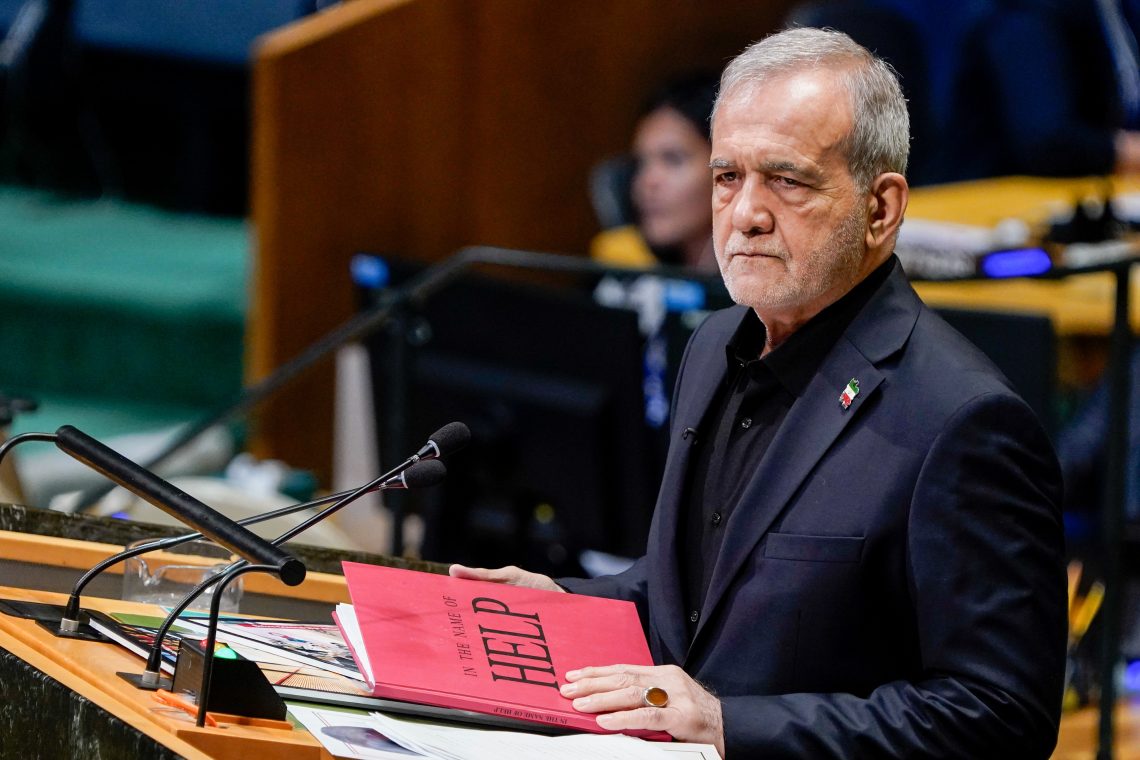
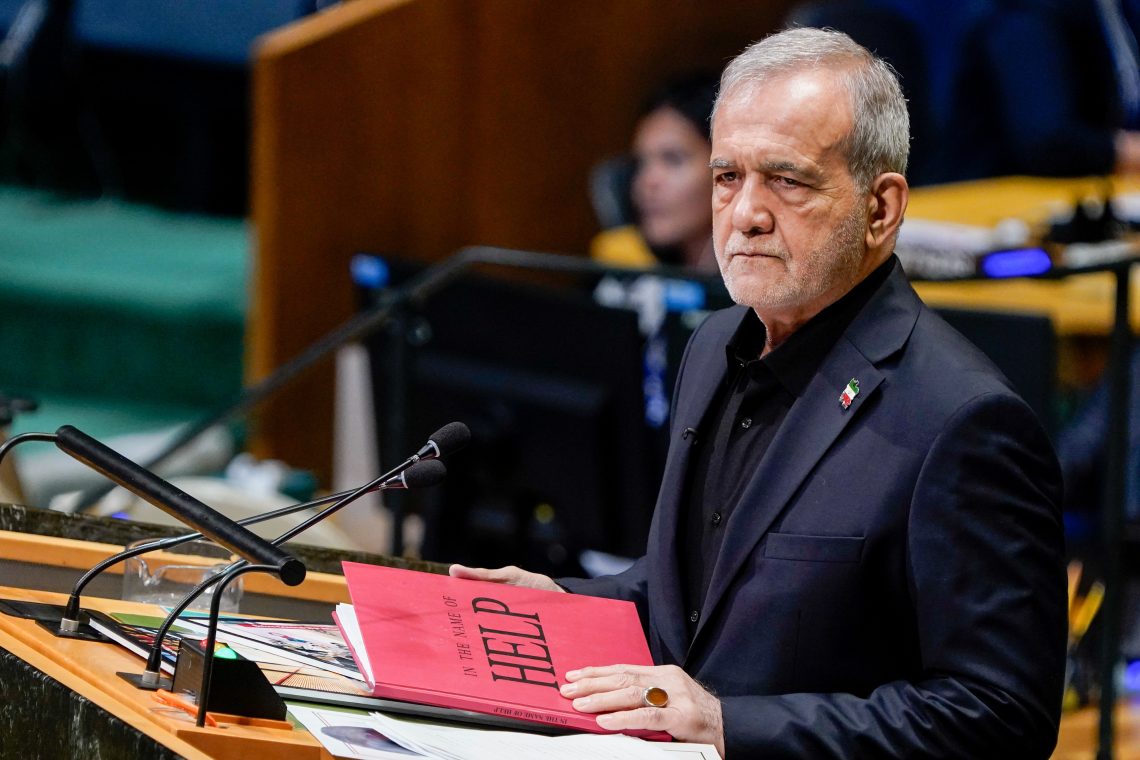 Sep. 23, 2026: Iranian President Masoud Pezeshkian holding printed material entitled “In the name of HELP” as he addressed the United Nations General Assembly in New York. © Getty Images
×In a nutshell
With Gulf access restricted, Iran uses costlier northern and eastern corridors
Russia, China, Pakistan provide alternatives to Western-controlled routes
Sanctions hurt Iran without delivering Washington’s desired outcome
To break the stalemate in its war with Iran, the administration of United States President Donald Trump is now trying to make Iran an international economic outcast with a new regime of sanctions. Iran has survived economic, military and diplomatic pressure from the U.S. and its allies since the 1979 Iranian revolution, albeit at great cost to its people.
This time, too, the Iranians expect to evade the most devastating impact of U.S. sanctions through the transportation and logistics networks they have created over the years to deal with Western pressure. Iran’s key partners in this effort so far have been Russia, Pakistan and China. This time around, Iran might also look to Turkiye as both a market and supplier, while expecting lukewarm implementation of sanctions or requests for exemptions from India.
The current war with Iran started because President Trump believed that his “maximum pressure” campaign against Iran was proving inadequate in preventing Tehran from developing nuclear weapons, neutralizing Iranian-backed terror networks and stopping the country’s missile armament.
The “Economic D-Day” announced by U.S. Treasury Secretary Scott Bessent in August 2026 is an enhanced version of the February 2025 authorization the U.S. Treasury had to “impose maximum economic pressure” on the Iranian government.
Tehran circumventing sanctions
Before February 2025, Iran’s total trade stood at $110 billion annually. The sanctions limited Iran’s ability to sell its oil and to import commodities, yet China, Iraq and Turkiye remained Iran’s largest trading partners. Over the following year, China purchased 80-90 percent of Iran’s crude oil, worth nearly $32 billion. Trade with Iraq and Turkiye, both of which share land borders with Iran, was $10 billion and $5 billion, respectively.
The war that began on February 28, 2026, has disrupted Iran’s economy significantly, but there is no evidence that it has been completely crippled. Iran’s neighbors continue to serve as a lifeline, with cross-border commerce continuing in various forms, including illicit exchanges tolerated by border officials.
Among countries in Iran’s immediate neighborhood, the United Arab Emirates is the only one that has demonstrated the will to confront Iran, especially in the aftermath of Iran’s missile and drone attacks. Historically, the UAE was Iran’s second-largest trading partner, totaling $28 billion in 2024, for example. But the UAE implemented the U.S. “maximum pressure” sanctions and more recently, on August 19, 2026, suspended all trade, commercial exchanges and financial transactions with Iran.
This meant that Iran lost all residual economic advantages of its historical business ties with the UAE, especially Dubai, where Iranian traders were once ubiquitous.
Limited by war and sanctions, Iran’s clerical regime, increasingly under control of the militant Islamic Revolutionary Guard Corps (IRGC), understands that it can no longer depend on its Gulf ports as the main venue for its imports and exports. Tehran is now increasingly using its Caspian ports, including Bandar Anzali and Amirabad, and its land borders to manage continued economic activity.
×Facts & figures
Iran’s alternative trade routes
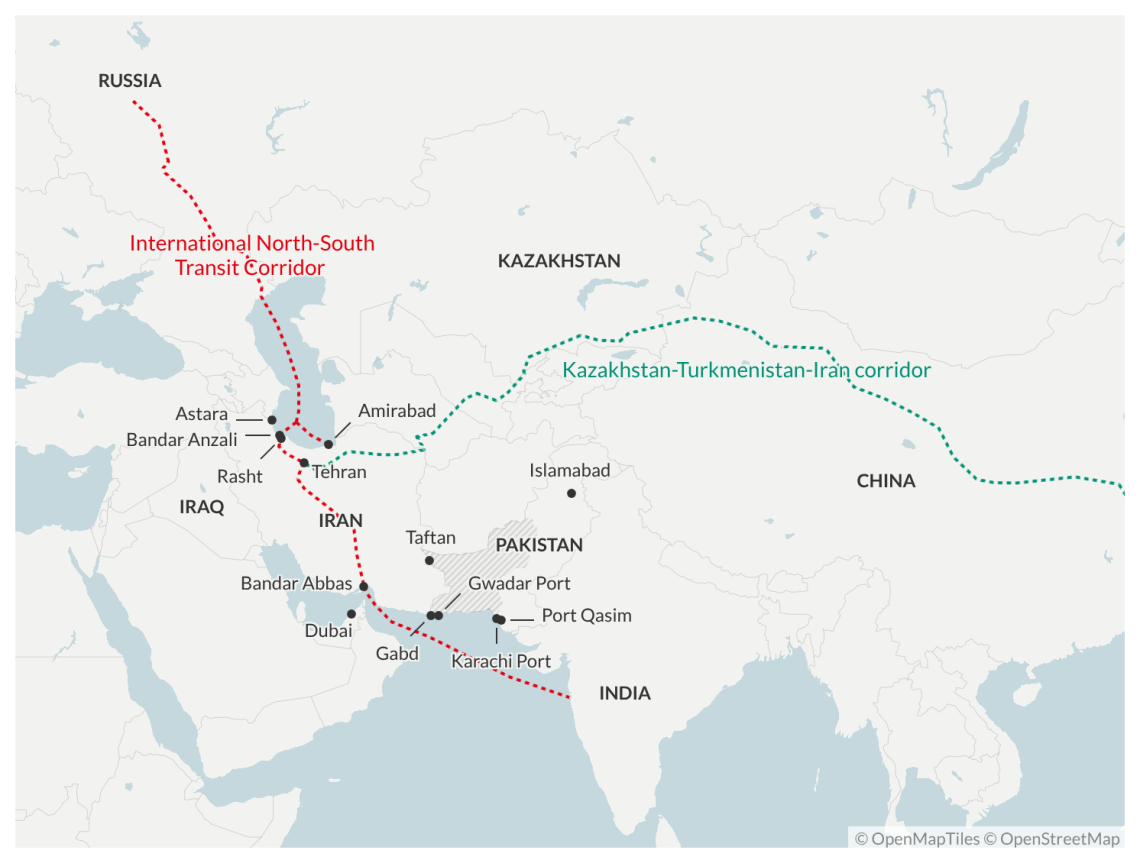 No longer strictly constrained to trade via the Strait of Hormuz, Iran has been able to maintain trade using alternative routes. Pakistan’s province of Balochistan (shaded) has enabled overland trade and is of particular significance for Iran. © GIS
The Caspian corridor, free of disruption from the U.S. navy, allows Iran to maintain supplies of wheat, corn and edible oil, as well as military materials. But the Caspian ports have limited capacity and can only handle smaller vessels. Additionally, in July 2026, Ukraine targeted Iran-linked vessels in the Caspian Sea.
Using trucks to move goods through northern land routes is also much more expensive than shipping goods through ocean links. But in its effort to survive, Iran appears willing to pay that price for now; shipments across the Caspian Sea have reportedly increased significantly.
Iran-Pakistan trade and transport links
Iran and Pakistan share a relatively porous 900-kilometer border straddled by the ethnic Baloch people. Pakistan’s mediation role in the Iran war seems to have provided a boost to their trade and transport ties, which has, in turn, helped Iran evade Western sanctions.
Even before the latest war, Iran and Pakistan had tried to expand their economic and commercial partnership, in keeping with Pakistani leaders’ decades-old goal of regional economic integration with neighboring Muslim countries. Following President Trump implementing his maximum pressure sanctions, first in 2018 and reintroducing them in early 2025, Iran and Pakistan signed 12 agreements in August 2025, setting a target of $10 billion in bilateral trade by 2028.
Iranian-Pakistani commerce in March 2025 alone reached $3.13 billion. In its effort to circumvent sanctions, even this relatively small volume of trade was important for Iran, especially because cash payments and barter arrangements helped it bypass dollar-clearing requirements. Soon after mediating a ceasefire between Iran and the U.S. in June, Pakistan allowed the entry of goods originating from third countries into Iran overland through Pakistan.
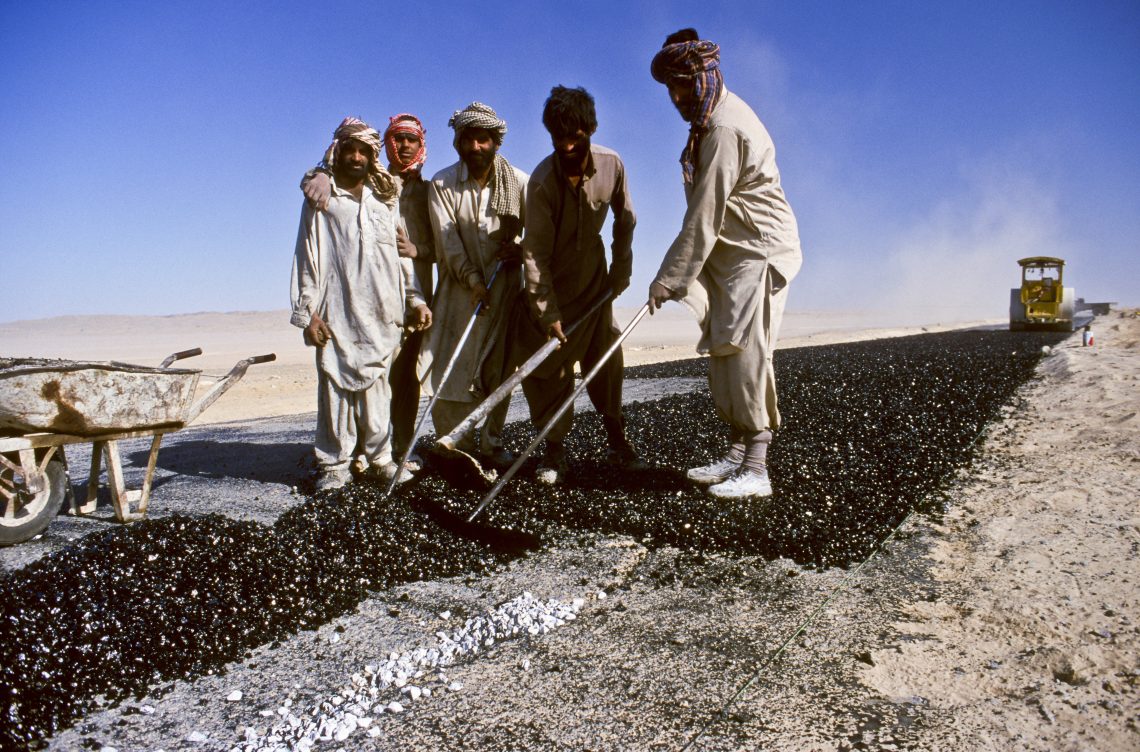 Workers paving a road between Taftan, a town on Pakistan’s border with Iran, and Quetta, the capital of the province of Balochistan, in 2000. Transport links between Pakistan and Iran are now crucial for Iran’s economic survival. © Getty Images
When Iran attempted to blockade the Strait of Hormuz, Pakistan designated six road corridors linking its ports in Karachi, including Port Qasim, as well as in Gwadar, to the Gabd and Taftan land crossings through Balochistan for trade with Iran. These crossings have enabled exchanges in daily essentials as well as fuel, including electricity and gas.
The economy along the Iran-Pakistan land border operates with both formal customs procedures and smuggling of a wide range of goods, including liquified petroleum gas and other petroleum products, steel, food, agricultural goods and some manufactured items. Pakistan benefits by receiving cheap Iranian fuel and consumer goods, while Iranian suppliers are able to access Pakistan’s market and hard-currency transaction mechanisms.
Iran and Pakistan are currently implementing a barter mechanism and have applied the Customs Convention on the International Transport of Goods under Cover of TIR Carnets (TIR Convention, 1975), both of which enable them to bypass sanctions by avoiding the scrutiny in traditional banking channels. Pakistan often grants temporary exemptions from normal banking-instrument requirements for essential exports to Iran.
Iranians and Pakistanis seem to believe that the development of these overland routes has a long-term significance that will outlast the current war.
Pakistan has also eased some export rules to facilitate transit trade between Iran and Central Asian countries through its territory. Islamabad has temporarily waived formal banking rules for essential supplies to Iran as well as Pakistani exports to Central Asian states, trying to bolster its own exports. As a consequence, Iran is building resilient transportation corridors through Pakistan and into Central Asia.
All of this ties in with Pakistan’s geostrategic ambitions. Islamabad has, for years, sought to make Pakistan a transit trade and energy corridor between the Middle East and Central Asia. Its leaders see an opportunity to attain that goal while the U.S. tries to bring the Iranian regime to heel through economic measures.
Iranians and Pakistanis seem to believe that the development of these overland routes has a long-term significance that will outlast the current war.
Iran and Russia
As two countries that are revisionist, revolutionary and seek to reprise their pride and status, Iran and Russia have a lot in common. Both Iran and Russia face Western sanctions and have built interdependence in financial, commercial and transportation fields.
Over time, Iran and Russia have moved to conduct bilateral financial settlements using a rial-ruble exchange bypassing the SWIFT architecture. Currently, 90 percent of their bilateral trade is through this mechanism linking Iran’s homegrown interbank telecommunication and financial messaging system SEPAM to Russia’s alternative to SWIFT, called SPFS. Even though bilateral trade stands at only $5 billion, it avoids Western sanctions and banking restrictions.
Given its geography, regional influence and strategic interests, Russia has been key to Iran’s attempts to build resilient and efficient supply chains. The 2025 Comprehensive Strategic Partnership Treaty between the two countries institutionalized what has been built over the previous two decades.
The central element of this effort is the International North-South Transit Corridor (INSTC), which was established in 2000 by India, Russia and Iran as an alternative transportation corridor and trade route to the Suez Canal. The INSTC, a 7,200-kilometer multimodal network, gained significance for Russia after it launched war on Ukraine in 2022.
Currently, 75 percent of the entire project has been completed. From an efficiency standpoint, movement through the INSTC is expected to be 30 percent cheaper and 40 percent shorter than traditional trade routes, such as the Suez Canal. According to the Kazakhstan-based Eurasian Development Bank, the corridor will be able to haul 30 million tons by 2030, providing $1.5 billion in transit fees to Iran.
In addition to this corridor, cargo already moves through St. Petersburg-Astrakhan-Anzali-Bandar Abbas via the Caspian Sea-river link, and through Kazakhstan and Turkmenistan by rail. The next step of the project involves completion of the Rasht-Astara railway, which would give unimpeded railway access from St. Petersburg in Russia to Bandar-Abbas in Iran.
For Iran and Russia, this route enables them both to avoid American sanctions while ensuring a stable flow of goods. It prevents them from being reliant on Western supply lines or chokepoints not under their direct control. It is also diverse with two land routes and one sea route, meaning disruptions can be mitigated by switching supply lines. The western path goes through Eastern Europe, while the Caspian route and the eastern route go through Central Asia.
Iran and China
Iran’s geography, at the crossroads of the Middle East, South and Central Asia with a large coastline, has long made it attractive to Beijing. For China to trade with the Middle East, both overland and via sea, trade and transport corridors through Iran are critical. Iran formally joined China’s Belt and Road Initiative in 2021 when the two nations signed the 25-year Cooperation Program, according to which China receives discounted oil and a market for its exports while Iran gets technology and Chinese investments.
The primary land-based transport links between the two countries are rail connections through Central Asia. These lines have become increasingly important since the start of Iran’s war with the U.S., and the American naval blockade only deepened their strategic value. The key rail link connects the Chinese cities of Yiwu and Xi’an to Iran via the Kazakhstan-Turkmenistan-Iran corridor that first opened in 2014 but was extended in 2025 by Chinese freight links.
Read more by Ambassador Husain Haqqani
The rail corridors provide a trade route that bypasses U.S. sanctions and is more removed from geopolitical tensions. However, rail transport is less efficient for Iranian exports. While the rail link does save time (goods on that route take less than two weeks to reach China), freight trains on the line can only carry 50 containers, whereas sea tankers are able to hold 20,000 in a single journey.
Pakistan plays a key role in deepening the Iran-China relationship because of its strategic relationship with China and because many of the transport links between Iran and China pass through Pakistan.
×
Scenarios
Most likely: Iran reroutes trade and builds parallel networks
To maintain some, albeit less, economic activity until a new administration moves into the White House, Iran will continue to respond to Washington’s trade and financial pressures by rerouting trade and building parallel networks where it believes the U.S. lacks leverage.
America’s ideological adversaries, Russia and China, and Iran’s opportunistic neighbors, Turkiye and Pakistan, are likely to continue to help Iran in that effort, making sanctions less effective. These links cannot make Iran sanctions-proof, but they raise the cost of isolating it, which is precisely their strategic value.
Iran’s total global trade volume was $125 billion in 2024, which fell to $110 billion just before the February 2025 sanctions, and stood at $32 billion for the first five months since the beginning of the current war. Using monthly figures from the Iran Customs Administration, Iran’s current trade levels are projected to reach $76 billion in 2026.
There has been an over 28 percent decline in non-oil exports, and imports have also fallen by over 26 percent as a result of the latest conflict and trade restrictions. These official trade figures do not include the value of illicit trade through the Caspian and Pakistan corridors.
For most countries, such a massive drop in normal trade value would be crippling. But Iran’s leadership is interested in survival, not economic growth or the welfare of its people. With the alternative trade and finance networks it has built, the regime could limp along until the end of the Trump administration and the emergence of a different U.S. policy toward Iran.
Less likely: U.S. exploits weaknesses in Iran’s remaining trade partners
Among Iran’s remaining trade partners, Pakistan is most vulnerable because its land routes of trade with Iran run through Balochistan, home to a long-running insurgency. Its economy could also suffer from secondary sanctions from the U.S. Nevertheless, Pakistan’s utility to President Trump as a mediator with Iran hedges against that risk.
Least likely: Collapse of the Iranian regime or international sanctions consensus
The collapse of the Iranian regime within the next 18 months or the success of the U.S. in building an international consensus for more enduring and punitive sanctions would require Russia and China to put pressure on Iran, which appears unlikely under present circumstances.
Contact us today for tailored geopolitical insights and industry-specific advisory services.
Sign up for our newsletter
Receive insights from our experts every week in your inbox.