

Listen to this article
Estimated 5 minutes
The audio version of this article is generated by AI-based technology. Mispronunciations can occur. We are working with our partners to continually review and improve the results.
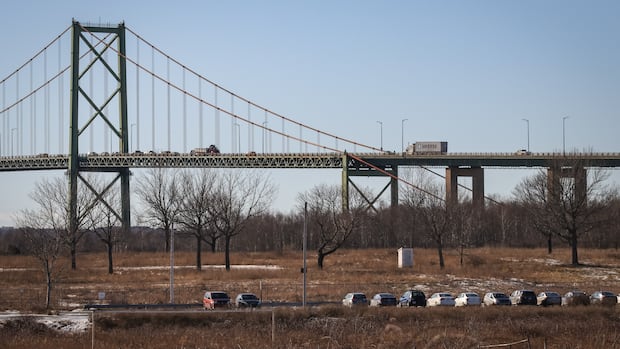
Any plan to upgrade or replace Halifax’s aging A. Murray MacKay Bridge would cost up to $3 billion and could involve private sector financing partners or selling the bridge, says the CEO of Halifax Harbour Bridges.
But CEO Tony Wright said all funding options are still on the table.
The bridge opened in 1970 and will need significant enhancements in the coming years in order to remain operational, said Wright. But fixing it isn’t the only option.
“We need to know what the long-term plan is so we can fine-tune our maintenance requirements to deal with that expected life cycle of the structure,” said Wright in an interview last week.
The two most likely alternatives, he said, are full replacement of the bridge or a tunnel between the Windsor Street exchange and Burnside.
The province solicited proposals for the project earlier this year, asking companies to pitch possible crossing options and a preliminary design outline for their preferred plan.
Proposals also included cost estimates, procurement options and funding strategies.
Historically, harbour bridge-related projects have been publicly funded, including the $150 million “Big Lift” project between 2015 and 2017 that extended the Angus L. Macdonald’s life.
That public funding was largely supported by tolls until last year, when the province removed them.
Public-private partnership
The project’s inclusion in the province’s portfolio at the Canada Investment Summit earlier this month indicated possible interest in incorporating private financing into the equation.
The project’s listed capital expenditure was $3 billion, which Wright said is a ballpark figure based on other recent bridge builds in the country.
Wright says its inclusion at the summit was helpful because it boosted the project’s profile and could help generate federal funding down the line. He didn’t say whether it generated any interest from private investors.
The public-private partnership model, by which the government retains ownership but uses private funding to cover costs, is common for major infrastructure projects.
But Liberal MLA Becky Druhan said she was surprised when she saw the bridge on the list of projects at the summit.
“We went from a system where tolls provided revenue and that revenue supported the maintenance, operation and supported the replacement of bridges,” she said in an interview last week.
“Private capital isn’t free … so investors are going to expect a return.”
During the legislature’s fall sitting, she asked Public Works Minister Fred Tilley how it would generate that return.
“It could be a design build. It could be a trade-off or something. Land or something like that, on the Dartmouth side,” said Tilley.
“We’re not sure what the return will be, but I can guarantee you one thing: it won’t be tolls.”
Full privatization
Moshe Lander is a senior lecturer of economics at Concordia University in Montreal. He said a public-private partnership makes sense in a lot of cases, and that another way for the government to pay back its investors is to raise taxes.
But Lander thinks the third option on the table is the best one: full privatization.
“Sell it to the highest bidder,” he said.
The move would generate significant revenue for the government upon sale and shift the replacement or enhancement and future maintenance costs off the province’s books.
He said the province would be able to set strict conditions regarding allowable profits for prospective owners to prevent “some rent extraction exercise for the poor people that have to use the bridge,” if it reintroduced tolls.
Should the province privatize the MacKay bridge, he said, it could still mitigate costs for those who rely on it.
“You offer a public transport option. You can offer a carpooling option,” he said.
“Or you can credit it back so you have to pay the toll. But if you earn less than $50,000 a year, the government will pay your tolls for you by subtracting it off of your income taxes.”
While most major bridges that accommodate millions of cars annually like the MacKay bridge are government-owned, private ownership is not without precedent.
The Ambassador Bridge, which connects Detroit, Mich., and Windsor, Ont., was built in the 1920s and is presently owned by billionaire Matthew Moroun and his family of Detroit.
The for-profit bridge generates revenue just as most publicly-owned bridges do, by charging tolls to users.
Wright said it will likely take another 18 months for the province to decide on a plan for the future of the MacKay bridge and what combination of public and private money will pay for it.
He said while a private sale isn’t entirely off the table, it’s too early to know whether it could make financial sense for the province and its taxpayers.
“Is that something that the consultants that we’re going to be working with will bring to the table?” he said.
“We would really need to understand what the value is for Nova Scotians.”
MORE TOP STORIES