
(Sept. 29, 2026 / JNS)
Few holidays display the extraordinary variety of Jewish life quite like Sukkot.
The basic requirements are the same whether a sukkah stands in Jerusalem, New York, Casablanca or Samarkand. Jews dwell in a temporary structure and take the “Four Species” or “Four Kinds” prescribed by the Torah.
But over the centuries, communities around the world added their own touches, drawing on the plants, flowers, foods, and decorative traditions of the places where they lived. The result is a remarkable collection of Sukkot customs, many of which survived migrations, upheavals and the disappearance of the communities that created them.
The practice of decorating a sukkah is itself ancient. The Talmud (Sukkah 10a-b) describes holiday huts adorned with colorful fabrics and sheets, along with nuts, almonds, peaches, pomegranates, clusters of grapes, wreaths made from stalks of grain, and even wines, oils and flour.
Subsequently, a related custom developed in the Land of Israel and some Sephardic communities, where the seven species were used to decorate the sukkah. Wheat and barley, along with olive oil and honey, were placed in glass bottles, while grapes, figs and pomegranates were hung directly from the sechach—the thatched or branched roof.
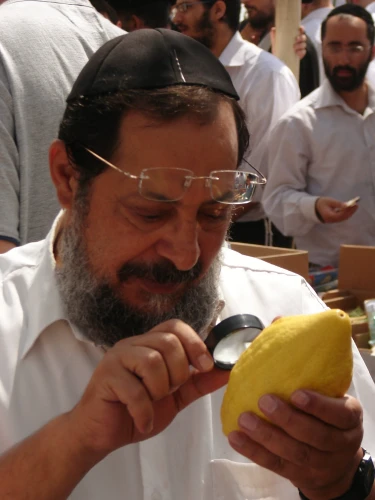
A Jewish man inspects a Yemenite etrog at a market in Bnei Brak, Israel, in 2007. Credit: Aviad2001/Creative Commons via Wikimedia Commons.
The decorations took very different forms from one community to another.
In Yemen, some Jews had a particularly practical custom. Wheat was harvested around the month of Tishrei, when Sukkot is celebrated. The grain would then be set aside for making matzah for Passover, while the stalks were used as sechach, thereby connecting the two festivals. Yemenite sukkahs were also frequently built in a designated area of the house beneath a section of roof that could be removed when the holiday arrived.
Bukharan Jews made use of what grew around them as well. In Bukhara, in present-day Uzbekistan, willow branches were commonly used for sechach. Willow branches and wildflowers were also fashioned into wreaths and placed around the entrance to the sukkah. (A well-known photograph taken in Samarkand in 1902 preserves an image of just such a sukkah.)
For the Jews of Rhodes, Sukkot had its own sights and smells. The Rhodes Jewish Museum records that sukkot were decorated with palm branches, myrtle, fruit, colored paper chains and embroidered tapestries. One recollection from the community describes the aroma of the leaves mingling with orange blossoms and grapevines, as well as biscochos, the traditional Sephardic cookies, hanging from the sukkah along with fruit.
The basic mitzvah remained unchanged, even as each community made the sukkah unmistakably its own.
Moroccan sukkahs could be considerably more elaborate. In The Book of Jewish Food, Claudia Roden, who was born and raised in Cairo, described huts erected on rooftop terraces, lined with cloth and furnished with rugs, mattresses, brocades, silk shawls and embroidered curtains.
One distinctive custom had some Moroccan families placing a small decorated chair in the sukkah for Elijah the Prophet. Holy books associated with Sukkot were sometimes placed upon it. Rabbi Daniel Bouskila has described how his own Marrakesh family maintained the custom, linking Elijah with the mystical traditions of Moroccan Jewry.
Italian Jewry developed a very different visual tradition. In the 18th century, elaborate paper decorations bearing Hebrew texts and illustrations became popular in Italian sukkahs. One surviving example, created around 1775 by Israel David Luzzatto of Trieste, uses tiny Hebrew lettering from Ecclesiastes to form an intricate astronomical image—an armillary sphere rendered in micrography.
Ashkenazi communities across Central and Eastern Europe favored their own paper arts: chains, cut-outs and hanging apples and pears that offered another way of making the sukkah festive without altering the sechach.
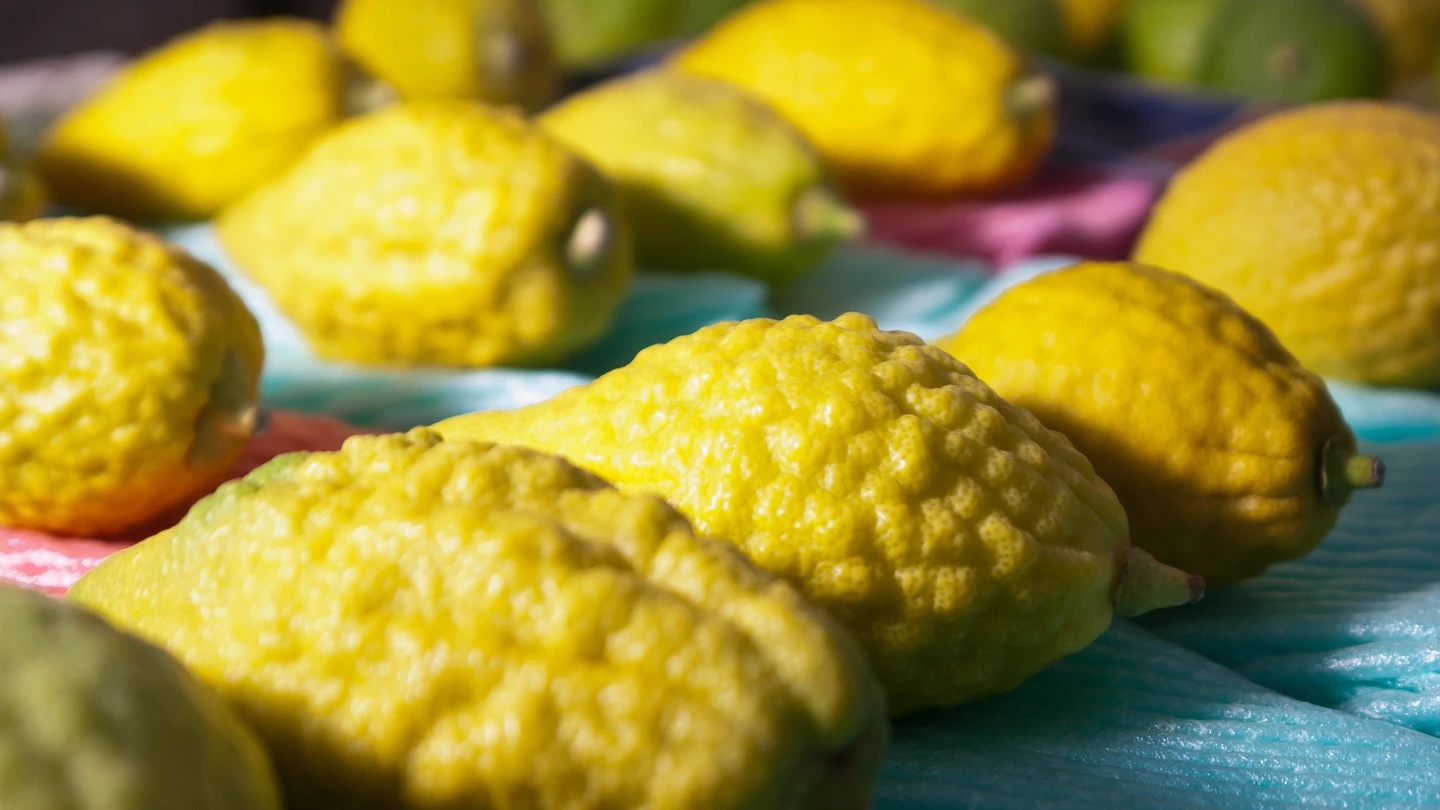
Italy also left its mark on another central feature of Sukkot: the etrog.
For centuries, Jews prized citrons grown in Calabria in southern Italy. Because an etrog from a grafted tree raises problems with Jewish law, or halachah, considerable care was taken to obtain fruit from trees considered acceptable for the mitzvah. Calabrian etrogs became known as Yanover etrogim, from “Yanova,” the Yiddish name for Genoa, the port through which they were shipped to Jewish communities across Europe. The preference for such etrogs remains particularly strong among Chabad Chassidim, who make a point of using Calabrian ones whenever possible.
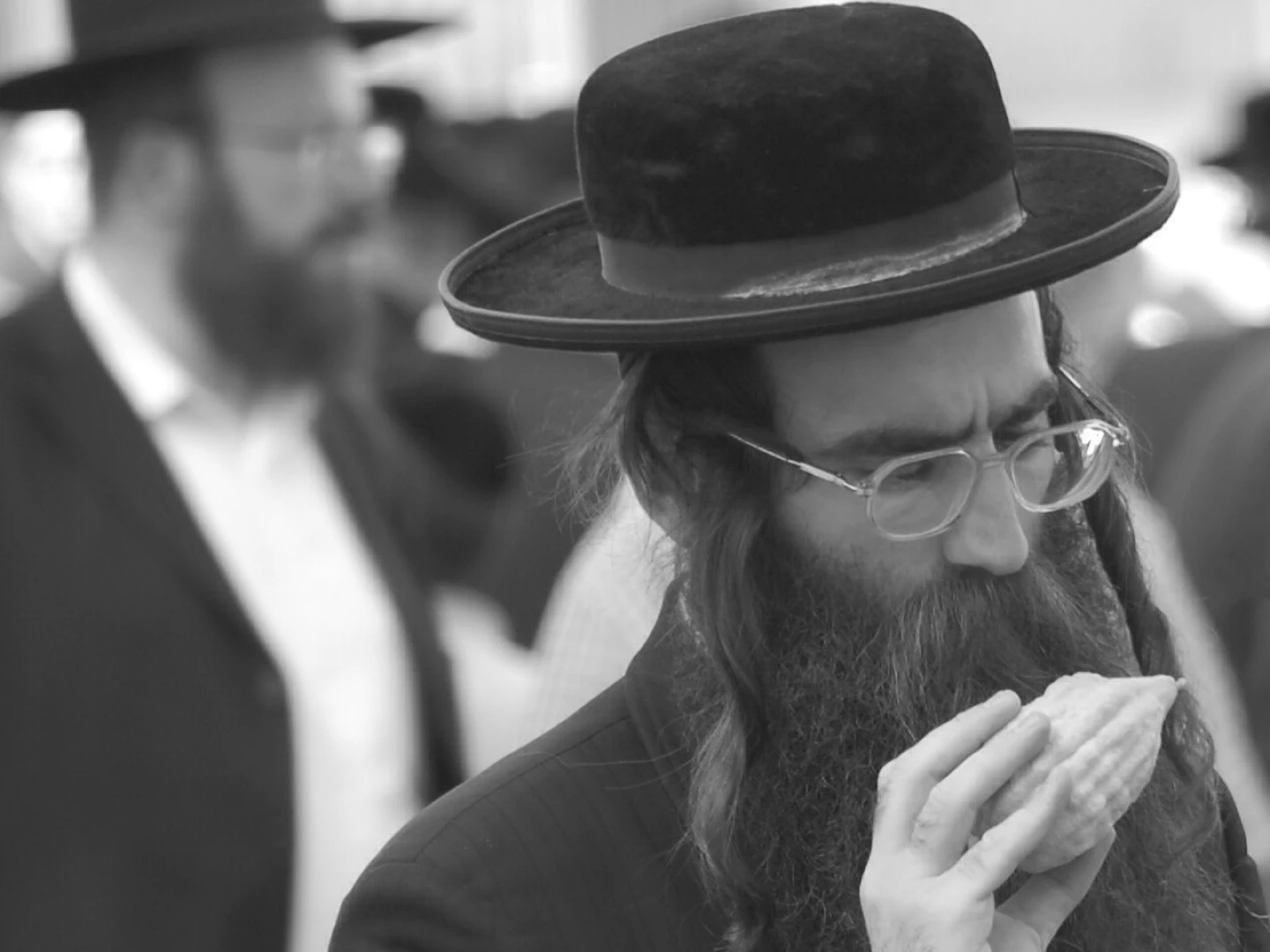
An Orthodox Jewish man inspects an etrog in Jerusalem. Credit: Sir Kiss/Public Domain via Wikimedia Commons.
A kind of map of Jewish history
Elsewhere, the local landscape supplied the roof itself. In Argentina, eucalyptus branches were widely used for sechach, filling the sukkah with their distinctive fragrance. In Cochin, India, huts were traditionally built with bamboo and plaited coconut-palm leaves.
Ethiopian Jews developed a very different custom. Rather than every family building its own sukkah, entire communities would gather in one large communal sukkah, turning the festival into an explicitly shared experience.
And then there are Jews who deliberately decorate their sukkah with nothing at all.
That is the Chabad-Lubavitch custom.
In a letter dated 7 Cheshvan 5715 (Nov. 3, 1954), the Lubavitcher Rebbe explained that the sukkah’s bare walls and sechach should themselves make an impression on the person sitting inside. Decorations, he wrote, are additions to the sukkah rather than part of its essence, and Chabad tradition preferred that the sukkah convey its message without what he called external ornaments.
Taken together, these customs form a kind of map of Jewish history.
A Yemenite sukkah preserved the wheat stalks of the Arabian Peninsula. A Bukharan one carried the willows and wildflowers of Central Asia. Jews on Rhodes hung the cookies they baked, Moroccan Jews brought the fabrics and furnishings of North Africa inside, and Italian Jews turned the sukkah walls into works of Hebrew art. Argentine eucalyptus, Indian palm leaves, and Ethiopia’s communal sukkah told the same story in very different settings.
The basic mitzvah remained unchanged, even as each community made the sukkah unmistakably its own.
That may be one reason minhagim (Jewish customs) matter so much. Long after Jews have left Yemen, Bukhara, Rhodes or Morocco, a particular branch, decoration, cookie or piece of fabric can preserve something of the Jewish life that once flourished there.
The sukkah is used for a week. But the customs we bring into it can carry centuries of Jewish memory.