
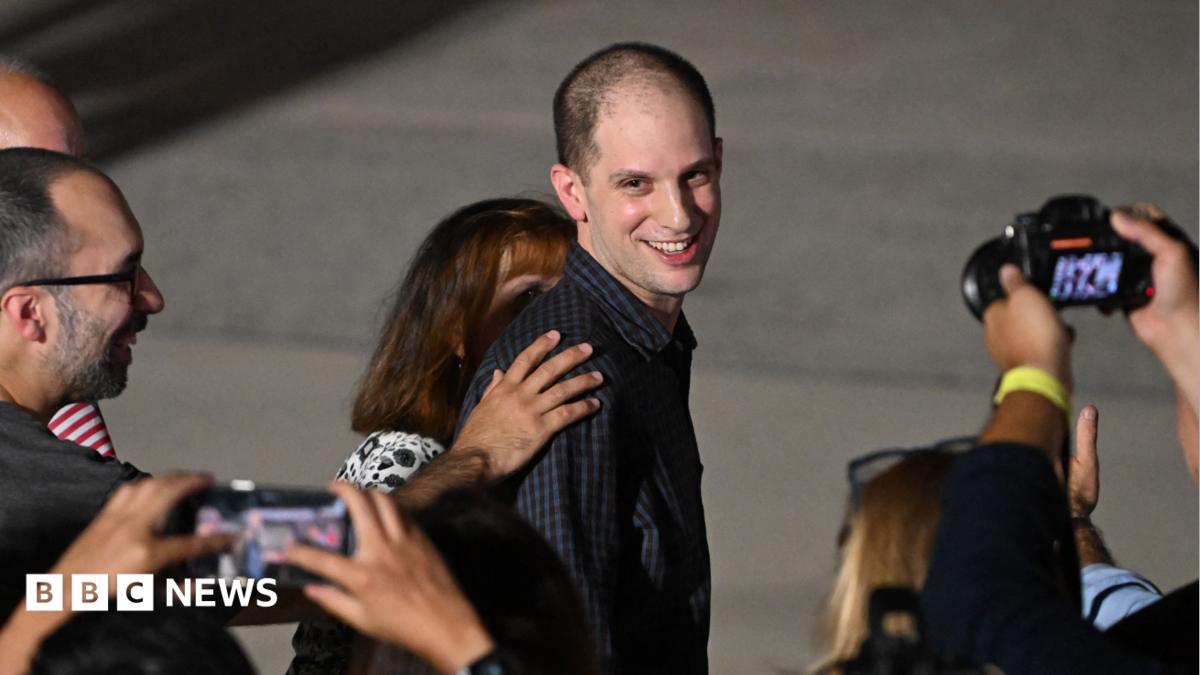
US journalist Evan Gershkovich has said that he knew he was being set up by Russia when he was arrested by FSB agents and accused of being a spy.
In an interview with Radio 4’s Today programme, Gershkovich spoke about the moment he realised he had been “lured into a trap” when masked men surrounded him at a restaurant in 2023, and detained him.
“I’m not interrogated, I’m not tortured… I’m accused of espionage,” he said, describing a sense of relief: “They’ve set me up and fabricated this case so that I can be a valuable hostage – a pawn in a greater game”.
Gershkovich, now 34, was sentenced to 16 years in prison, but freed 16 months later as part of a high-profile prisoner swap deal.
Gershkovich had been living in Russia since 2017, and was the Wall Street Journal’s foreign correspondent in Moscow when he was arrested – he is now based in Berlin, Germany. He and his employer have always maintained that the charges were false.
On the day he was arrested, Gershkovich was in Yekaterinburg – about 1,600km (1,000 miles) east of Moscow – meeting someone who he thought was a source for a story.
They were sitting in a half-empty dining hall “and a group of about half-dozen masked men marched in and said ‘I think we booked that table’.” An odd phrase, Gershkovich said, but on reflection it is clever because it “freezes you in place”.
The two men stood up and Gershkovich was told he was under arrest by the notorious and powerful FSB, Russia’s domestic security service.
“It’s at that moment that you realise it’s something really serious… When it’s the FSB, you know it’s been planned.”
What about the man he’d been meeting? Gershkovich saw him disappear into the crowd.
Not long after his arrest, the journalist said he realised that the fact he was not being interrogated or tortured – common tactics used by Russia’s security service on spies – likely meant that he was being treated more like a commodity, not a true enemy of the state.
“I have this odd moment – a sense of relief flooding over me,” he said. “I realised they’re not treating me like a real spy. They’ve set me up and fabricated this case so that I can be a valuable hostage, a pawn in a greater game. That means it will take a while, but I won’t be here for 12-20 years.”
That realisation helped him stay “stable and disciplined in prison”, but also gave him a unique way of predicting what might happen next – and one guess was a prisoner swap.
“I assumed that it would be really loud, that it would cause a global uproar. I mean, it’s a foreign correspondent for the Wall Street Journal,” he said – and he was right.
Media organisations around the world reported on the case, his face was on a billboard in Times Square and then-US President Joe Biden said he had “no higher priority” than bringing Gershkovich home.
The journalist believed that this was all part of Moscow’s plan – to have a high-profile prisoner that it could swap for one of its own – and that was Vadim Krasikov, an assassin who was serving a life sentence in Germany.
“They [Moscow] got away with it in the sense that there were no sanctions imposed. And so they played it really smart, if you think about it cynically.”