
A new push for the Senate nominee to moderate his position comes as the Democratic establishment is lining up behind him.
(JTA) The activists on the Zoom supporting Abdul El-Sayed knew they faced an uphill climb when it came to persuading their fellow Jewish Democrats to overcome their concerns about the Michigan Senate candidate and vote for their party’s nominee despite his strong disapproval of Israel.
Two progressive Jews, former Biden administration appointee Sam Bagenstos and Detroit Jews for Justice co-founder Hayley Sakwa, made the Jewish case for the candidate to a sometimes skeptical, sometimes combative crowd of around 30 people on Sunday night.
Sakwa and Bagenstos urged voters to prioritize the chance to put a check on the larger Trump agenda – including heavy immigration crackdowns and the rightward tilt of the federal judiciary – given that the Michigan seat could help determine who controls the legislative chamber.
But their appeal wasn’t enough for several of the people on the call, who less than two days later would sign on to the “Nonnegotiables” petition. Spearheaded by a group of Michigan Jewish clergy, the open letter calls for El-Sayed to moderate his views on Israel and affirm more vocal support for Jews in politics as a condition for earning their votes.
The 17 new names to the petition, shared with the Jewish Telegraphic Agency ahead of their release on Tuesday morning, include state Rep. Noah Arbit, the founder of the Michigan Jewish Democratic Caucus.
Arbit recently gave a speech denouncing antisemitism on the floor of the Michigan House and has been critical of El-Sayed publicly: After progressive Jews recently hosted the candidate for a Rosh Hashanah dinner at their house, the representative accused them of “tokenism.” (Arbit declined to comment to the Jewish Telegraphic Agency.)
Other new names on the list include an elected University of Michigan regent and prominent local attorney, as well as several board members of the Jewish Democratic caucus, which itself is not endorsing a candidate in the race.
Concerns raised on the Sunday night Zoom call included El-Sayed’s opposition to Iron Dome funding for Israel and his earlier campaigning with anti-Israel streamer Hasan Piker, whom he has since distanced himself from. Some said they were worried he could open a door to a more hostile Democratic Party for Jews.
“With Abdul it sort of feels like letting a fox into the henhouse,” one said.
“I refuse to be anyone’s dhimmi,” another wrote in the chat, referring to a term for non-Muslims living under Islamic rule.
Yet any pressure Jewish Democratic critics of El-Sayed hope to place on the candidate are partly balanced out by the work of those such as Sakwa, who along with other Jewish liberals has to date secured 900 signatures pledging to vote for El-Sayed. A competing letter of Jewish voters pledging to back his Republican challenger, former U.S. Rep. Mike Rogers, has picked up 524.
At the same time, the broader Democratic Party has ramped up its efforts to get elected officials in line behind the nominee. The El-Sayed campaign has yet to respond publicly to the “Nonnegotiables,” and with little more than a month to go before Election Day, it might not need to.
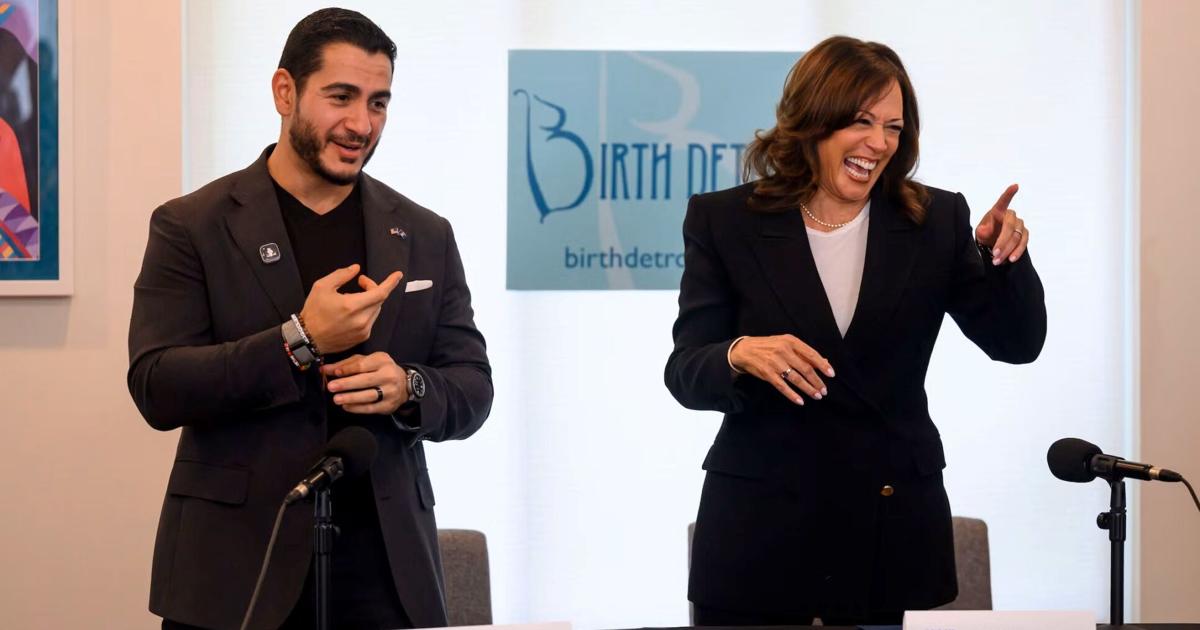
Former Vice President Kamala Harris campaigned with El-Sayed last week in Detroit, and the liberal-leaning editorial board of the Detroit Free Press, the state’s largest daily newspaper, endorsed the former county health director over the weekend.
The Free Press wrote that its own endorsement was against an “extremist” — referring to Rogers and President Donald Trump — in language that one bloc of Jewish voters also used to refer to their own decision to vote for Rogers over El-Sayed.
In addition, Michigan Attorney General Dana Nessel, who is Jewish and has fiercely criticized El-Sayed for his past comments about Jews and Israel, endorsed and appeared with the candidate on a local liberal podcast hosted by a Jewish woman to project unity.
“There is no choice,” Nessel said.
But the conversation demonstrated that tensions still remain even with many Jewish Democrats who have thrown in their lot with El-Sayed.
“Is there space for a Jewish Zionist like myself?” she asked him. “Is there space for us in the big tent of the Democratic Party?”
“I believe in a big tent,” he answered. “I am committed to having a tent where we march in lock step on the 95% of issues that we agree on.”
But the attorney general, who cited the risk of antisemitic threats as the reason she skipped the party convention earlier this year, wasn’t done.
“The question many of us have is: Are you seeking our votes?” Nessel asked El-Sayed. “Do they matter to you?”
“Yes,” the candidate responded. “If you trust that I’ll lead well for the community, even if there’s an issue on which we deeply disagree, then I hope I can earn your vote.” Later, El-Sayed said, “I look forward to working” on the Jewish American Security Act, a bipartisan bill to institute new Jewish security measures, including in synagogues and on college campuses.
“We’ve had an uptick in antisemitism, and it is critical to protect Jewish Americans,” El-Sayed said.
As with Nessel, El-Sayed’s candidacy is pushing other Jewish Democrats to perform a difficult two-step: pushing for the party platform and against Trump, without getting too close to the candidate himself.
The Jewish Democratic Council of America, whose CEO, Halie Soifer, is a Michigan native, is also not endorsing in the race. Yet Soifer told JTA, “Jewish voters will support Democrats in large numbers in the midterms, including in Michigan.” She predicted that Rogers wouldn’t earn more than one-quarter of the Jewish vote.
“Jewish voters recognize that a vote for any Republican in 2026 is a vote for Donald Trump,” Soifer told JTA over text. “We know Jewish voters are a critical component of a winning Democratic coalition.”
Decky Alexander, who chairs the Michigan Jewish Democratic Caucus, pointed to consistently high Democratic voting records for Jews in arguing that Jews still matter to the party’s coalition. She also favorably noted the Democratic National Committee’s recent announcement that it would establish a “Jewish American Council,” to convene in 2027.
“We can’t be distilled down to one vote or one idea,” Alexander told JTA.
One part of the state’s Jewish Democratic bloc unlikely to support El-Sayed: members of Temple Israel, the country’s largest Reform congregation. Speaking to the national publication The Free Press last week, several members, including a preschool teacher who was in the building when it was attacked in March, said El-Sayed’s apology for his earlier remarks about the temple was insufficient and that they couldn’t bring themselves to vote for him.
“No thinking Jew could vote for Abdul El-Sayed,” a former temple president told The Free Press.
None of the synagogue’s clergy signed the “Nonnegotiables” letter, or any other Jewish letter circulating about El-Sayed. But one of the temple’s rabbis told congregants in a Kol Nidre sermon that they had a say in drafting it, stating, “Our full participation in American political life is also non-negotiable.”
“No one should have to pass a test about Israel to be welcomed into a coalition on a campus or in a political party,” Rabbi Josh Bennett told his congregation, which had convened in the Temple Israel building for the High Holidays for the first time since the March attack. Rabbi Jen Lader, also of Temple Israel, recently visited Washington, D.C. to advocate for the Jewish American Security Act.
As Rogers has looked to win over dissatisfied Jews to his campaign, he has also moved toward El-Sayed on at least one issue tangentially related to Israel: opposition to the war in Iran. Initially a supporter of the war, Rogers in recent days has said he thinks it should “end quickly.”
El-Sayed, meanwhile, has raised eyebrows of his own in recent days. He dithered on denouncing the Iranian regime when urged to by an Iranian Christian college student, and appeared at a Dearborn fundraiser with Osama Siblani, a local Arab-American activist and newspaper publisher who once stated at a rally, “We are not going to be intimidated by staying silent when they say Hamas is a terrorist organization.”
The “Nonnegotiables” petition was launched earlier this month by a group of more than a dozen Michigan Jewish clergy after a series of apologies by El-Sayed to Jewish audiences for past comments he had made about the Temple Israel attack. The candidate needs to do more to earn the community’s confidence, the campaign’s organizers have told JTA.
“A large number of Jews haven’t decided how they will vote,” David Kramer, the caucus’s vice chair and one of the new signers, told JTA about the letter’s potential influence. “I speak to these people every day. Regardless of how they vote, Michigan Jews want and deserve to feel safe and have a seat at the table.”
As the Zoom call wrapped, some of the assembled Jews said they would vote for El-Sayed, even if reluctantly. Alexander of the state’s Jewish Democratic Caucus, who signed the letter supporting him, told the crowd the candidate has nothing to hide, even if they don’t like what he says.
“He’s basically stated what he believes,” she said. “And you have to decide if that’s the word for you.”