
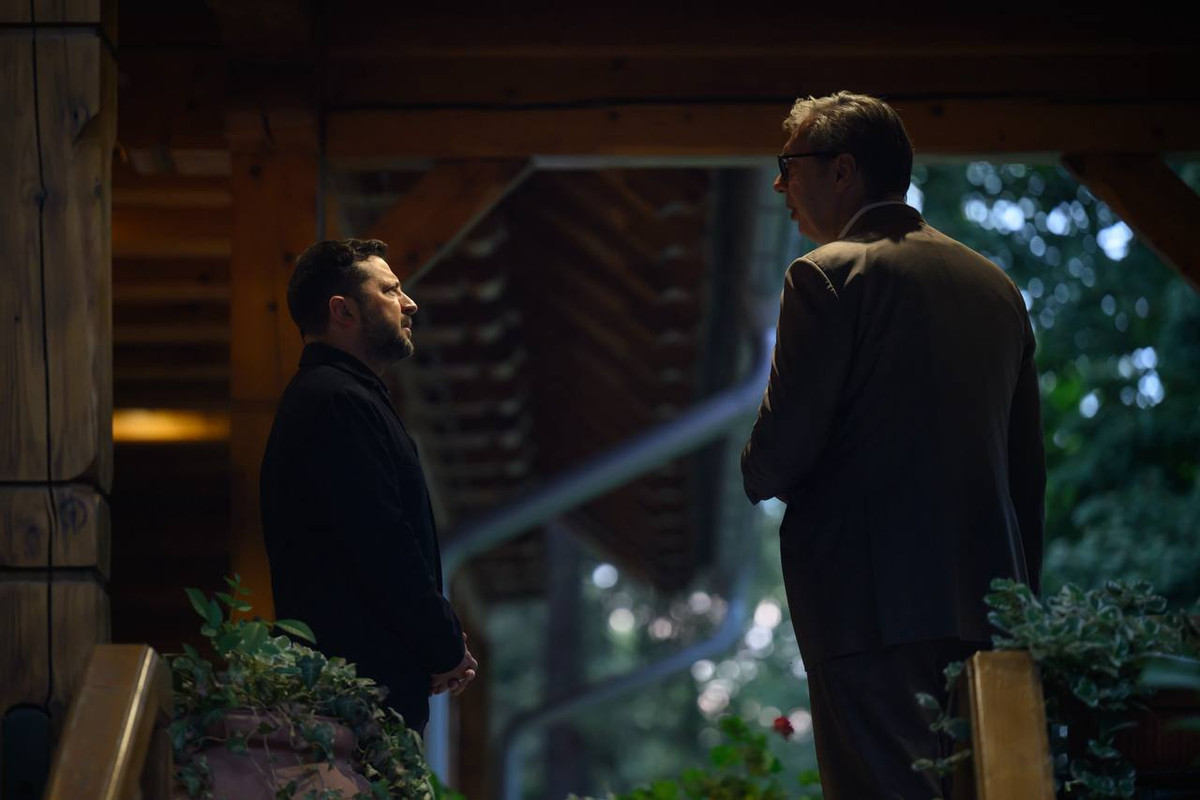
After months of publicly announcing that he would step down from his post, Serbian President Aleksandar Vučić officially submitted his resignation on Sunday, following a telephone call in which he informed his long-time ally, Russian President Vladimir Putin, of his decision.
Vučić, first elected in 2017 and re-elected in 2022, signed his resignation live on television on Sunday evening, cutting his second and final term short by eight months.
JOIN US ON TELEGRAM
Follow our coverage of the war on the @Kyivpost_official.
He stepped down to campaign “as an ordinary citizen” before the Oct. 25 parliamentary election, after which he intends to become prime minister if the Serbian Progressive Party (SNS) wins, according to Index.hr.
Bloomberg likened the switch to a power move by Putin, who swapped the presidency for the premiership in 2008.
Under Serbia’s constitution, an early presidential election must be held within 90 days, no longer than Dec. 26, with SNS member Ana Brnabić serving as acting president until then.
The decision to resign comes as Vučić navigates several pressures; pursuing EU membership, maintaining close economical and political ties with Russia and supporting Ukraine’s territorial sovereignty.
Why Vučić chose to stepp down
Vučić’s resignation follows months of student-led anti-government protests that erupted when a canopy at Novi Sad’s newly renovated railway station collapsed on Nov. 1, 2024, killing 16 people.
The demonstrations were among the world’s largest in recent years, fueled by grievances of government corruption.
Other Topics of Interest
Government to Prioritize Defense, Social Spending Amid Tight Public Finances
Prime Minister Serhii Koretskyi said part of the planned international funding has not yet arrived, in part because Ukraine failed to fulfill some of the obligations towards international partners.
The same student-led movement is now fielding its own list of 250 candidates.
Balancing EU path and Russian ties
Vučić attended the Carpathian Eight (C8) – Ukraine’s newest regional cooperation initiative, which was launched by President Volodymyr Zelensky on Sept. 18 in Bukovel, western Ukraine.
The format brings together Ukraine, Serbia, Romania, Poland, Slovakia, the Czech Republic, Austria and Hungary, along with EU institutions.
“We have much to offer – from railway lines and roads to more open borders,” Vučić said, signaling openness to future cooperation with Ukraine across several sectors. His participation, he said, was aimed to preserve stability and peace for Serbia and its citizens.
Yet, just days before resigning, Vučić emphasized Serbia’s energy partnership with Moscow, while also boasting their 14 year long “friendship.”
In a video address posted on social media on Saturday, he said the annex to the gas agreement with Russia could be extended from Monday, securing what he called a “good and low gas price” of of €318 ($361) per 1,000 cubic meters (264.172 gallons), far below the market rate of €868 ($987).
Currently, Belgrade remains one of the few European countries that has not joined EU sanctions against Russia and continues to import discounted Russian gas and oil, citing discounted prices.
Vučić is also one of a small number of European leaders who continue to travel to Moscow.
Meanwhile, the Serbian president has long positioned the country as a candidate for EU membership – a process that requires progress on rule of law and normalization of relations with Kosovo – which Serbia does not recognize.
Regarding Kosovo, Kyiv sides with Belgrade. Russia does as well, which Vučić previously cited as the reason for not sanctioning the country.
During his first official visit to Serbia in August, Zelensky said Ukraine would not recognize Kosovo’s independence in the future either; a move that bolstered his standing in Belgrade but drew criticism from other Balkan states that compared it to the situation in Ukraine.
Meanwhile, Russian state-owned media TASS is closely monitoring the situation in Serbia and reports that analysts do not expect the election outcome to lead to any major shifts in Belgrade’s foreign policy course.
However, they particularly note that Serbia could move closer to Western positions.
Polina Sokolova, a research fellow at the Russian Academy of Sciences’ Institute of World Economy and International Relations, said that a Serbian turn against Russia under Western pressure “cannot be excluded.”
For Moscow, should Serbia become more Western-aligned, this could lead to the hindered “prospects of transitioning to a peaceful settlement.”
According to TASS, this is precisely because the European countries, “which have been Ukraine’s main sponsors, do not demonstrate any intention to enter substantive negotiations, taking Russia’s interests into account.
Yet on Sept. 23, 51 countries issued a joint statement backing Ukraine at the 81st United Nations General Assembly (UNGA) and urging Russia to accept a full ceasefire, which Ukraine agreed to in March 2025.
Throughout the five years of the war, Ukrainian authorities have repeatedly pushed for a direct meeting with Putin, while also urging its allies to organize a trilateral negotiation.
So far, the Kremlin has rebuffed every proposal.
During the same summit, Russian Foreign Minister Sergey Lavrov said Russia would not halt its war, even during negotiations.
Backing Kyiv on Crimea and Donbas
Despite Vučić’s deep ties to Moscow, Serbia has backed Ukraine’s territorial integrity since the early days of Russia’s full-scale invasion, stating that Crimea and Donbas are Ukrainian territory.
His position runs counter to Moscow’s core demands in any possible ceasefire settlement, which envisions retaining control over the annexed peninsula and parts of eastern Ukraine.
Kyiv has repeatedly rejected giving up its territorial sovereignty as a prerequisite for peace.
Belgrade has also provided Kyiv with non-military assistance throughout the war, which has drawn sharp criticism from Russia. The Kremlin has also accused Vučić of selling munitions to Ukraine, which the Serbian president has repeatedly denied.
Serbia is one of Kremlin’s last reliable partners in Europe, and every step Belgrade takes toward the EU could narrow Moscow’s influence in the Balkan region.
While cheap gas could keep Serbia close for now, should the EU membership ever demand a choice, the country may have to take a stronger stance towards Russia.