
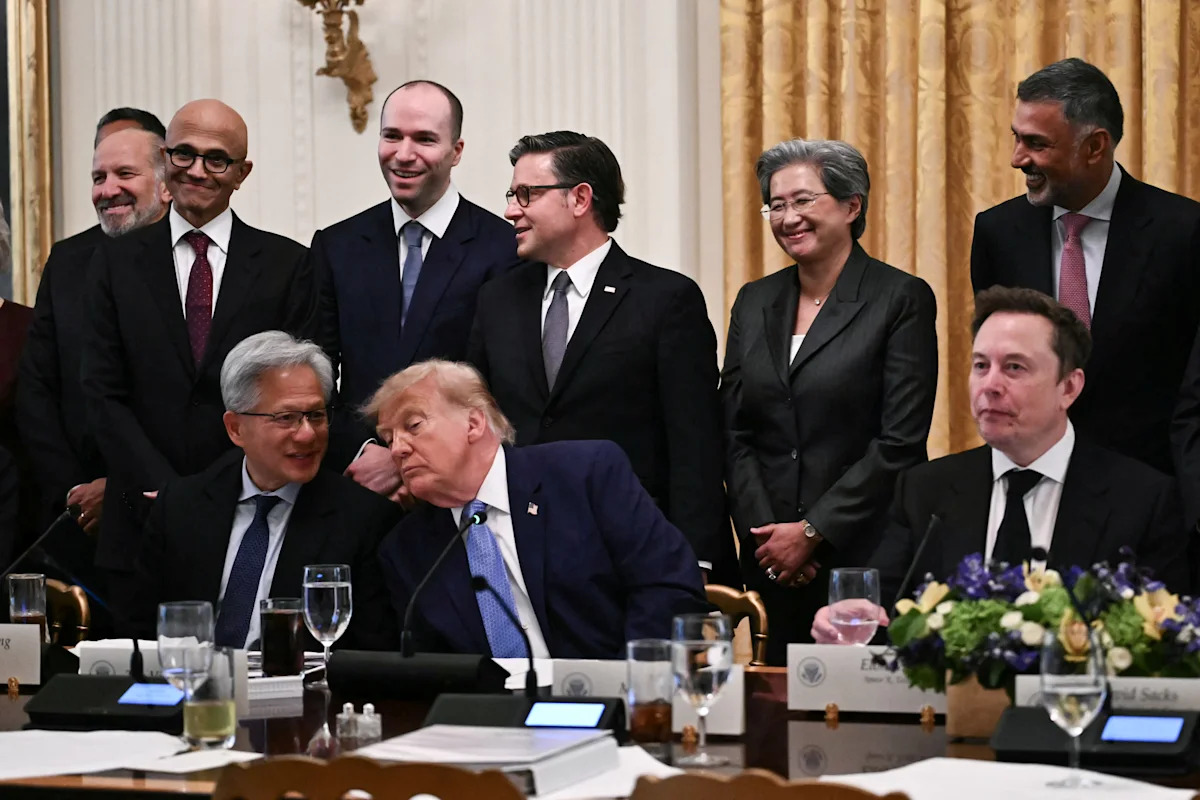
President Trump gathered top artificial intelligence leaders in Washington on Tuesday and doubled down on his opposition to government intervention, suggesting that “self-regulation” is the answer to growing worries about the technology getting out of human control.
“There’s a belief that there should be tremendous self-regulation,” the president said after meeting with the assembled CEOs. “There was a lot of commonality in this room.”
Trump said he and the CEOs signed a “morally binding” accord that wasn’t immediately released but that the president said would keep the companies in line through “self-policing and group policing.”
Some executives on hand said the so-called Accord on Super Intelligence would include commitments to a combination of technological controls to detect problems with new models, internal risk review efforts, external auditors, and other measures.
Meta (META) CEO Mark Zuckerberg called the accord “a start,” while others suggested some details still needed to be worked out.
 President Trump speaks with Nvidia CEO Jensen Huang and others during a meeting with technology executives about artificial intelligence in the East Room of the White House on Sept. 29. (Kent Nishimura/AFP via Getty Images) · KENT NISHIMURA via Getty Images
“The mechanism, how we address those risks, is still under discussion,” Anthropic (ANTH.PVT) CEO Dario Amodei said. Progress had been made toward both the US winning AI and also winning safely, he said, though he emphasized that the technology still poses “real dangers.”
Amodei published an essay earlier this month titled “We Must Pace the Frontier,” which set off a fierce debate about the need for a cooperative slowdown in AI capability.
The accord also formally changed the name of the technology in government record-keeping to Super Intelligence.
“We’ve changed the name officially to SI,” Trump said.
The “meeting and luncheon on Super Intelligence,” as the White House described the event, took place in the East Room, with Trump even posting the seating chart. The location was the same spot where just a few days ago, many of the same AI leaders gathered for a state dinner for Chinese President Xi Jinping.
Elon Musk of Tesla (TSLA), Jensen Huang of Nvidia (NVDA), and Lisa Su of Advanced Micro Devices (AMD) were all at the head table with Xi last Thursday and again received prominent spots near Trump.
After the meeting, Trump also said he was “very close” to a decision on an AI czar and would announce it in the next three to four days.
Other notable guests included Google (GOOGL, GOOG) CEO Sundar Pichai, Microsoft (MSFT) CEO Satya Nadella, OpenAI (OPAI.PVT) president Greg Brockman, Palantir (PLTR) CEO Alex Karp, Amazon (AMZN) founder Jeff Bezos, and others.
President Donald Trump holds a press briefing with AI executives following a meeting on artificial intelligence at the White House on September 29. (Kevin Dietsch/Getty Images) · Kevin Dietsch via Getty Images
The gathering came as the US continues to digest a raft of alarming new AI disclosures in recent days, such as an Axios report that OpenAI, Anthropic, and security researchers were sifting through thousands of incidents of problematic actions by AI agents.
And in Florida, the attorney general unveiled a new state-level challenge asking a court to halt OpenAI’s training of new models unless it puts outside safeguards in place.
But that skepticism didn’t change the tenor of the gathering in Washington.
Trump repeatedly brushed off worries about the technology, saying after the meeting that he believes AI will make the world a safer place and that fears about data centers driving up costs were overblown.
He said instead that these new facilities “are going to make communities very happy.”
At an event earlier in the day to launch a new government website powered by AI, Trump promised that AI is “going to mostly be put to great use and we’ll stop the bad use,” through the Department of Justice and FBI.
President Trump speaks during a meeting with technology executives about artificial intelligence on Sept. 29. (Kent Nishimura/AFP via Getty Images) · KENT NISHIMURA via Getty Images
He added he would “never stifle the growth of technology that will be bigger than the industrial revolution.”
This story has been updated.
Ben Werschkul is a Washington correspondent for Yahoo Finance.
Read the latest financial and business news from Yahoo Finance