
This afternoon (29 September), Security Council members are expected to participate in the fourth straw poll to select a candidate to recommend to the General Assembly as the next UN Secretary-General. According to Article 97 of the UN Charter, the “Secretary-General shall be appointed by the General Assembly upon the recommendation of the Security Council”. Straw polls are informal ballots used to determine the viability of Secretary-General candidates before the Council makes its formal recommendation by adopting a resolution during a private meeting.
Like the previous three straw polls, which were held on 30 July, 21 August, and 18 September, today’s straw poll is expected to take place in the consultations room. Yesterday (28 September), Bahrain and the Democratic Republic of the Congo (DRC) were appointed as tellers.
There will again be no difference between the ballots used by the five permanent members (P5) and the ten elected members (E10). Council members are expected to receive one ballot per candidate, containing the candidate’s name followed by three options: “encouraged”, “discouraged”, and “no opinion expressed”. No representatives of the UN Secretariat will be present, no official record of the results will be kept, and the Council president is expected to shred the ballots at the end of the straw poll. (For background, see our April research report titled “Power, Process and Participation: The Search for the Next Secretary-General”.)
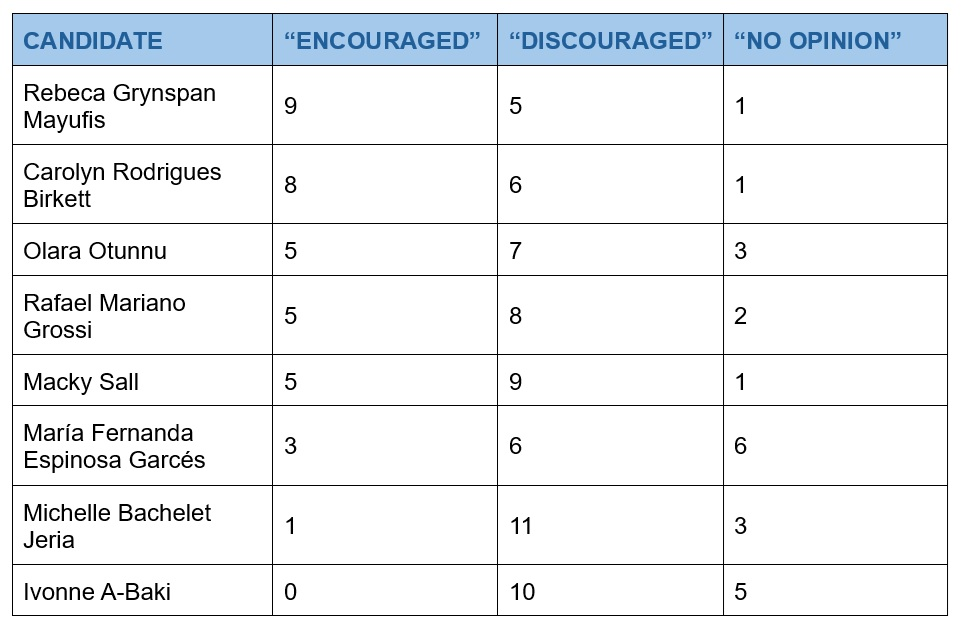
On 20 September, Michelle Bachelet Jeria (Chile) withdrew her candidacy. Her decision followed the third straw poll in which she received one “encouraged”, 11 “discouraged”, and three “no opinion” votes. In the statement announcing her withdrawal, Bachelet said that although some might believe that the time was not right for the candidacy she sought to put forward—at a time marked by strong headwinds against multilateralism, international law, recognition of climate change, democracy, and human rights—this was the right moment to advance these principles. (Bachelet was nominated by Brazil, Chile, and Mexico on 2 February. Chile withdrew its nomination on 24 March.)
Following Bachelet’s withdrawal, seven candidates are expected to be voted upon today:
Ivonne A-Baki (Ecuador), who was nominated by Tonga on 17 August;
María Fernanda Espinosa Garcés (Ecuador), who was nominated by Antigua and Barbuda on 11 May;
Rafael Mariano Grossi (Argentina), who was nominated by Argentina on 26 November 2025;
Rebeca Grynspan Mayufis (Costa Rica), who was nominated by Costa Rica on 3 March;
Olara Otunnu (Uganda), who was nominated by Uganda on 24 July;
Carolyn Rodrigues Birkett (Guyana), who was nominated by Guyana on 15 June; and
Macky Sall (Senegal), who was nominated by Burundi on 2 March.
Similarly to the previous straw polls, the Council will not release the results of the informal vote. Ambassador Jérôme Bonnafont (France), in his capacity as this month’s Council president, is expected to announce to the press that the straw poll has taken place, without giving any information about the results. Although the results of the first three straw polls were not officially announced by the president of the Security Council, they were nonetheless quickly leaked and published online.
Results of the Third Security Council Straw Poll
Results of the First Three Straw Polls (in alphabetical order):
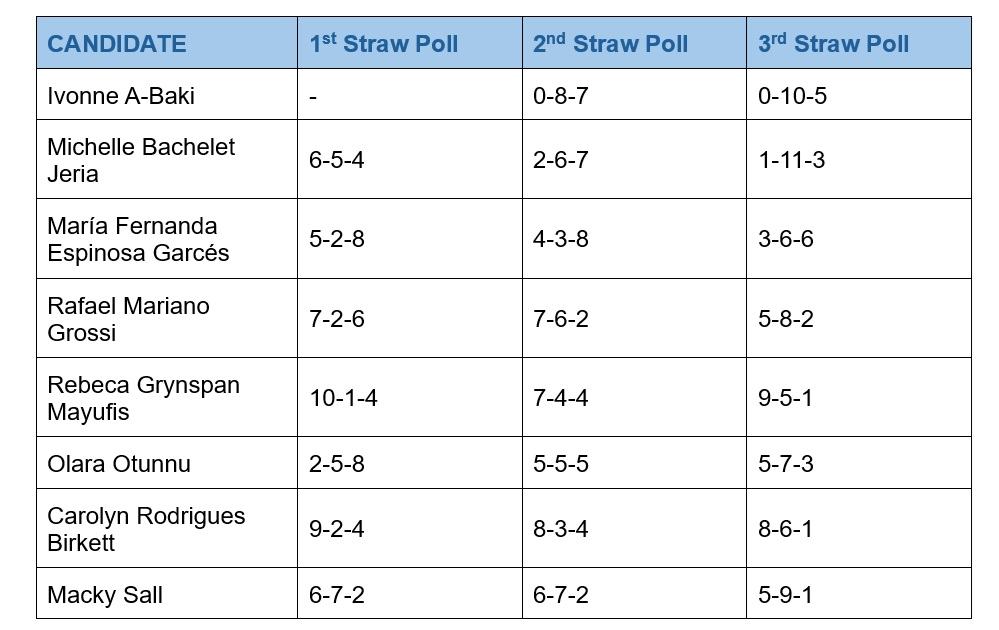
Source: 1 for 8 Billion.
After three rounds of straw polls, it does not appear that any of the candidates has established a pattern of votes that would suggest the Security Council is clearly rallying around a consensus choice. While the high number of “no opinion expressed” votes seen in the first two straw polls has declined, several of those votes appear to have shifted to “discouraged” votes, raising questions about the viability of several contenders.
In the second straw poll, the “encouraged” votes accounted for 32.5 percent of the ballots, the “discouraged” votes for 35 percent, and the “no opinion expressed” votes for 32.5 percent, an almost even split among the three categories. In the third straw poll, the “discouraged” votes rose to 51.7 percent, while the “no opinion expressed” dropped to 18.3 percent. The “encouraged” votes were almost unchanged, accounting for 30 percent of the ballots.
After coming in second in the second straw poll, Grynspan moved back into first place in the third straw poll, reaching the threshold of nine “encouraged” votes, the minimum number needed if this were a formal vote. (The Council’s decision to recommend to the General Assembly a candidate for appointment as Secretary-General is considered a matter of substance, which under Article 27 (3) of the UN Charter requires “an affirmative vote of nine members including the concurring votes of the permanent members”.) However, Grynspan obtained an additional “discouraged” vote, going from four to five. By comparison, António Guterres received no more than three “discouraged” votes during the 2016 selection process.
In second place, Rodrigues Birkett remains close to Grynspan, with one fewer “encouraged” vote and one additional “discouraged” vote, which brings her total number of “discouraged” votes to six. This is a significant increase compared to her previous results, given that she received just two “discouraged” votes in the first straw poll and three in the second, where she was the leading candidate. Since members have yet to begin using colour-coded ballots that differentiate between P5 and E10 votes, it is yet unclear whether either Grynspan or Rodrigues Birkett is opposed by a permanent member.
Otunnu performed comparatively better than some of the candidates from Latin America, including Grossi, whose position appears to have further weakened—but Otunnu’s seven “discouraged” votes still represent a substantial obstacle. Espinosa Garcés continues to attract a relatively high number of “no opinion expressed” votes, suggesting that some Council members remain undecided. At the same time, she received three additional “discouraged” votes in the latest round.
The pace of Council members’ decision-making is increasingly attracting attention, particularly given that the final straw polls, which were colour-coded, in both the 2006 and 2016 selection processes took place in early October. There is a growing sense that Council members may soon need to seriously consider when to move to colour-coded ballots in order to obtain greater clarity on the viability of the candidates.
Although there is a general understanding that it is important for the next Secretary-General to have sufficient time to prepare before assuming office on 1 January 2027, some members may see advantages in prolonging the process. Keeping the process open might allow Council members to assess shifting patterns of support and set the ground for new candidates to come forward, while potentially providing opportunities to secure commitments on issues of interest.
Today’s straw poll comes days after the high-level week of the 81st General Assembly, where all the candidates were present and actively engaged with a range of member states. The results may offer insights into whether candidates’ efforts helped Council members narrow their preferences or whether the field remains as unsettled as it has been in recent rounds. If today’s informal vote produces stronger levels of support for one or two candidates, while reducing their “discouraged” votes, it could indicate that members are beginning to coalesce around a leading contender or contenders. If the results remain fragmented, however, questions about the direction and duration of the process, including whether the field of candidates should be broadened, may gain further traction.
Depending on the results of today’s vote, the fifth straw poll may be scheduled as early as next week.
Tags: Appointment of the Secretary-General, Insights on UN Institutional Issues
Sign up for What’s In Blue emails