
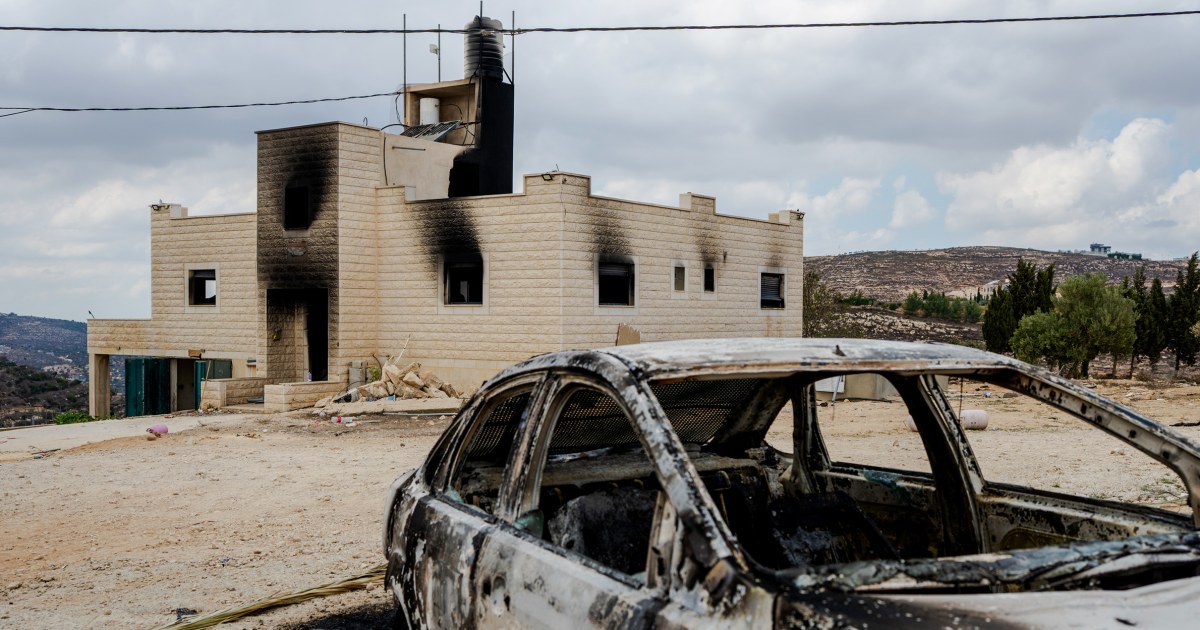
After the settlers entered the property, Tubassi said, his family was urged by the Israeli security forces to go to the roof, where the settlers followed them. Several of the soldiers and officers formed a physical barrier between the family and the settlers, Tubassi said.
Tubassi said the security officials told them to get back in an armored car and drove them to safety.
The security forces’ failure to return the Tubassis to their home comes as settler violence in the occupied West Bank has become a growing international embarrassment for Israeli leaders, who have struggled to explain how Israel’s formidable military has repeatedly found itself outmatched by hundreds of lightly armed young men.
Israeli Prime Minister Benjamin Netanyahu condemned the attacks in a statement Tuesday and called on the rioters to be prosecuted. The “handful of rioters are not representative of the law-abiding settler public in Judea and Samaria,” he said, using the biblical and historical term for the West Bank.
The statement echoed his comments at the United Nations General Assembly last week, in which he rejected “vigilantism” by Jewish settlers in the West Bank but sought to minimize the violence, suggesting the problem only involved “a handful of juvenile delinquents, about 150 in number, who throw stones, who down olive trees, occasionally they light some fires.”
According to the U.N. Office for the Coordination of Humanitarian Affairs (OCHA), some 6,500 Palestinians have been displaced due to settler attacks in the West Bank since 2023. Between Jan. 1 and July 24, Israeli forces or settlers killed 76 Palestinians, according to the latest data available from OCHA. Three Israelis were killed over the same period, the data shows.
The agency recorded nearly 200 settler attacks that resulted in Palestinian casualties or property damage in August alone.
Israel has regularly accused the U.N. of siding against it. But many governments around the world consider the West Bank to be illegally occupied by Israel.
Monday night’s police and military action in Jalud was an attempt to execute an order by Israel’s High Court of Justice, which had instructed the “relevant authorities” earlier this month to ensure that the Tubassis return to their home within two weeks.
The court also demanded that security forces explain to the Tubassis and another Palestinian family “why they are not working to return the family to their homes and why they are not removing the barriers and obstacles blocking access to the houses.”
It was unclear Tuesday if or when the police and military would try to execute the court’s order again, and the Israel Defense Forces said it had no details about how the issue would be handled in the near term.
“The Israelis didn’t say anything to me” about future plans, Tubassi said in the phone call from his father’s home nearby where the family has been staying. “I don’t know if they will let me go back.”
Whether they will be able to return after last night’s fire remains to be seen as the home has been badly damaged.
“What happened was a nightmare for us,” Tubassi said. “And now we are living through other nightmares, because our loss has become so great. The state of Israel has not stopped these thugs from taking our homes and our land and from killing us.”