

2026-09-29 11:15
11:15
September 29, 2026
am
America/Chicago
Republish this story
GLADSTONE, Missouri — Missouri’s constitutional right to an abortion is on the verge of disappearing, again.
It’s a threat that loomed over Tiffany early on a recent September morning, when she drove into Gladstone, just north of Kansas City, for her abortion.
The 26-year-old mother of three made the two-day trip to reach the clinic just a couple of weeks after finding out she was pregnant. Despite living in Springfield, a city of about 170,000 near the Arkansas border, she couldn’t find an appointment for an abortion at her local clinic until late October, near the end of her first trimester.
Instead of waiting, she decided to spend the night at a friend’s house halfway between her home and the Planned Parenthood in Gladstone — the first clinic that could take her — hours away. After her appointment, she planned to drive back home in time to meet her children when the bus dropped them off.
“I love kids so much,” she said, sitting on an exam table, waiting to see the doctor. This abortion, she explained, “has everything to do with loving my own children, that I already chose to have.”
But in November, the rights of Missourians including Tiffany to get such care — which has been slowly becoming more available across the after a 2024 vote to enshrine abortion rights in the state constitution — may come screeching to a halt.
A proposal known as Amendment 3 would reverse that vote and ban abortion in the state constitution, allowing the procedure only in rare cases: when pregnancy constitutes a medical emergency, upon the discovery of a fetal anomaly or before 12 weeks in cases of rape or incest. It would also ban gender-affirming care for transgender minors, even though such care is already illegal in Missouri.
More from The 19th
The measure, put forth by the state legislature months after the 2024 vote that dismayed conservative lawmakers, would make Missouri the only state in the country whose constitution explicitly bans abortion. If successful, it could inspire similar efforts in other states whose governments consist largely of lawmakers who oppose abortion but whose residents have voted to protect reproductive rights, such as Ohio, Montana or even neighboring Kansas.
“I think of the constitution as something that’s supposed to protect us, and that doesn’t feel very protective,” Tiffany said.
Tiffany, who asked that her last name be withheld because she has told few people about her abortion, knew that terminating her pregnancy was the right choice. A fourth grade teacher, she also has a part-time gig on the weekends, and drives for Lyft and Doordash in her spare time. Still, she was struggling to pay her bills. Now, a new source of strain: She and her husband, whom she had been with since she was 17, separated in July. The divorce would be yet another thing to pay for, another burden on her children.
She hadn’t wanted to keep her first pregnancy 10 years ago. But she was 16 and didn’t have a choice; she couldn’t find anyone in Missouri who would give her an abortion. Now, she said, she would travel anywhere she had to for one — even out of state. Credit card debt was nothing compared to what having another child would do to her family.
“I would have continued to exhaust all options to find an outcome that wasn’t having a baby,” she said.
Her last pregnancy, three years ago, had also been difficult. At 30 weeks, she’d been diagnosed with preeclampsia, a dangerous high blood pressure condition that left her with residual kidney damage. When she had her son less than a month later, he stayed in the hospital for weeks after.
At the Gladstone clinic, she received two medications: mifepristone, to stop her pregnancy from growing, and misoprostol, which she would take from home to expel the embryo inside her.
This was the fourth clinic she’d contacted and the first one that could see her, a reflection of the difficulty of getting an abortion even in a state where its right remains, for now, enshrined in the constitution.
The 2024 vote that established abortion rights in Missouri undid a ban that took effect the day Roe v. Wade fell in 2022. But translating that into actual clinics offering appointments, and to patients getting abortions, has been a slow, painstaking process in a state that for years prior to Roe’s end had made the procedure almost impossible to come by through a litany of restrictions. By the time Roe fell, providers had already stopped performing abortions at all but one clinic in the state.
Reproductive health clinics across the state have had to build their abortion offerings almost from scratch since 2024, recruiting physicians and training personnel, many of whom had never worked in clinics that offered the service.
Even now, two years after the vote, abortion appointments aren’t easy to find in Missouri. Planned Parenthood Great Plains, which operates most of the six clinics available statewide, offers abortions on eight or 10 days a month. The Planned Parenthood in Gladstone, where Tiffany finally got her abortion, only began offering the service in July.
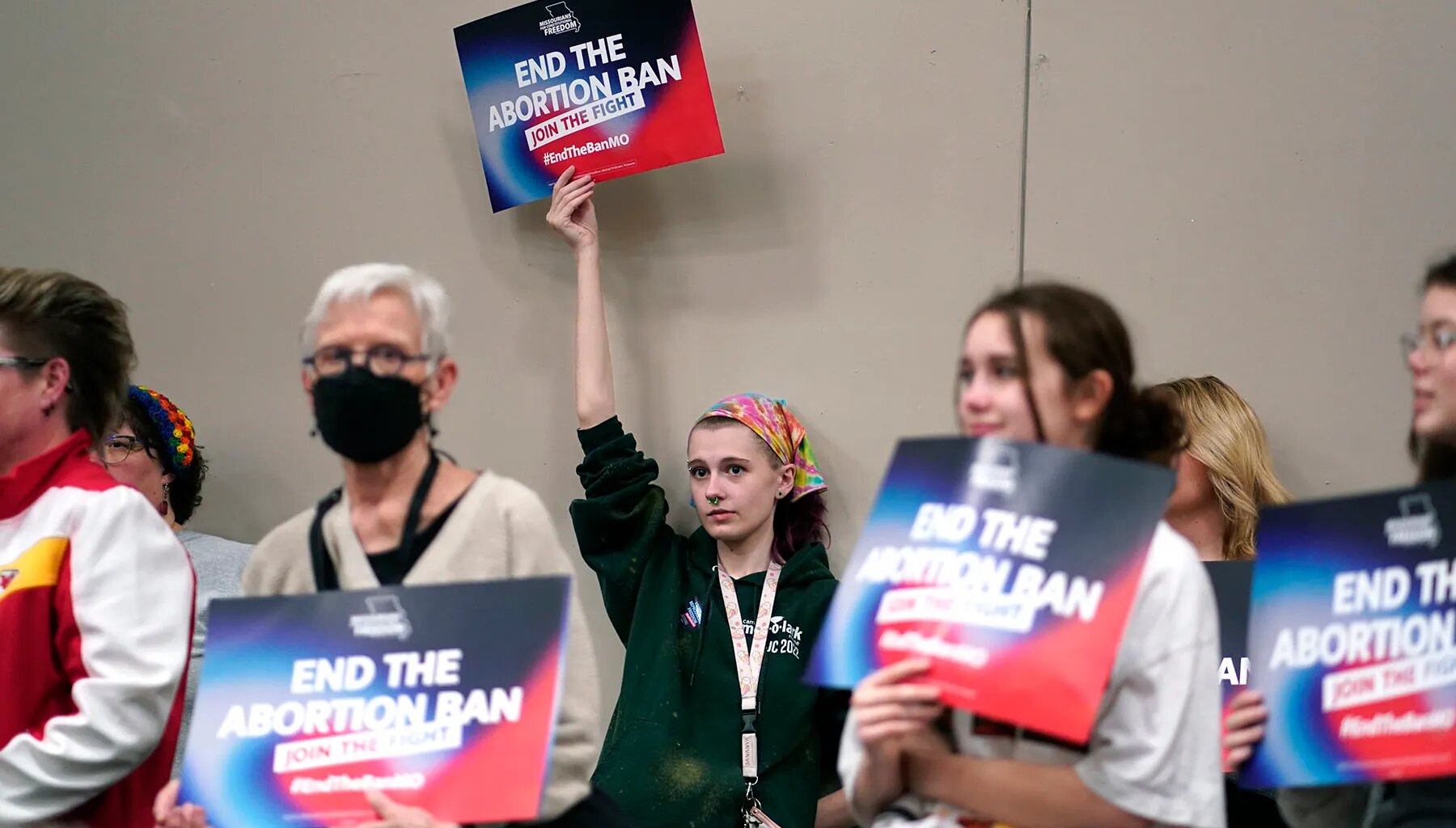
Missouri’s general assembly, fully controlled by Republicans, has pushed to weaken or even reverse the abortion protection — leading last year to the statehouse voting to put Amendment 3 on the 2026 ballot.
The campaign is fierce, with ads supporting Amendment 3 airing even during a primetime Kansas City Chiefs game. The pro-Amendment 3 campaign, whose treasurer is the state’s first lady, Claudia Kehoe, has raised more than $1 million. The abortion-rights side has close to $5 million, including massive donations from progressive heavy hitters like the American Civil Liberties Union and the Planned Parenthood political advocacy arm.
More from The 19th
An August survey conducted by pollsters at St. Louis University found a near-even split among voters, with 43 percent saying they supported Amendment 3 and 44 percent expressing opposition. Another 13 percent were undecided.
Amendment 3’s backers are leaning in particular on the measure’s gender-affirming care ban — which the August polling suggests is far more popular than banning abortion — in the hopes of avoiding the same defeat they experienced two years ago.
“We’re trying to do everything. We’ve had canvassers knocking on thousands of doors,” said Tom Estes, a Republican state Senate staffer working on the pro-Amendment 3 campaign. “There are several pieces of this that resonate really well, that we may not have gotten last time. The number one piece of that is the trans issue.”
The anti-Amendment 3 campaign declined to make someone available for an interview.
Some healthcare providers say that the remaining state abortion restrictions — including limitations on insurance coverage — combined with the looming uncertainty over whether abortion will still be legal after the election has undermined their efforts to expand their offerings.
“I would love to provide abortion services four to six days a week in Springfield,” said Dr. Margaret Baum, the chief medical officer at Planned Parenthood Great Rivers, which began offering abortions at its Springfield clinic in July. “I think the demand is there.”
But doing so, she said, would involve hiring new staff and possibly physically expanding the clinic. Those are “expensive decisions” that are difficult to commit to without knowing how the election will turn out, she said. Right now, abortions are only available when a doctor can travel into town to provide them. Often that’s Baum, who lives on the other side of the state, in St. Louis.
In addition to advocating against Amendment 3, providers are currently challenging a state law requiring that abortion — typically a simple procedure that can be done by a nurse practitioner — be performed only by doctors. Such a law, they argue, treats abortion differently from other forms of healthcare.
“We are getting questions from patients, who are like, ‘I see this is on the ballot again, do I have to be thinking now about whether I can get care in Missouri?’” said Emily Wales, the head of Planned Parenthood Great Plains. “We’re trying to tell people, ‘You can still come and get care, healthcare continues.’”
By the time Tiffany got her abortion, she had spent about $120 on gas, a few hundred dollars on a Wichita hotel she’d stayed at the prior weekend in futile hopes that a clinic there could squeeze her in for an appointment, and hundreds of dollars more for the medication that ended her pregnancy.
When she came home, she said, she didn’t anticipate much time to recover. She was already thinking about how many hours she would have to work to earn back what her abortion had cost her. She had work. She had the kids.
Maybe, in a few days, she’d have a chance to sit and process everything that had happened.
“I have to just keep being a mom,” she said.
Republish this story