
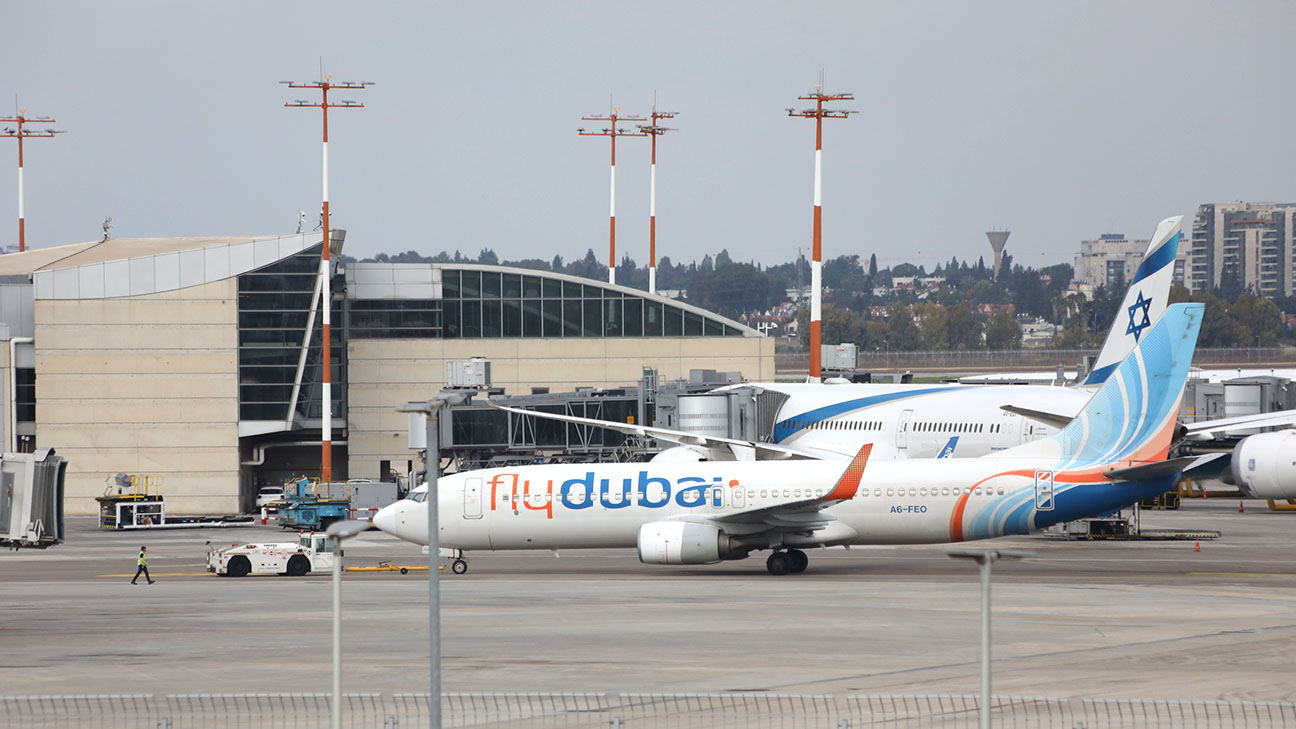
Sometimes heroism announces itself with trumpets. Sometimes it happens at 33,000 feet, in a matter of seconds, when ordinary people realize that unless they act immediately, they and everyone around them may die.
On Wednesday, passengers aboard a flydubai flight from Dubai to Tel Aviv experienced a nightmare almost beyond comprehension. The co-pilot attacked and stabbed the captain, Indian national Smit Machchhar, and the Boeing 737 plunged dramatically before passengers and crew managed to regain control. The aircraft ultimately made an emergency landing in Tabuk, Saudi Arabia. Investigators have not yet publicly established the attacker’s motive.
But whatever investigators ultimately determine about motive, we already know something about courage.
Four men whose names deserve to be known — Yaniv Hayoun, Asaf Rejwan, Dr. Shota Musayev, and Tzvika Manes — were among those who confronted an unfolding catastrophe rather than waiting helplessly for someone else to save them.
There are moments when history gives you no time to deliberate. You either run toward the danger or away from it.
Yaniv Hayoun ran toward it.
According to accounts from the aircraft, after passengers gained access to the cockpit and confronted the attacker, Hayoun found himself facing something no ordinary airline passenger ever imagines: an aircraft descending dangerously and controls that had to be dealt with immediately. He described grabbing the controls and pulling back before trained crew members took over.
Think about that.
No committee. No meeting. No preparation.
A human being sees mortal danger and acts.
Tzvika Manes likewise described a violent struggle to overpower the attacking co-pilot. This was not cinematic heroism. There were no stunt doubles and no guarantee of a happy ending. According to Manes, it took sustained physical force to subdue the man.
Then there was Dr. Shota Musayev, an Israeli dentist who suddenly had to become an emergency battlefield medic thousands of feet above the earth.
Musayev said he heard screaming and ran toward the cockpit almost immediately. He later explained that he initially went forward to help confront the attacker, not because he knew medical assistance would be required.
Once the attacker had been restrained, Musayev encountered the gravely wounded captain, bleeding heavily from his head. Musayev says he managed to stop the bleeding and stabilize the captain’s blood pressure.
One moment he was fighting to save an airplane. The next he was fighting to save a life.
And none of this should overshadow another extraordinary hero: Captain Smit Machchhar himself.
Reports indicate that despite being seriously wounded, Machchhar managed to facilitate access to the cockpit before collapsing, allowing others to intervene. Prime Minister Benjamin Netanyahu publicly praised the Indian captain’s bravery.
He should be celebrated in Israel.
He should be celebrated in India.
He should be celebrated everywhere human courage is honored.
Captain Smit Machchhar was not born in Israel. But in the moment Israelis desperately needed him, he fought for their lives.
And there is something profoundly appropriate about this occurring as Jews prepare to celebrate Sukkot.
Sukkot is Judaism’s great festival of vulnerability.
For seven days we leave the illusion of permanence represented by our houses and enter a fragile hut. Its roof is deliberately porous. We can see the heavens through the schach. The Torah commands us to remember that security does not ultimately come from concrete ceilings, bank accounts or technological sophistication.
Human beings are vulnerable.
An airliner is one of the supreme symbols of modern technological mastery. Hundreds of thousands of components work together. Computers calculate trajectories. Pilots undergo years of training. Air-traffic controllers watch from the ground.
And yet, in seconds, the people aboard this aircraft discovered how fragile life remains.
Then something else happened.
Human courage answered human vulnerability.
That, too, is Sukkot.
The sukkah is fragile, but the people sitting inside it need not be.
Jewish history is filled with people who survived not because they were invulnerable but because, when danger arrived, somebody stood up.
The sukkah teaches that our shelter may be fragile. These men taught us that our courage must never be.
There is another remarkable dimension to this story.
Look at the geography and nationalities involved.
An Emirati airline.
An Indian captain.
Israeli passengers.
An emergency landing in Saudi Arabia.
A wounded Indian pilot receiving treatment after the aircraft landed on Saudi soil.
Whatever investigators ultimately establish about the attack itself, the rescue tells another story about the Middle East — one that deserves attention.
The region has known enough death.
Here was an extraordinary chain of people of different nationalities whose actions resulted in lives being saved.
There will be investigations, and there should be. Aviation authorities must determine exactly how this happened, whether warning signs were missed, what motivated the attacker, and whether security procedures for Israel-bound flights require revision. Those questions are urgent.
But investigation should not obscure gratitude.
We should know the names of people who run toward danger.
Yaniv Hayoun.
Asaf Rejwan.
Shota Musayev.
Tzvika Manes.
And Captain Smit Machchhar.
Their individual roles should continue to be documented carefully as investigators and eyewitnesses reconstruct precisely what occurred. But the larger truth is already unmistakable: when catastrophe threatened an aircraft carrying people toward Israel, human beings refused to remain spectators.
They acted.
And people lived.
As Jews enter our sukkot and look upward through their fragile roofs, perhaps we should think about an airplane high above the Middle East and the people aboard who suddenly discovered just how thin the barrier can be between life and death.
For those passengers, that barrier consisted of a wounded captain who kept fighting, courageous passengers who charged forward, medical assistance administered under terrifying conditions, and crew members who ultimately brought a damaged aircraft safely to earth.
Call it bravery.
Call it providence.
On the eve of Sukkot, I will also call it a miracle.
At 33,000 feet, a handful of human beings became the walls of a sukkah protecting everyone aboard.
And this Sukkot, Israel should say their names — and say thank you.
Rabbi Shmuley Boteach is the international bestselling author of thirty-eight books, translated into more than twenty languages. He has been hailed as “the most famous rabbi in America” (The Washington Post, Newsweek), “arguably the most famous Orthodox Jew on earth” (The New York Observer), and named one of the fifty most influential Jews in the world (The Jerusalem Post).