
Facebook
Twitter/X
LinkedIn
Pinterest
Reddit
Email
Print
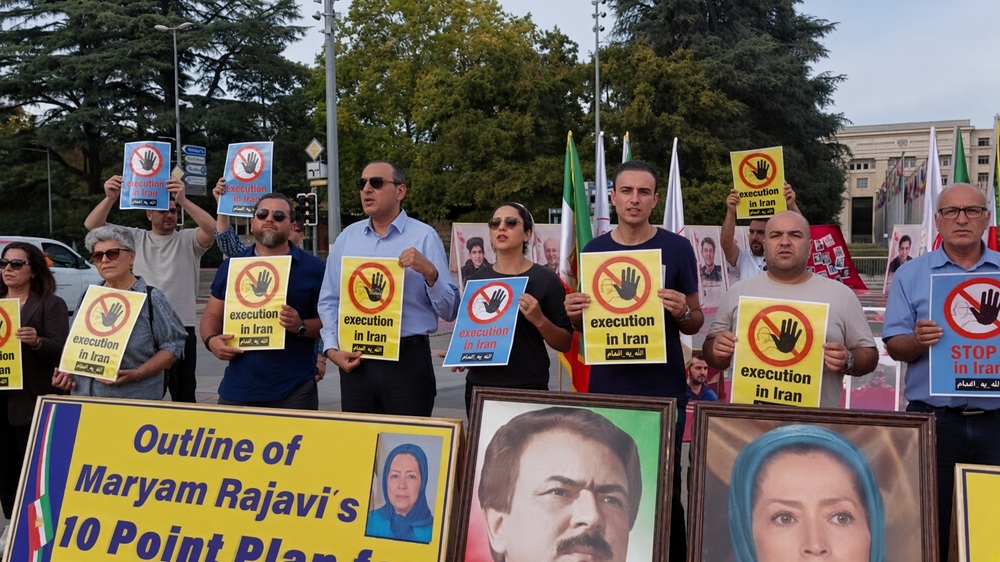
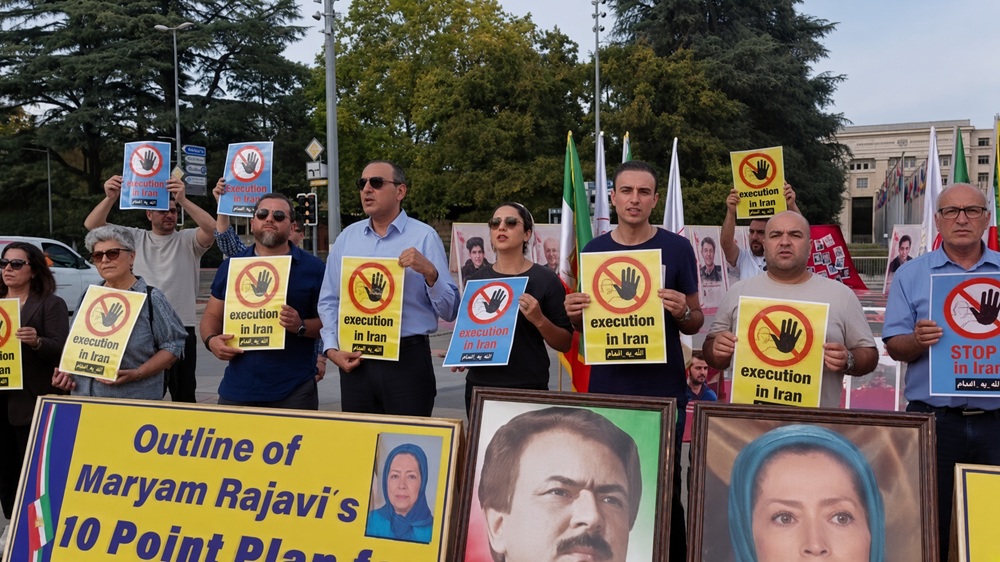 On September 28, 2026, for the second consecutive week, NCRI supporters held a gathering and photo exhibition outside the European headquarters of the United Nations in Geneva, Switzerland
THIS PAGE WILL BE UPDATED WITH THE LATEST NEWS
UPDATE: 7:00 AM CEST
IRGC Appeal to Americans Masks Tehran’s War Abroad, Repression at Home
WASHINGTON, Sept. 30, 2026 — The Iranian regime’s Islamic Revolutionary Guard Corps (IRGC) has taken the dubious step of directly appealing to American voters, urging them to reject U.S. policy toward Iran, even as Tehran continues regional aggression and intensifies repression, executions, and imprisonment of dissidents at home. In a lengthy open letter addressed to the American people, the IRGC urged U.S. voters to follow the advice of a terror entity operated by the world’s leading state-sponsor of terrorism. IRGC spokesman Hossein Mohebbi also portrayed Tehran as the “defender of Iran” against foreign aggression.
The absurd appeal comes from an organization with a decades-long record of creating, funding, and training proxy groups and involvement in terrorism abroad.
The United States designated the IRGC as a Foreign Terrorist Organization in 2019. The European Union formally added the IRGC to its terrorist list in 2026, while Argentina, Paraguay, and other governments have taken similar action. Most recently, Colombia designated the IRGC a terrorist organization on September 24, saying it represents a grave danger to international peace and security and citing both its repression of the Iranian population and covert operations beyond Iran’s borders. Britain has separately designated the IRGC under its state-threats regime.
Iran’s Regime Executes Two Protesters Arrested In January Uprising
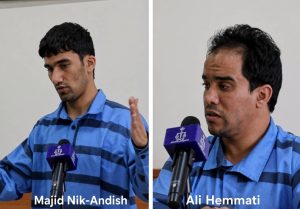
Iranian authorities executed Ali Hemmati, 21, and Majid Nik-Andish, 25, at dawn on September 30, months after the two young men were arrested in connection with the January 2026 uprising in Mashhad.
The regime’s judiciary described Hemmati and Nik-Andish as “leaders” and “field elements” of the protests in Mashhad’s Tabarsi district and alleged that their actions during the unrest led to the deaths of four members of the security forces. Their death sentences were upheld by the Supreme Court before being carried out. The executions add Hemmati and Nik-Andish to the growing number of protesters put to death following the nationwide uprising that began in January.
The regime’s judiciary claimed that Hemmati and Nik-Andish took part in protests in the Tabarsi district on January 8 and 9. Authorities accused them of involvement in acts including arson, destruction of property, blocking roads and attacks on security forces.
State media also relied on what they described as confessions by the two men. The judiciary claimed Hemmati admitted during interrogation and judicial proceedings to setting fire to a store, obstructing traffic and injuring a member of the security forces. It alleged Nik-Andish admitted to participating in the January 8–9 protests, carrying a knife, damaging public property and joining an attack on a store.
September 2026 Report: The Crisis of Education in Iran Threatens Schoolgirls’ Fundamental Rights and Future
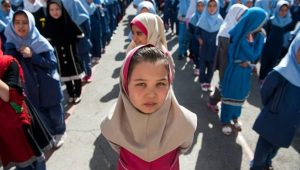
As the new academic year (2026–2027) begins, official regime media reports present an alarming picture of the crisis of education in Iran, marked by a steep drop in first-grade enrollments, rising dropout rates, worsening learning poverty, deteriorating educational quality, chronic teacher shortages, and intense economic pressure on families.
These intersecting factors have created a deep crisis within Iran’s education system, which forms the focus of this September 2026 report by the Women’s Committee of the National Council of Resistance of Iran (NCRI).
Schoolgirls bear a disproportionate burden of this crisis. Widespread poverty forces many young girls to abandon their education entirely. Even for those who manage to stay in school, declining academic standards, inadequate facilities, and restricted access to vocational training severely stifle their future opportunities.
State officials have acknowledged the shrinking student body and growing number of children denied an education:
Drop in First-Grade Enrollment: Ali Farhadi, Deputy Minister of Education, announced at the start of the school year that first-grade elementary enrollment stands at approximately 1,000,154 students, representing a sharp decrease of 160,000 students compared to the previous year. (IRNA News Agency, September 22, 2026)
The Regime’s Imaginary Superpower and the Reality of Iran
One of the clearest signs of decay in an authoritarian system is the widening gap between the rulers’ narrative and the reality experienced by society. When a political establishment can no longer provide credible answers to basic economic, social, and administrative problems, propaganda increasingly becomes a substitute for governance.
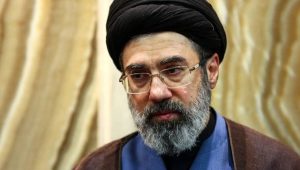
The latest statements by Iran regime leader Mojtaba Khamenei offer a striking illustration of this phenomenon. In a message published on September 28, Khamenei claimed that some already consider Iran the “fourth superpower” but went further, asserting that according to “divine calculations,” Iran is the “first power in the world.” He also claimed that more than 30 million Iranians had declared themselves ready to sacrifice themselves for the regime and that a capacity of 500,000 people was filled within the first 100 minutes of a mobilization effort.
These are not ordinary boasts about military capability. They point to a much deeper problem: the regime increasingly needs an alternative reality in which its claims of power can survive the evidence visible in everyday Iranian life.
Ali Younesi: Rejecting a State “Pardon” and Facing Five Additional Years in Prison

Ali Younesi wrote these words in a letter from Qezel Hesar Prison. On 11 May 2026, he had been informed that the remaining seven months of his sentence were covered by a pardon announced for the anniversary of the 1979 revolution. Referring to six former fellow prisoners who had been executed, he replied: “They did not bargain for their lives; shame on me if I bargain for my freedom.” Rather than accept the designation of “pardon”, Younesi insisted that freedom was his right.
Now, as that period of imprisonment nears its end, an appeals court has upheld a further five-year prison sentence against him. The news came at the start of the academic year, when Younesi remained separated from university for a seventh consecutive year. Read the report on the appeal decision.
Younesi is a computer engineering student at Sharif University of Technology. While at secondary school, he won silver and gold medals in Iran’s national astronomy olympiad. In 2018, he was a member of the team that won a gold medal at the International Olympiad on Astronomy and Astrophysics in China. Amirhossein Moradi, a physics student at the same university and an astronomy olympiad medallist, was arrested alongside him. These achievements do not define either man in full, but they show the course of study and the formative years of their lives that the arrests interrupted. Read the account of their academic backgrounds.
Iran: Escalating Repression of Civil Society Activists and Teachers’ Union Advocates in 2026
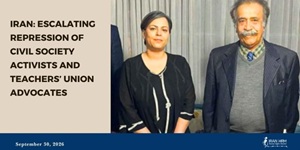
In 2026, pressure on Iranian civil society extended beyond political activists to encompass a broad spectrum of journalists, civil rights advocates, teachers, retirees, and trade unionists. Evidence compiled in this report demonstrates that civil activism and trade union work are increasingly met with security, judicial, and extrajudicial measures. Alongside subpoenas, arrests, and judicial sentences, numerous reports have been published detailing house searches, confiscation of personal belongings, restriction of access to communication and banking services, harassment of families, and keeping activists in prolonged pre-trial detention. This pattern has been particularly evident among teachers’ union activists, where demands regarding the state of education, teachers’ livelihoods, retirees’ rights, and the quality of the educational system have been met with security crackdowns rather than institutional accountability.
Reports published from Khorasan provinces indicate heightened pressure on civil society activists, journalists, and political figures. These pressures have not been limited to summonses and arrests; cases of SIM card restrictions or banking blockades targeting certain activists have also been documented. Notable individuals affected include Nasrin Hassani (a journalist based in Bojnourd) and Esa Khan Hatami (a political activist based in Esfarayen).
Iran Steps Up Security Force Deployments and Paramilitary Mobilization as School Year Begins
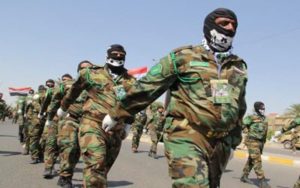
TEHRAN — Iran’s military and security institutions carried out a series of drills and mobilizations in Tehran and several provinces in the second half of September, including the organization of units known as “Janfada,” large-scale Basij parades, security force deployments at hundreds of educational sites, and an increased security presence in Kurdish areas.
The Seyyed al-Shohada IRGC command in Tehran province first announced a drill with a reported 110,000 participants. The event was held on September 16 across 14 counties in Tehran province, with Basij units and groups known as the “Janfadayane Iran,” or “Iran’s Devotees,” taking part. The provincial IRGC commander described the purpose of the drill as demonstrating the “strength, readiness and cohesion of the Basij members and the people.”
Two days later, the Tehran IRGC staged a considerably larger event in the center of the capital. State media said 313,000 people participated in the September 18 drill, a figure that has not been independently verified. Participants marched from Imam Hossein Square and the Navab intersection toward Enghelab Square, while Iranian military equipment and drones were also displayed during the event.
Paris: PMOI Supporters Hold Exhibition to Denounce Iran Regime Executions, Demand Democratic Iran
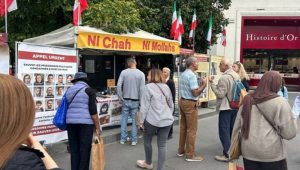
Paris, France – September 29, 2026 — Supporters of the People’s Mojahedin Organization of Iran (PMOI/MEK) organized a public book table and photo exhibition at Place des Invalides in Paris, drawing attention to the deteriorating human rights situation in Iran. The event highlighted the regime’s use of the death penalty and executions targeting political prisoners and protesters detained during nationwide uprisings.
Organizers said the gathering reflected the Iranian people’s demand for a democratic republic and their aspirations for peace, freedom, justice, and fundamental rights. They also underscored the Iranian Resistance’s call for greater international solidarity with the people of Iran.
They urged the French public and the international community to recognize the suffering of Iranians and their rejection of dictatorship in both monarchical and theocratic forms.
Photographs, personal testimonies, and other materials showcased the courage and sacrifices of those who took part in the Iranian uprisings. The exhibition also pointed as the Iranian regime’s ongoing human rights violations, including executions of political prisoners and the continued imprisonment of protesters.
Geneva Gathering Highlights Iran’s Executions as Maryam Rajavi Addresses Human Rights Conference
Geneva, Switzerland – September 28, 2026: For the second consecutive week, supporters of the People’s Mojahedin Organization of Iran (PMOI/MEK) held a gathering and photo exhibition outside the European headquarters of the United Nations in Geneva, commemorating the victims of Iran’s uprisings and political prisoners executed by the Iranian regime.
The event coincided with the 63rd session of the United Nations Human Rights Council and with a conference on human rights violations in Iran, attended by jurists, experts, and international figures. Mrs. Maryam Rajavi, the President-elect of the National Council of Resistance of Iran (NCRI), sent a message to the conference, addressing the escalation of human rights violations in Iran, including executions, arrests, torture, and the mistreatment of political prisoners.
Gothenburg Rally Supports 140th Week of “No to Execution Tuesdays” in 66 Prisons Across Iran
Weekly Rally Against Executions in Gothenburg
Gothenburg, Sweden — September 29, 2026: Supporters of the People’s Mojahedin Organization of Iran (PMOI/MEK) held a rally in solidarity with the 140th consecutive week of the “No to Execution Tuesdays” campaign, a movement protesting the Iranian regime’s escalating executions and systematic repression.
Participants also highlighted the regime’s intensifying crackdown, the rising number of executions, and broader repressive measures. They chanted slogans such as “Down with the executioner regime” and called for the immediate release of all political prisoners.