
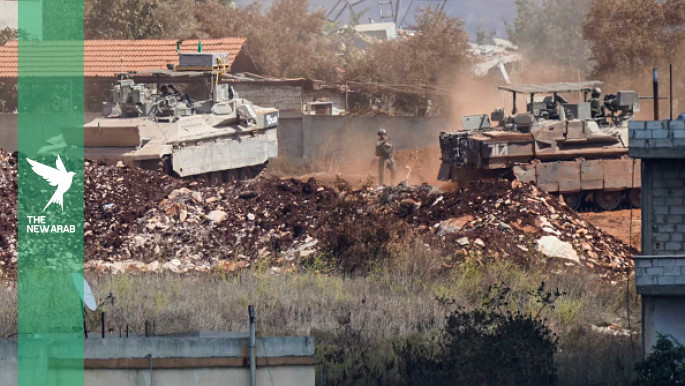
Israeli armoured vehicles manoeuvre in the village of Zawtar al-Sharqiya in southern Lebanon in September 2026 [Getty]
Lebanon and Israel are expected to hold a new round of negotiations in Tampa, Florida, later this month, according to information obtained by The New Arab, as Beirut seeks US intervention to halt Israeli attacks and secure further withdrawals from southern Lebanon.
Lebanese presidential sources told The New Arab that Beirut had been informed of the planned talks, which are expected to take place before Israel’s general elections on 27 October, potentially on 20 October. However, a final date has yet to be officially confirmed.
The negotiations, which will be exclusively military in nature, are expected to focus on the situation on the ground, security arrangements and the first pilot zone, which includes the southern towns of Froun, Srifa and Zawtar al-Sharqiya.
The development comes as the Israeli military announced on Wednesday that its Golani Brigade had ended a seven-month deployment in southern Lebanon, although Israeli attacks and the occupation of Lebanese territory continue.
The last round of negotiations between Lebanon and Israel took place in Rome on 6 August. An eighth round, initially expected to take place in the Italian capital in September at a technical and political level, was postponed until October, according to the US State Department.
Tampa was subsequently selected as the venue because the upcoming round will focus on military matters and developments on the ground, according to TNA’s sources.
The direct talks, which began in April, have faced repeated obstacles, with little progress on the implementation of a trilateral framework agreement amid continued Israeli attacks and its refusal to meet Lebanese demands.
The US-sponsored framework, signed between Lebanon and Israel on 26 June, calls for a gradual Israeli withdrawal from designated pilot zones, followed by the redeployment of the Lebanese army in those areas. Under the agreement, the Lebanese military is responsible for ensuring that the zones are cleared of Hezbollah weapons and infrastructure.
The first three pilot zones were announced in July, but no further areas have been designated.
Lebanon presses US to secure Israeli withdrawal
Lebanese government sources told The New Arab that Prime Minister Nawaf Salam had urged Washington to pressure Israel into complying with the framework agreement and returning to the negotiating table during his recent US visit, particularly in his meeting with Secretary of State Marco Rubio.
Salam received assurances that the US would take steps in that direction, the sources said.
The upcoming negotiations in Tampa represent an important opportunity to break the diplomatic deadlock and address military developments and security arrangements, they added.
Lebanon intends to reiterate its demands for a complete halt to Israeli military operations in the south so that the Lebanese army can fulfil its responsibilities in bringing weapons under state control, alongside an Israeli withdrawal from a second pilot zone.
Salam also stressed during his meetings in Washington that the framework agreement must be implemented on the principles of reciprocity and a phased approach.
He called for a clear timetable linking Israeli withdrawals to the Lebanese army’s efforts to establish exclusive state control over weapons, with both processes advancing simultaneously.
Lebanon should not be the only party complying with the agreement while Israel continues to violate it daily, the sources said, adding that Beirut was relying on US leadership to ensure that both sides fulfilled their commitments.
The sources described Salam’s meetings in the US as positive, saying he had received messages praising the Lebanese government’s decisions, particularly its commitment to bringing weapons under state control and engaging in direct negotiations with Israel.
However, some US officials also stressed the need for more serious and faster action.
US officials reportedly told Salam in New York this week that Israel would continue to occupy parts of southern Lebanon and expand its operations if the Lebanese government failed to bring Hezbollah’s weapons under state control.
Washington nevertheless reaffirmed its support for Lebanon and maintained that the framework agreement remained the only viable path towards security and peace, according to the government sources.
Despite these assurances, no progress has been made on the ground. Israel continues to reject demands to halt its attacks, while efforts to resolve the future of the United Nations Interim Force in Lebanon (UNIFIL) and establish an alternative coordination mechanism remain stalled by unresolved complications.
Lebanese President Joseph Aoun and Salam have repeatedly maintained that diplomacy is the only viable means of ending the conflict and have urged Washington to exert greater pressure on Israel.
Israel currently occupies large parts of southern Lebanon and has expanded its so-called security zone in recent months, with dozens of towns and villages razed or heavily damaged.
Israel has maintained that it will not withdraw until Hezbollah is fully disarmed, while the Iran-backed group has rejected disarmament as long as Israeli forces remain on Lebanese territory.
Israeli forces continued their attacks across southern Lebanon on Thursday, despite the prospect of renewed negotiations.
Israeli warplanes carried out strikes on the town of Bani Hayyan in the Marjayoun district, while artillery bombardment targeted Nabatieh al-Fawqa, Mays al-Jabal, Haris, Khiam, Beit Lif and Wadi al-Slouqi.
Israeli forces also carried out a demolition in Khiam, while Israeli military vehicles were seen moving towards the town of Mansouri.
Israeli aircraft subsequently bombed Mansouri, while Israeli forces set fire to several homes on the outskirts of Baraachit, towards the neighbouring town of Kounine.
Golani Brigade ends seven-month deployment
Separately, the Israeli military announced on Wednesday that forces from one of its elite infantry brigades had withdrawn from southern Lebanon after seven months of operations.
Israeli army spokesperson Ella Waweya posted footage on X showing troops from the Golani Brigade’s combat team leaving the area.
She said the forces, operating under the army’s 36th Division, had been deployed in the so-called security zone in southern Lebanon to eliminate what she described as threats to northern Israel.
In recent months, the troops operated in the Shqif Heights area around Beaufort Castle and had recently completed a “focused military operation” to destroy infrastructure near the Litani River, Waweya said.
She added that Israeli forces had destroyed more than 900 structures allegedly used by Hezbollah and discovered weapons depots containing RPG rounds, explosive devices, booby-trapped drones and Kalashnikov rifles.
Earlier this month, Israeli forces demolished an underground Hezbollah complex beneath the strategic Ali al-Taher ridge, raising fears that Israel could advance towards the nearby city of Nabatieh as it seeks to control other strategic heights in the south.
Israeli attacks on Lebanon have killed close to 9,000 people since October 2023, while more than 30,000 others have been wounded, with many civilians among the casualties.