

On Wednesday morning, flydubai flight FZ1073 from Dubai to Tel Aviv sent the signal every aviation authority dreads. A struggle had broken out in the cockpit, the captain had been stabbed, and the plane plunged thousands of feet. Thanks to the extraordinary courage of the Israeli passengers and crew members who forced their way in, the aircraft was stabilized and diverted. It landed safely in Tabuk, in northwestern Saudi Arabia, with 174 passengers on board, 27 of them children, nearly all of them Israeli.
Israel has rightly celebrated the heroes on that plane. But there is someone else Israelis should thank, and I want to say it plainly: thank you, Saudi Arabia.
Consider what the Kingdom did in a matter of hours. It brought an Israel-bound airliner down safely, secured the aircraft, took the suspect into custody and treated the wounded pilots. Its officials worked closely with their Israeli counterparts from the first minutes of the crisis, reportedly within a regional effort with the US, the UAE and Jordan, with Israeli Air Force jets reportedly shadowing the airliner as it descended. That cooperation continues now, as Saudi and Israeli investigators work together to establish exactly what happened. And by the end of the day, the Kingdom allowed a commercial airliner to take off from Saudi soil and fly those passengers directly home to Ben Gurion.
Not long ago, news that a plane full of Israelis had made an emergency landing in Saudi Arabia would have sent the entire country into a panic. On Wednesday, as the news broke, Israelis everywhere, not just the families waiting at Ben Gurion, breathed a sigh of relief. That shift did not happen by accident. It is the product of years of quiet work, shared threats and deliberate leadership in Riyadh, above all by Crown Prince Mohammed bin Salman.
This matters on three levels. Regionally, Saudi Arabia is the anchor of the Arab world; when Riyadh moves, others follow. Globally, it is an energy superpower and a G20 heavyweight at a moment when war has choked the Strait of Hormuz. And spiritually, its King is the Custodian of the Two Holy Mosques. When the guardian of Islam’s holiest sites acts alongside the Jewish state, it sends a message no preacher of hatred can easily dismiss: this is not a war between religions, but between those who build and those who destroy.
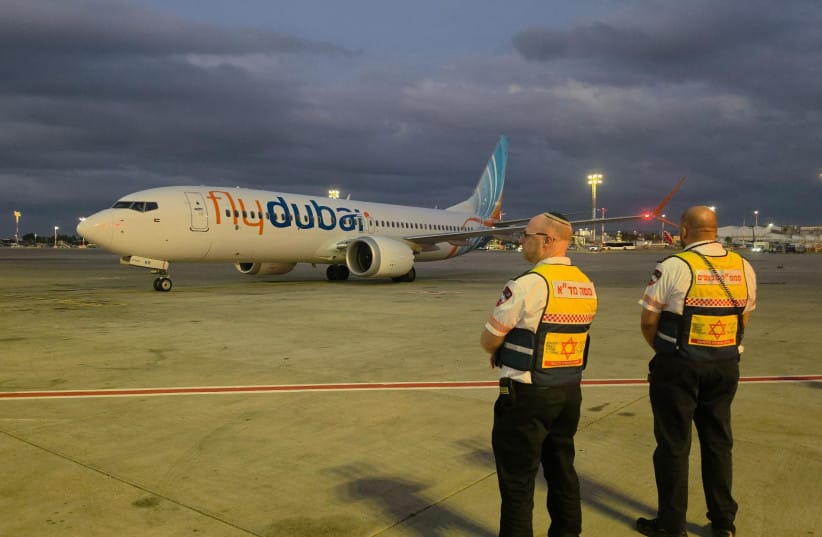 The flydubai rescue flight for hijacked flight FZ1073 lands in Israel on September 30, 2026. (credit: MDA)Allies are measured by what they do, not what they say
Anyone who has spent time in diplomacy learns an early lesson: statements are cheap. Countries, and allies, are measured by what they do, especially when doing it carries a cost.
By that measure, Saudi Arabia made its position unmistakably clear this week. It did so in public, on top of years of cooperation that rarely makes headlines, including the quiet coordination against Tehran that continues today. When Iran fired waves of missiles and drones at Israel, Saudi air defenses reportedly helped bring them down before they reached Israel. Israel and Saudi Arabia still have no formal diplomatic relations. On Wednesday, they behaved like partners anyway.
Partnership, however, runs in both directions. And right now, the Kingdom is under fire from an enemy Israel knows all too well.
Israel should take action against Houthis for Saudi Arabia
For months, Iran’s proxy in Yemen has turned its guns on Saudi Arabia. In July, the Houthis declared a blockade of Saudi shipping in the Red Sea. On September 8, a barrage of missiles and drones wounded 73 people and set energy facilities ablaze in the south of the Kingdom. Days later, they fired on Riyadh itself. The Houthis are not targeting Saudi Arabia by chance. They are targeting it precisely because of what it has come to stand for: a Muslim power that rejects extremism and oppression, that chooses modernity over fanaticism, and that is willing to stand next to Israel rather than against it.
This is the moment for Israel to take clear action against the Houthis, in close coordination with Washington and Riyadh. That means degrading the missile and drone capabilities that threaten both countries, sharing intelligence that protects Saudi cities, and helping restore freedom of navigation in the Red Sea. Not as a favor, but as a message to Tehran that its proxies will not be allowed to pick off Israel’s friends one at a time.
The passengers of flight FZ1073 landed at Ben Gurion singing Am Yisrael Chai. They came home because a country that once would have turned them away chose instead to protect them. Israel should not let that moment pass with a thank-you note alone.
Thank you, Saudi Arabia. Now let us act like the allies we are becoming.