
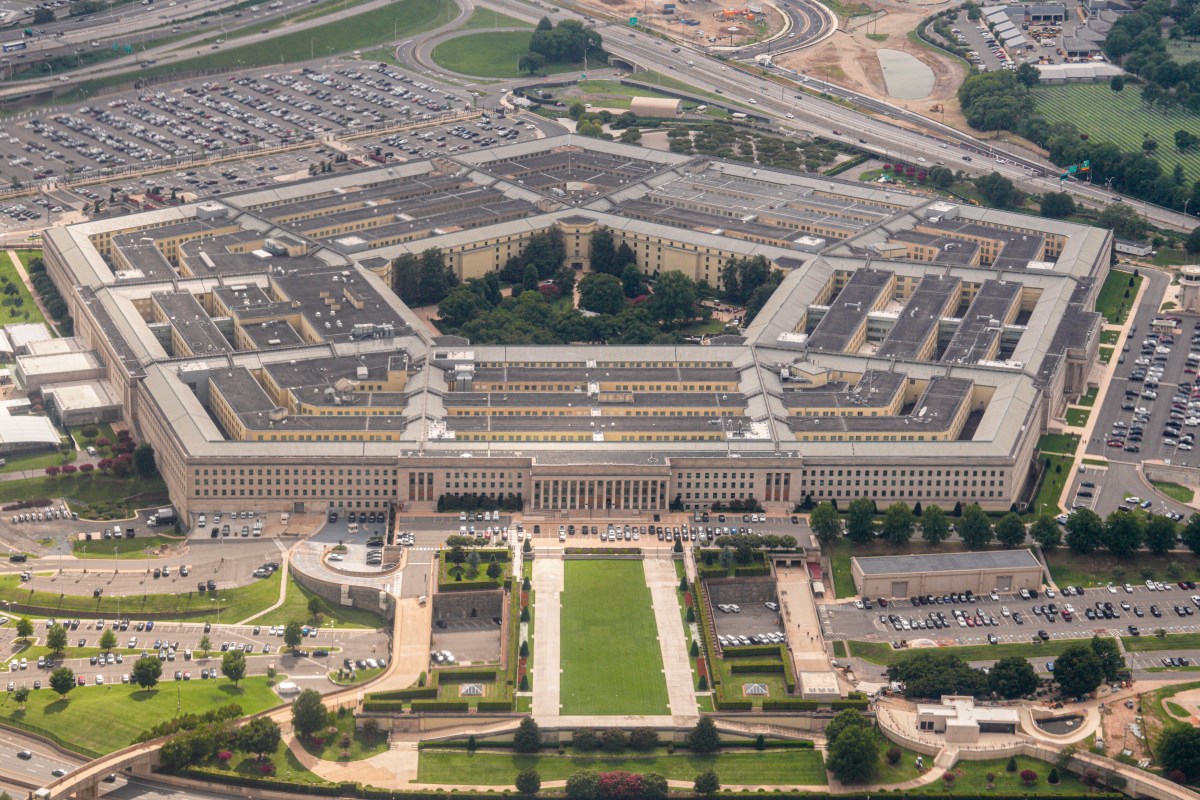
No one can tell you exactly what’s in the bloated Pentagon budget and what it costs. After all, the Defense Department has never passed an audit. Still, we know it’s larded up with terrible, lethal, wasteful expenditures. There are $2.2 million Tomahawk missiles — the type that killed more than 150 Iranian civilians, most of them school children. And the Zumwalt class of naval destroyers that were billed as a $1.5 billion per ship bargain, but now cost taxpayers $10 billion each. And there are the untold sums spent by self-styled War Secretary Pete Hegseth’s department to line the pockets of online influencers. Yep, that’s a thing. American taxpayers are on the hook for all of it.
The Pentagon secretly hired conservative military veterans with large online followings to work in undefined roles earlier this year. When called on his participation in the program, for example, Kurt Schlichter, a retired Army colonel with more than 620,000 followers on X, admitted he “came back as a civilian for a short time to help improve our work colleges.” This may mean rooting out supposed woke-ness at the military war colleges, but when TomDispatch asked the Pentagon for clarification, Deputy Pentagon Press Secretary Joel Valdez failed to comment.
What we do know, thanks to recent reporting by Wired, is that Schlichter is a conservative gadfly with extremist views. He has, for instance, suggested that people who don’t have children, don’t own property, and haven’t served in the military shouldn’t be allowed to vote. “Penalize barren, non-familial lifestyles through taxes and disqualification from political participation,” wrote Schlichter. “Establish property and military service qualifications for voting.” He has also lauded murderous dictators from Chile’s Augusto Pinochet to Spain’s Francisco Franco; referred to immigrants as “perverted Third World peasants”; and branded “liberal women” as “self-righteous crones” who “are a pestilence, a plague upon Western society … whose antics, if unchecked, will inevitably lead to the fall of civilization.”
Just how many vicious vitriol-spewing vets have been put on the Pentagon payroll and at what cost remains unknown. But there’s plenty of taxpayer-funded largess to pay them — with lots more on the way. Today, TomDispatch regular David Vine exposes a shadow budget loaded with Pentagon excess, waste, and bloat that has grown to epic proportions and may leave Americans on the hook for $1 trillion in secret spending next year if Trump has his way.
— Nick Turse, editor of TomDispatch
If you haven’t yet, sign up to receive TomDispatch in your inbox here.
Our Government’s Real Priorities
News reports that next year’s U.S. military budget will top out at $1.5 trillion if President Donald Trump gets his way are misleading at best. The true total, if Trump’s proposal passes, could be at least $1 trillion higher.
Long before Trump took office, U.S. taxpayers have spent far more on the Pentagon — and its wars — than most know. For decades, Congress, the White House, and the Pentagon have hidden the military’s true cost through little-known bureaucratic practices and budgeting tricks. Journalists, academics, and think tank experts have, with rare exceptions, perpetuated the problem by repeating “official” numbers that don’t come close to telling the full story.
Data shows that the budget was already between $1.5 trillion and $1.8 trillion in the last full fiscal year, 2025, as detailed by a recent Project on Government Oversight, or POGO, report I co-authored. Trump’s requests would add another $781 billion, bringing the potential total to at least $2.581 trillion in 2027.
The troubling revelation that the government is misleading the public and effectively hiding hundreds of billions in military spending reflects the out-of-control nature of the Pentagon budget. It’s also the only sector of government spending that seems largely insulated from public scrutiny: Imagine the outrage if news broke that the government was hiding hundreds of billions in spending for public housing, Medicaid, or hunger prevention programs.
If Congress passes Trump’s full budget proposal, military spending will eat up around 75 percent of the discretionary budget Congress controls.
People have a right to know how much tax money goes to military spending. This is critical to debating the proper size of the military budget both on its own and compared to other spending priorities, particularly any program related to education or the social safety net. Understanding the military’s true cost means understanding where and how the government has been hiding the money.
Spending Hidden in Other Budgets
It’s difficult to untangle how much the country actually spends on the military in part because Congress pays for the armed forces and wars from many budgets rather than one. Beyond the agency controlling the military branches that Trump calls the “Department of War” (the official name is still the Department of Defense), hundreds of billions of dollars are effectively hidden in the budgets of at least 17 other government agencies and entities. In total, each of these additional sums are larger than what Congress appropriates for every non-military agency.
For years, TomDispatch and a small but mostly ignored group of budget experts have warned that total military spending is far higher than reported. Our new POGO report consolidates this prior work and five different methodologies for calculating the true military budget. The report shows a consensus that military spending was at least $1.5 trillion, with three of five methods reaching similar estimates of $1.7 trillion to $1.8 trillion.
The newest of the five methodologies provides the easiest way for anyone to see the hidden spending. The methodology uses data from a government website, USAspending.gov, the product of a 2006 law requiring the government “to give the American public access to information on how their tax dollars are being spent.” The site includes the closest thing to actual spending receipts, making it easier to identify military spending beyond the Department of War’s budget.
Let’s take a look at where the money’s hiding.
Hidden Nuclear Weapons Costs: $33.8 Billion
The most obvious place where Congress and the executive branch hide military spending is in the Department of Energy’s budget. That’s where taxpayers can find the bill for the U.S. nuclear weapons arsenal, which cost around $33.5 billion in 2025.
The Department of War controls and deploys these weapons, and their costs should properly be part of its budget, not rolled into the Department of Energy. While the Energy Department plays a role in overseeing the U.S. nuclear weapons stockpile, putting nuclear weapons spending in the DOE’s budget is like a city putting the costs of its police department’s bullets in its transportation department budget rather than in the police budget.
Another $300 million in nuclear weapons spending hides in the budgets of the Defense Nuclear Facilities Safety Board and the Army Corps of Engineers, bringing the total to nearly $34 billion.
Hidden Military Personnel (Veterans) Costs: $393.3 Billion
Taxpayers spend huge sums on the military in the Department of Veterans Affairs and related budgets. The existence of a separate veterans’ agency is a sleight of hand that leads the public to believe this is not military spending. It is. The only difference is the appropriation of money to still another agency.
To recruit and maintain armed forces, any government needs to pay its troops and offer sufficient long-term benefits (such as pensions, medical care in retirement, and survivor benefits) to encourage people to join and stay in a dangerous job that involves the risk of killing and being killed. These forms of long-term compensation are personnel costs, just as much as basic pay, and they should be counted as military spending. If a military fails to spend money to support vets, it’s unlikely to function for long. The Bureau of Pensions for veterans was originally part of the War Department (which was the name until 1947, long before Trump’s rebranding) and its budget until 1849 when Congress transferred the bureau to the Department of the Interior.
Funding for the Department of Veterans Affairs adds another $389.8 billion to the USAspending.gov methodology total. Almost $4 billion more in long-term spending on personnel hides in the budgets of the departments of Labor, Justice, and several others. All told, these sums reach a staggering $393.3 billion.
Coast Guard and Other “Homeland Security” Costs: $16.8 billion
Spending for an entire branch of the military, the Coast Guard, is concealed in the budget of the Department of Homeland Security rather than the Department of War. While DHS controls the Coast Guard during peacetime and the branch plays some non-military functions, the Coast Guard is one of the armed forces and is controlled by the Pentagon in wartime.
Excluding non-military activities (such as improving boat safety and cleaning up oil spills), Coast Guard spending adds nearly $14 billion to the total military budget. Additional DHS expenses for programs to counter weapons of mass destruction, radiological preparedness, cybersecurity, and other military spending add just under $3 billion, bringing this total to $16.8 billion.
The True Cost of the Department of War: $1.3 Trillion
The bulk of military expenditures still appear in the Department of War’s budget, which pays for the armed forces and the rest of the Pentagon’s sprawling bureaucracy, including all the weapons, salaries, some benefits, military construction, fuel, maintenance, operational expenses, and much more. USAspending.gov receipts show the Department of War alone spent $1.273 trillion in 2025. The Pentagon controlled another $480 million in spending that hid in the budgets of the State Department, the U.S. Agency for International Development, and the Department of Transportation.
Combined with the $444.8 billion tallied previously, total military spending hits $1.718 trillion. That’s more than double the military budget usually reported for 2025: the $850 billion Congress appropriated to the Department of War.
Total Military Spending by Agency (FY2025)
Agency Name
Net Outlays ($)
Department of Defense
1,273,158,423,924
Department of Veterans Affairs
389,755,646,022
Department of Energy
33,538,322,898
Department of Homeland Security
16,798,958,047
Department of Labor
3,277,521,935
Department of State
461,862,025
Department of Justice
385,060,843
Army Corps of Engineers
260,017,630
Armed Forces Retirement Home
137,519,390
American Battle Monuments Commission
103,483,062
U.S. Court of Appeals for Veterans Claims
49,662,873
Defense Nuclear Facilities Safety Board
43,703,554
Agency for International Development
15,504,280
Department of Transportation
2,604,283
U.S. Chemical Safety Board
958,374
Social Security Administration
260,504
Department of Agriculture
0*
Executive Office of the President
0*
TOTAL
1,717,989,509,643
*No FY2025 spending. However, there was a $1 billion budget appropriation to the Executive Office of the President for “Submarine Security Activities, National Security Council.” The government also funded account line items in the Department of Agriculture budget to support the Air Force and Army.
We’re independent of corporate interests — and powered by members. Join us.
Join Our Newsletter
Thank You For Joining!
Original reporting. Fearless journalism. Delivered to you.
Will you take the next step to support our independent journalism by becoming a member of The Intercept?
By signing up, I agree to receive emails from The Intercept and to the Privacy Policy and Terms of Use.
Still Other Costs
The $1.7 trillion estimate for last year is conservative and still may be too low. While the War Department budget contains classified funding for the CIA, National Security Agency, and other intelligence agencies, the government may hide more intelligence spending elsewhere. NASA space research involves considerable military work, which could add another $10.5 billion, according to USAspending.gov data. Some would also count $1.9 billion in FBI salaries and expenses found in the Department of Justice budget.
Other experts consider much larger expenditures in the DHS budget to be military spending, given that department’s role in protecting the “homeland” and the increasingly militarized nature of Immigration and Customs Enforcement as well as Border Patrol. This would add at least $216.9 billion after excluding DHS’s Federal Emergency Management Agency spending. Alternate methodologies also include $211.9 billion in interest payments on the more than $40 trillion in national debt stemming from past military spending and wars.
You can add and subtract forms of spending that you think belong or don’t belong in the true total, thanks to the transparency of the POGO report’s methodologies. In total, these excluded sums could add another $441.2 billion to the USAspending.gov method’s prior total of $1.718 trillion for 2025.
Growing Opposition to Unchecked Pentagon Spending
POGO report’s conservative estimates of the FY2025 budget being $1.5 trillion to $1.8 trillion reveal that the true military budget for 2027 could hit $2.6 trillion if Congress gives Trump what he wants. This includes requested increases totaling $781 billion for just the Department of War ($500 billion), the Iran war ($70 billion), veterans ($144.9 billion), nuclear weapons ($53.9 billion), and the Coast Guard ($12.5 billion), let alone other smaller forms of hidden Pentagon spending.
When mind-numbing numbers like these reach the trillions, it can be tempting to think, What does it matter if it’s $1 trillion or $1.5 trillion or $2.6 trillion?
It helps me to remember that every single dollar spent on the Pentagon is a dollar not spent on our children, on healthcare, on affordable housing, on efforts to slow catastrophic climate change, and much more.
If Congress passes Trump’s full budget proposal, military spending will eat up around 75 percent of the discretionary budget Congress controls. Every dollar spent on the Pentagon is also a dollar more for Trump to continue waging his illegal, disastrous war on Iran and the funds to make good on his threats to attack Cuba and other countries.

Advocates for increased military spending will likely insist that more money is always needed, no matter today’s true total. That these Pentagon boosters have cited incorrect figures and helped mislead the public for decades raises serious questions about their credibility and the basis for their seemingly endless demands for more money.
Thankfully, there’s growing resistance to Trump’s proposals. Nearly 6 in 10 people nationwide believe even the official $1.5 trillion request is “too high,” according to a recent poll conducted by ReThink Media and the Costs of War Project at Brown University, a nonpartisan research group (where I’m a contributor). And Democrats appear to be listening: They’ve voted against Trump’s budget in unprecedented numbers as it winds through Congress. Some Republicans have also expressed concerns about supporting Trump’s proposal given fears about the rising national debt.
There are growing calls to cut the Pentagon budget by hundreds of billions of dollars without touching salaries and benefits for troops and veterans. This would still leave the country with the world’s largest military budget by far and allow Congress to reallocate the savings to programs that improve the lives of everyday Americans.
The public needs a full, accurate accounting of the military. Congress could provide an annual True Total Military Budget that tallies all of the Pentagon’s spending in one place and stop hiding funding in other agencies’ budgets. Until this happens, journalists and analysts can help by explaining the full scale of spending and no longer repeating incomplete totals.
As Trump asks for the highest military budget in the history of the world and people continue to suffer the effects of his war with Iran — which has killed and injured thousands, increased the price of gas and groceries, and risks even greater catastrophic harm globally — it’s time to have an informed debate about how much the country really needs to spend on its military.