
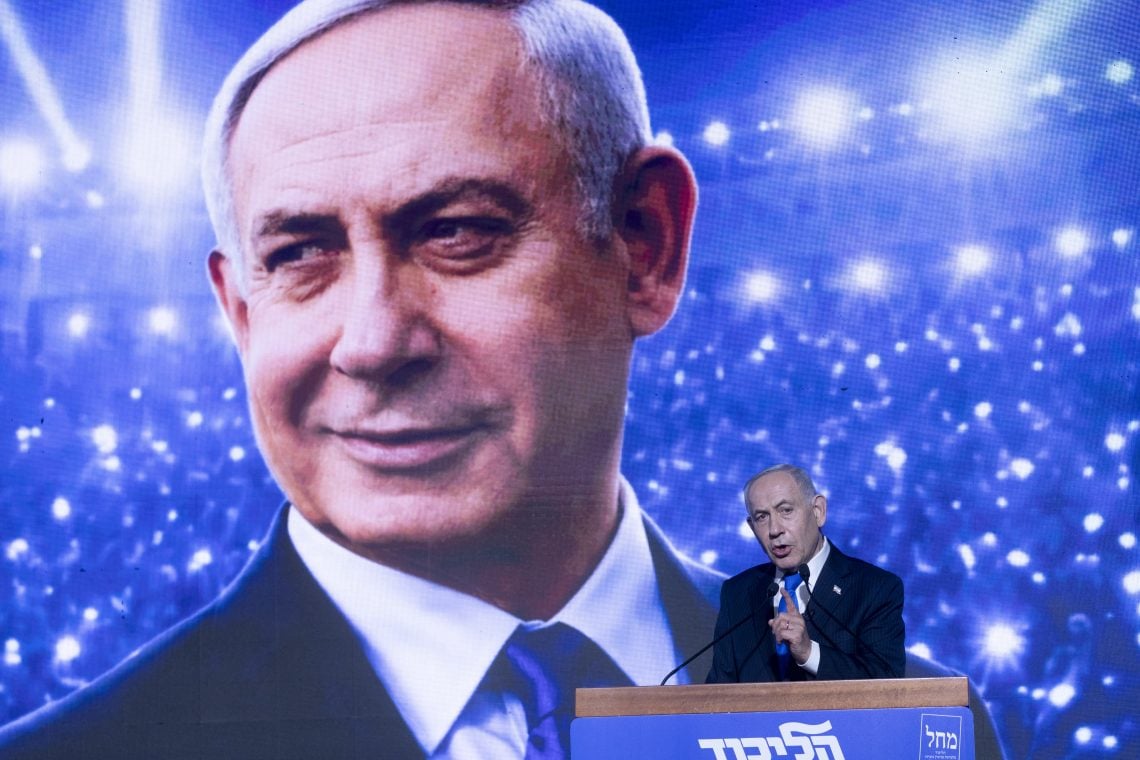
Israel’s October election may remove Prime Minister Benjamin Netanyahu without overturning the consensus forged by three years of war.
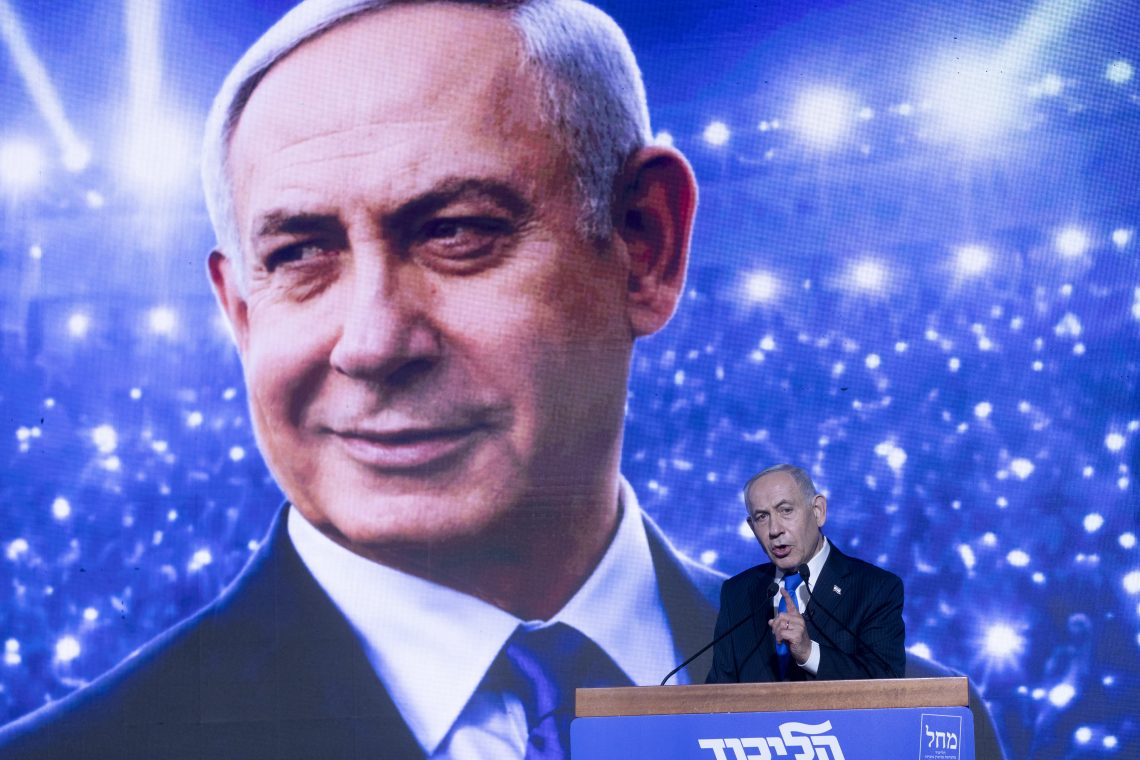 Israeli Prime Minister Benjamin Netanyahu speaks during a Likud campaign rally on Sep. 17, 2026, in Tel Aviv, Israel. The right-wing Likud party is seeking to retain power in the upcoming national election. © Getty Images
GIS Radio
Listen to our AI-powered podcast for comprehensive insights.
The October 7 attack shifted Israeli politics further toward security
Opposition challengers promise different leadership, not a strategic break
The election will likely produce broad policy continuity
After three years of war on multiple fronts, Israel is set to hold general elections on October 27, 2026. Prime Minister Benjamin Netanyahu stands as the country’s central political figure. His supporters view him as an experienced leader capable of taking on regional security challenges, while his opponents blame him for a host of political and strategic blunders. Although there is widespread dissatisfaction with the current government, the opposition has yet to present a coherent alternative.
Ultimately, the election is less likely to represent a conventional contest between left and right than a referendum on Mr. Netanyahu himself and, more broadly, on what the post-October 7 political order should look like. The Hamas attack on southern Israel changed the terms of the country’s political debate. The main divide is no longer over how much Israel should prioritize security, but over who can use military force effectively, how state institutions should constrain it and what diplomatic costs the country is prepared to accept.
The unprecedented October 7 events significantly harmed the standing of Prime Minister Netanyahu’s government among Israeli citizens. At the same time, the state’s response fueled disputes and deepened divisions over the country’s approach to Gaza, Lebanon and Iran. There has also been much public dissatisfaction over the national security failures that enabled the attack.
A poll from September 16 found that if the election were held that day, the Likud party, which currently holds 32 seats in the 120-member Knesset, would secure roughly 18, with the Yashar party securing 22. The result underscores the degree of electoral volatility and suggests that Mr. Netanyahu’s political dominance can no longer be taken for granted.

The prime minister nevertheless remains a competitive candidate. His strengths include Likud’s loyal support base, his decades of political experience, his reputation for prioritizing security and his ability to campaign on external threats. His vulnerabilities include failing to prevent the Hamas attack, his ongoing corruption trial, tensions with the Trump administration, his reliance on far-right coalition partners and his handling of the war with Iran. To win, Mr. Netanyahu will need to defend his record while persuading voters that his rivals are less capable of protecting Israel.
Change of approach but same security policy
Within the opposition, Gadi Eisenkot, a former Israel Defense Forces (IDF) chief of staff, has enjoyed rising popularity largely based on his personal reputation and security credentials. Recent opinion polls have shown the bloc of opposition parties, led by Mr. Eisenkot and his new centrist party Yashar, even narrowly ahead of the Netanyahu-aligned bloc. Mr. Eisenkot also leads Mr. Netanyahu in surveys asking who is better suited to serve as prime minister.
Mr. Eisenkot, whose son and two of his nephews were killed in the Gaza conflict, has campaigned on mandatory military service and criticized Prime Minister Netanyahu’s wartime leadership, particularly over hostage negotiations. His momentum notwithstanding, he still faces significant challenges in forming a governing coalition, as polls suggest that despite their slight lead, the opposition may remain short of a parliamentary majority. Divisions over cooperation with Arab-Israeli parties also make coalition-building a complicated process.
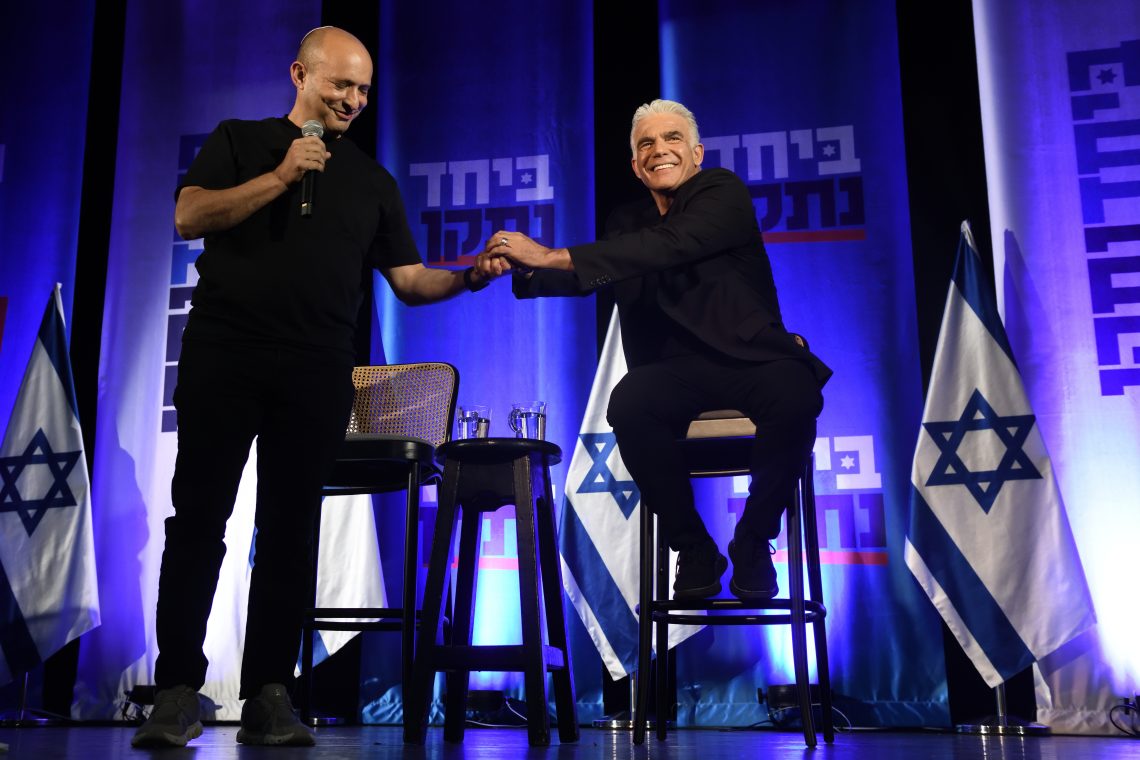 Former Israeli Prime Ministers Naftali Bennett (left) and Yair Lapid attend an election campaign event for their joint “Together” party in Ramat Hasharon, Israel, on Aug. 20, 2026. The two men have united under a single list to challenge Prime Minister Benjamin Netanyahu. © Getty Images
Former Israeli Prime Minister Naftali Bennett is another important challenger. Also former tech entrepreneur, and now a prominent figure in the nationalist right and settler movement, Mr. Bennett served as education and defense minister before making history in 2021 by forming a broad coalition government that included support from an Arab party, ending Mr. Netanyahu’s 12-year run in office.
Although his government lasted only a year, Mr. Bennett returned to the political spotlight after October 7. Seen as a hardliner on security who opposes a Palestinian state, some right-wing voters see him as a more pragmatic and less divisive alternative to Prime Minister Netanyahu. Mr. Bennett has also teamed up with another opposition leader, former Prime Minister Yair Lapid, in an effort to maximize support against the sitting prime minister.
Mr. Lapid, a former television presenter and founder of the centrist Yesh Atid party, has been one of Prime Minister Netanyahu’s most prominent rivals for more than a decade. He has served in several senior cabinet roles, including finance and foreign minister, and briefly became prime minister in 2022 under a power-sharing agreement with Mr. Bennett.
A secular, centrist politician, Mr. Lapid was a leading opponent of the government’s controversial judicial reforms. He remains the most visible voice of the anti-Netanyahu camp. However, his appeal has largely been limited to urban, secular and moderate voters, making it unlikely he could secure the premiership on his own. Instead, he is likely a potential kingmaker through his alliance with Mr. Bennett.
Yair Golan and the Democrats represent Israel’s shrinking center-left political camp. A former senior IDF general, Mr. Golan rose to prominence after October 7, transforming himself into an opposition figure through public outreach, media strategy and coalition-building. As leader of the Democrats Party, formed through the merger of Labor and Meretz, he has sought to rebuild the liberal Zionist movement around issues of democracy, strong institutions, civil rights and social concerns. Mr. Golan emphasizes protecting democratic values, maintaining checks and balances, and addressing social issues while also supporting a two-state solution and opposing much of the settlement movement in the occupied West Bank. His outreach to Arab-Israeli citizens and his efforts to broaden the party’s appeal reflect an attempt to create a wider coalition.
In terms of the future of Israel’s foreign and security policies, the three main opposition figures – Mr. Eisenkot, Mr. Bennett and Mr. Lapid – do not fundamentally disagree with Prime Minister Netanyahu. None of these figures stands in opposition to Israel’s wars on Gaza, Lebanon and Iran. Their criticisms of Mr. Netanyahu on those issues are about the manner in which he has conducted the conflicts and his perceived subservience to United States President Donald Trump, who, at various times and to varying extents, has put pressure on Israel’s government to adhere to ceasefires and hold off on continuing these wars at full intensity.
This distinction is critical to understanding the likely implications of the election. A change in government would not necessarily mean a dramatic change in Israeli military policy. The strongest opposition candidates have incentives to demonstrate that they can be trusted on national security. A rapid reversal of the post-October 7 security doctrine is highly improbable. What could change is the way Israel balances military objectives with diplomacy, relations with Washington, domestic political considerations and international pressure.
More on Middle East politics
The deeper significance is that Israeli politics may be moving toward a competition between different versions of a security-centered state rather than a range of approaches to managing the conflict with Hamas. Mr. Netanyahu’s opponents can seek institutional reform, greater coordination with Washington, and a more pragmatic diplomatic posture while still accepting the basic premise that peace with Israel’s enemies is unrealistic, and that the country must focus on defending against and neutralizing external threats. This would represent a significant change in political style and potentially in strategic management, but not a return to the previous political landscape.
Even if Mr. Netanyahu loses, the forces that have strengthened the Israeli right and elevated security above other political questions are unlikely to disappear. Conversely, another Netanyahu victory would demonstrate not simply the resilience of one politician, but the durability of a political order increasingly defined by security imperatives and distrust of diplomatic alternatives.
If Mr. Netanyahu survives, his victory would reinforce the durability of the existing right-wing order. If the opposition succeeds, it would demonstrate that Israeli voters can reject Mr. Netanyahu without necessarily rejecting the broader security consensus that has emerged during the war years. If another fragmented Knesset produces prolonged deadlock, it would underscore the difficulty of translating widespread dissatisfaction with the government into a coherent alternative political project.
Scenarios
Most likely: Political deadlock or the opposition forms a fragile coalition
The practical consequence of this scenario is substantial policy continuity. A fragmented government will have limited room to pursue major changes in Israel’s approach to Gaza, Lebanon or Iran, particularly if coalition partners disagree over military operations or relations with the Palestinian Authority. The security establishment likely retains considerable influence over strategic decision-making, while successive governments would face pressure to demonstrate toughness to an electorate still deeply affected by the October 7 attacks.
For the U.S., political instability makes long-term strategic coordination more difficult. Washington would continue dealing with Israel as a close ally, but disagreements over the pace and scope of military operations could become harder to resolve if Israeli leaders are constrained by fragile coalitions. Internationally, continued conflict without a clear political strategy could further increase diplomatic pressure on Israel and deepen disagreements with European and other Western partners.
Somewhat likely: Netanyahu remains prime minister through a renewed right-wing coalition
A renewed Netanyahu government would maintain an aggressive military posture in the region, while the influence of nationalist and religious coalition partners continues shaping policy toward the Occupied Palestinian Territories. The precise conduct of these conflicts could change as circumstances evolve, but a Netanyahu-led government will have strong incentives to resist pressure for major strategic concessions.
The U.S.-Israel relationship remains close but could become more transactional and contentious. Mr. Netanyahu seeks to preserve Washington’s diplomatic and military backing while resisting U.S. pressure when he believes coalition politics or Israeli security priorities require a harder line. This creates recurring disputes over ceasefires, humanitarian policy, settlement activity and the scope of military operations.
Internationally, another Netanyahu government will face continued global criticism over Israel’s conduct. Rather than signaling a departure from the trajectory established after October 7, a renewed right-wing coalition will reinforce the perception that Israel is moving toward a more nationalist and security-driven political order. The result will be greater continuity at home but potentially higher diplomatic costs abroad.
Least likely: An opposition government secures a decisive majority
Such a government will probably produce the greatest change in governing style without necessarily producing a revolution in foreign or security policy. Mr. Eisenkot’s military background, Mr. Bennett’s nationalist credentials and Mr. Lapid’s centrist orientation will give the coalition an incentive to demonstrate continuity on core security questions. This government would therefore continue military campaigns against armed resistance groups while placing greater emphasis on strategic discipline, diplomatic coordination and the management of Israel’s international relationships.
The U.S.-Israel relationship will improve in tone and coordination, particularly if the new government seeks to reduce the friction that has characterized Mr. Netanyahu’s relationship with Washington. Greater consultation with the U.S. will make disagreements over ceasefires and military operations easier to manage, although fundamental disputes would remain over Iran, Gaza, the West Bank and the broader Israeli-Palestinian conflict.
A change in leadership will also improve Israel’s standing with some international partners if it were accompanied by greater attention to diplomatic engagement and international law. Yet the limits of this change must not be overstated. Given the post-October 7 security consensus, an opposition government would still face intense domestic pressure to maintain military strength and respond forcefully to perceived threats.
The most important consequence, therefore, is a possible shift in the balance between force and diplomacy rather than an abandonment of force. Such a government will seek to restore Israel’s international legitimacy while preserving its security posture, potentially creating greater space for diplomatic initiatives concerning Gaza, Lebanon and regional relations.
Contact us today for tailored geopolitical insights and industry-specific advisory services
 Sign up for our newsletter
Receive insights from our experts every week in your inbox.
Information about what personal data we collect about you and how we process it (including information about how we personalize our website for you and deliver content tailored to you) can be found in our privacy policy.
In a nutshell‹›
Scenarios‹›
Last reading position