
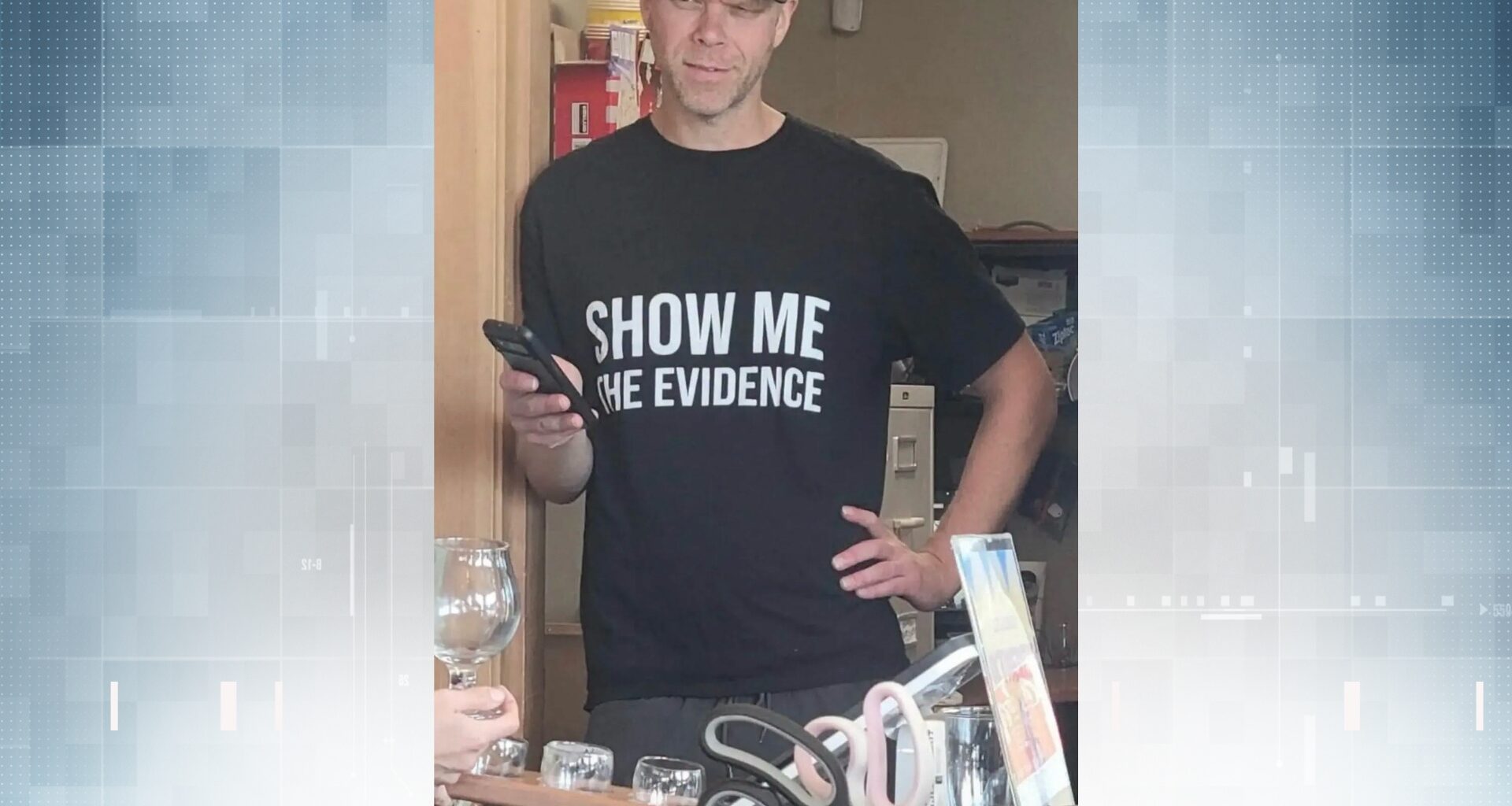
A Sooke brewery says a member of its ownership group has been “terminated, effective immediately” after he was photographed working on the National Day for Truth and Reconciliation wearing a shirt with the words “Show Me The Evidence.”
Sooke Brewing Company identified the man as John Adair in a statement Thursday, saying his “views and actions do not reflect the values of Sooke Brewing Company, its ownership or its staff.”
“We are devastated by his actions and sincerely apologize for the hurt they have caused,” the company wrote in a Facebook update Thursday. “We stand with our community in condemning this behaviour and have made the decision to close the brewery for now.”
The company did not clarify what it means by Adair being “terminated,” including whether he has been removed from the company’s ownership or terminated from an employment or operational role.
The controversy began after a photograph circulated online showing Adair wearing the shirt while working at the brewery on Sept. 30.
The wording of the shirt, and its appearance on the National Day for Truth and Reconciliation, prompted widespread criticism online from people who interpreted “Show Me The Evidence” as questioning documented accounts of Canada’s residential-school system.
In an initial statement, Sooke Brewing described the shirt as “offensive” and the incident as “inappropriate and unacceptable,” saying the message did not reflect the company’s values.
“We understand why it caused anger, hurt and disappointment, particularly within Indigenous communities, and we sincerely apologize,” the company said prior to announcing it had terminated Adair.
The brewery closed Thursday as it addressed the situation, and later confirmed it would be cancelling all upcoming events. The company said it has also reached out to local First Nations leadership to hear their concerns and discuss next steps.
“Sooke is our home. We grew up here. We live here. And we work here,” the statement read. “We care deeply about this community and the people who are part of it. We are committed to Truth and Reconciliation and to respectful relationships with local First Nations communities.”
A similarly named business, Sooke Oceanside Brewery, says that it is completely unaffiliated with Sooke Brewing.
“We are aware of the recent controversy involving an individual associated with Sooke Brewing Company. That individual’s actions and statements are not those of Sooke Oceanside Brewery, nor do they represent our business, our owners, our staff, or our values,” the company said in a statement.
“We ask that people please ensure they are directing any comments, messages, or concerns regarding this situation to the correct business.”
Efforts to contact Adair for an interview for this story were unsuccessful.
The company said it would share more information “when we are able to do so,” adding it was “grateful to everyone who has supported our staff and our brewery over the years.”
T’Sou-ke councillor calls for action beyond apology
T’Sou-ke Nation Elected Coun. Debra Lazzar told CHEK News the photo was upsetting, especially after spending Sept. 30 participating in Sooke’s annual Orange Shirt Day events and hearing people share their families’ experiences with residential schools.
“Sometimes you’re like, ‘oh, I should be shocked that this happened,’ but actually, we’re not shocked because this happens a lot of times every week and in our lives,” she said.
Lazzar said the history is personal for her family. Her father attended a day school at Songhees Nation, while other members of her family attended residential school.
For her, the response should be about creating an opportunity for further conversation and reconciliation.
“All these situations, they give us another time to have that conversation, and to just share our experiences,” she said.
Lazzar said she called Sooke Brewing Company Thursday and left her contact information in hopes of speaking with its owners. She welcomed the company’s stated intention to reach out to First Nations and said she hopes the two sides can develop a relationship and discuss how the company can “make it right.”
Lazzar said that should involve more than an apology, suggesting the company could support next year’s local Orange Shirt Day events or establish or fund scholarships for Indiegenous students.
‘It’s just so hard to believe’
She said one reason some people may struggle to comprehend the history of residential schools is because what happened can seem unimaginable today. She pointed to her own father’s experiences, saying he only began talking more about them later in life.
“A lot of survivors don’t talk about it, and my dad didn’t,” she said, adding her father has described being placed in a crate outside his school as punishment when he was a child.
“I think it’s just so hard to believe that this is part of Canada’s history, and it just seems so unimaginable that that would happen,” she said. “That the RCMP would come to your house and take your children. Like it’s just so hard to believe that that happened, but that is what happened.”
The controversy comes just days after an incident involving residential-school denialism in Kamloops prompted outrage.
On Sunday, a group of masked men associated with Second Sons Canada, which Tk’emlúps te Secwepemc describes as linked to white supremacist and white nationalist ideology, gathered on the First Nation’s reserve near the former Kamloops Indian Residential School. Members of the group later displayed a banner reading “Got bones?” from a Kamloops overpass.
The First Nations Leadership Council said in a statement the banner was “seemingly questioning the well-documented existence of unmarked graves at the sites of former Indian Residential Schools,” and described the demonstration as part of a rise in anti-First Nations racism and residential-school denialism.
For Lazzar, confronting those attitudes means continuing to share the experiences of Indigenous families rather than allowing the conversation to become a debate of whether those experiences occurred.
“It’s a day of honouring too, and a day of remembering, and that’s what we’re doing,” she said. “We’re not proving that did it or did it not happen.”
She said she has also been encouraged by the number of non-Indigenous people who have spoken out about the photograph and supported Indigenous community members.
For people wondering how they can contribute to reconciliation themselves, Lazzar said the answer doesn’t always require a grand gesture.
She suggested checking in with Indigenous friends, attending community events, volunteering, supporting Indigenous organizations or even starting a book club focused on Indigenous authors and history.
“It could be just in spending time with each other and just learning about each other and having that conversation,” she said.