
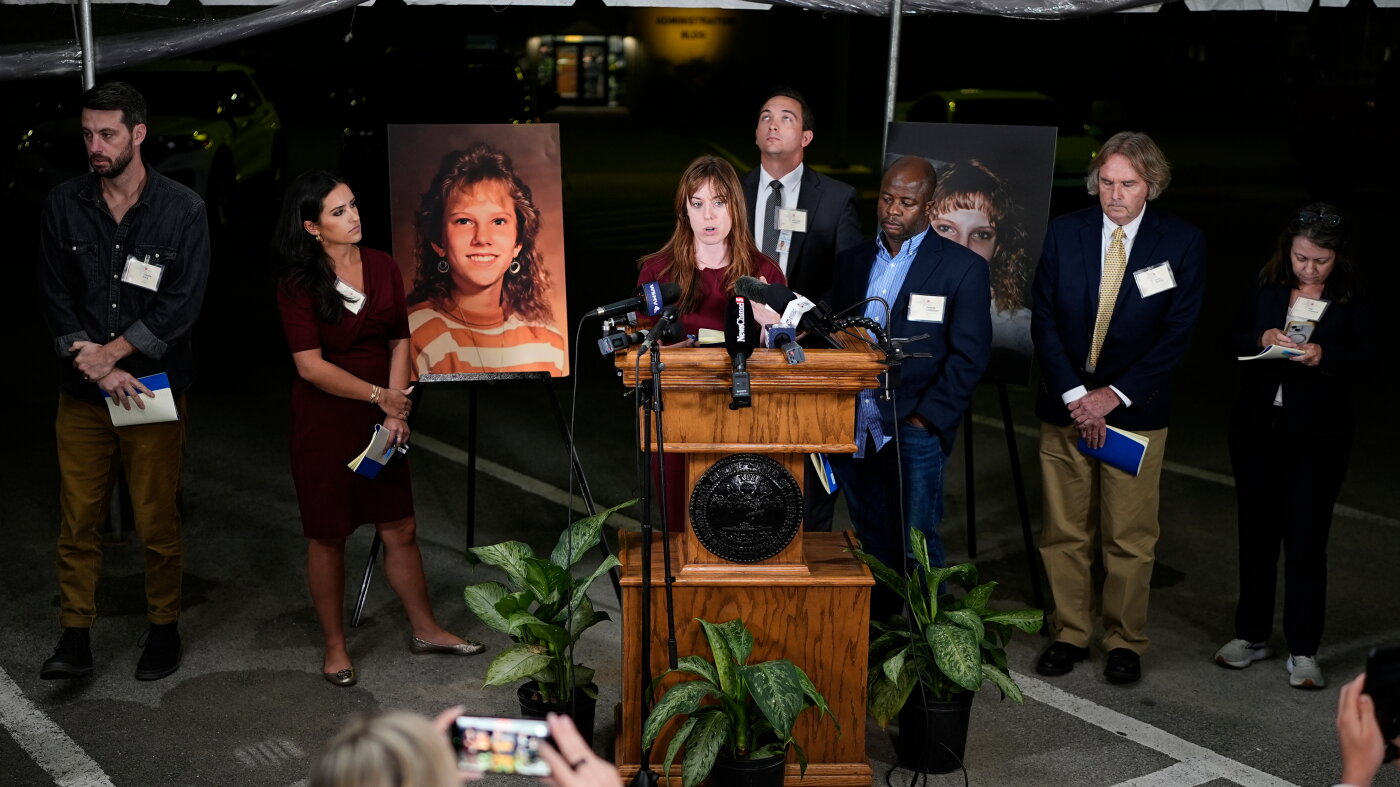
Media witnesses recount the moments before the execution of Christa Pike was halted Wednesday in Nashville, Tenn.
George Walker IV/AP
hide caption
toggle caption
i
George Walker IV/AP
The botched execution in Tennessee of Christa Pike, who survived despite being subject to two doses of lethal injection on Wednesday, has reignited furious debate about the death penalty in the U.S.
Witnesses say Pike, who was strapped to a gurney, was administered a supposedly lethal dose of the barbiturate pentobarbital but after several minutes said her arm was burning and asked if it was supposed to feel that way. She then asked “please try up on my shoulder higher.”
A second dose was administered, and the 50-year-old, who has been on death row for murder since she was 18, appeared to fall unconscious but continued breathing and snoring. Her lawyers made emergency calls, and the execution was halted. Pike was taken to the hospital, where she remains in critical condition and is being given “lifesaving care,” according to her lawyers. It is unclear yet whether she has suffered brain damage.
“We at this point do not know the ramifications of the chemical torture that she has endured,” Pike’s attorney Randy Spivey said in a video press briefing, calling what happened in the death chamber “torturous” and “cruel.”
The Death Penalty Information Center (DPI), a nonpartisan nonprofit organization, said Pike was the first person in the history of capital punishment to survive after being injected with lethal drugs. Other people have survived failed attempts to execute them when execution staff were unable to establish IV lines.
“This failed attempt is the worst we’ve ever seen and unlike any other botched execution in the modern era,” said Robin M. Maher, DPI executive director, in a statement.
“What happened to Christa Pike can be attributed to the extreme secrecy Tennessee officials have maintained about their execution procedures, their refusal to answer reasonable questions, and their unwillingness to accept responsibility for their mistakes,” she continued. The media are not allowed to witness key portions of the process, including the insertion of IV lines.
Pike, who was convicted of and admitted to the 1995 murder of fellow teenager and classmate Colleen Slemmer, who she saw as a love rival, would have been the first woman to be executed in Tennessee in more than 200 years. But it was the second botched attempt in the state this year, after Tennessee stopped the execution of Tony Carruthers in May when medical workers were unable to insert a second IV line.
Gov. Bill Lee, a Republican, has now called off executions in the state for the rest of the year. He has launched an investigation into what happened to Pike and said the botched execution “shouldn’t have happened.” However, he stressed at a press conference that “the people of Tennessee have determined that the death penalty is the appropriate penalty for the most heinous crimes in the state.”
U.S. Sen. Marsha Blackburn, who is running to replace Lee, agreed, but said the state should “bring back the electric chair” rather than using lethal injection.
Calls for abolition
However, Blackburn’s Democratic opponent, Jerri Green, condemned the practice, saying: “The fact of the matter is: the death penalty has always been inhumane, expensive, and biased.”
“As a public defender, I’ve met a few too many people who were wrongfully convicted on death row who were later exonerated … If we say we are pro-life, that means we must be anti-death penalty,” her statement read.
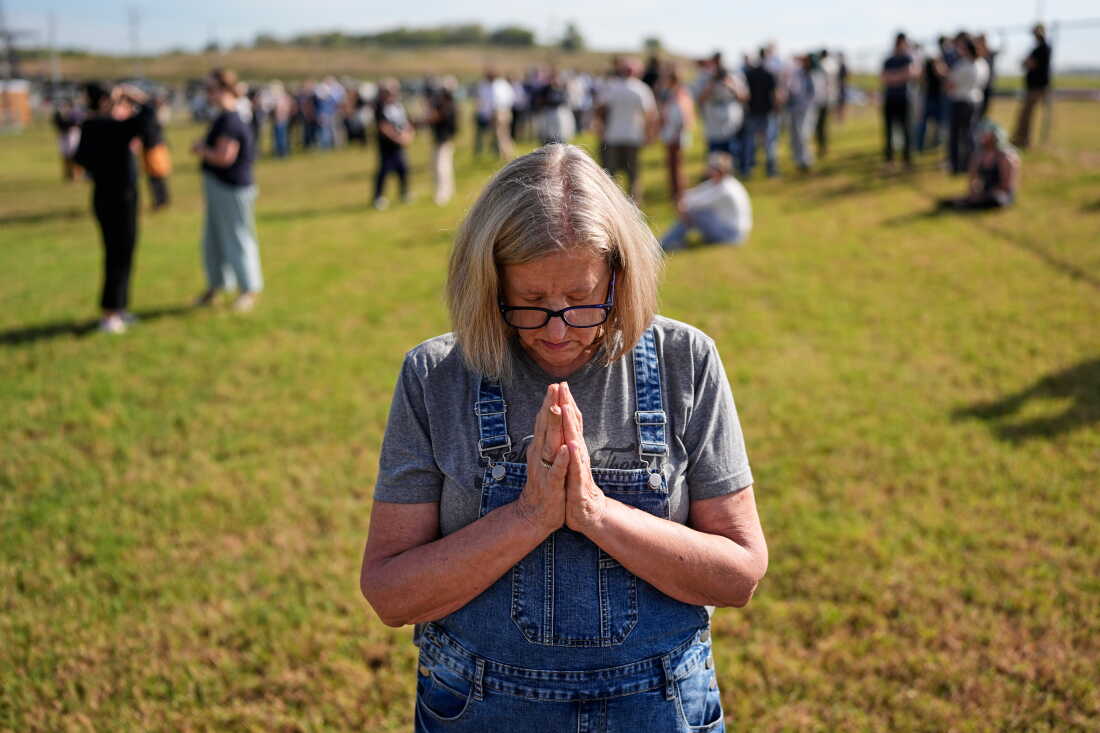
Kathleen Walter prays in the area reserved for people opposed to the death penalty outside Riverbend Maximum Security Institution before the planned execution of Christa Pike on Wednesday in Nashville, Tenn.
George Walker IV/AP
hide caption
toggle caption
i
George Walker IV/AP
In May, fellow Democrats Sen. Dick Durbin, D-Ill., and Rep. Ayanna Pressley, D-Mass., reintroduced legislation to try to abolish the death penalty, after the Department of Justice announced it was bringing back firing squads. The bill was referred to the Senate Judiciary Committee.
“The death penalty is not a punishment reserved for the worst of the worst; it is one reserved for the poorest of the poor. And it is a penalty disproportionately faced by Black Americans,” said Durbin at the time.
“It is far from clear that the death penalty even serves its primary purpose. There has yet to be any evidence conclusively demonstrating that the death penalty deters people from committing heinous crimes compared to the threat of life in prison,” he said.
Americans’ opinions on capital punishment have shifted over the decades, a Gallup Poll shows. The 1960s were the last time approval for the death penalty dropped below 50%. Approval was at its highest in the mid-1990s, but has dropped again since, with 52% of respondents saying they favored the death penalty in 2025.
On Thursday, International rights watchdog Amnesty International called on the U.S. to abolish the death penalty, saying: “As the death penalty continues to decline around the world, the United States remains increasingly isolated.”
Executions in the U.S. have been on the rise. Last year, 47 people were put to death nationwide, the most since 2009. Data shows Florida carried out the most executions, accounting for 19 of those carried out last year.
Methods also differ across states, with the majority of executions in 2025 carried out by lethal injection. However, three were by firing squad and five were by nitrogen inhalation, which United Nations experts have said is akin to “state-sanctioned torture.”